
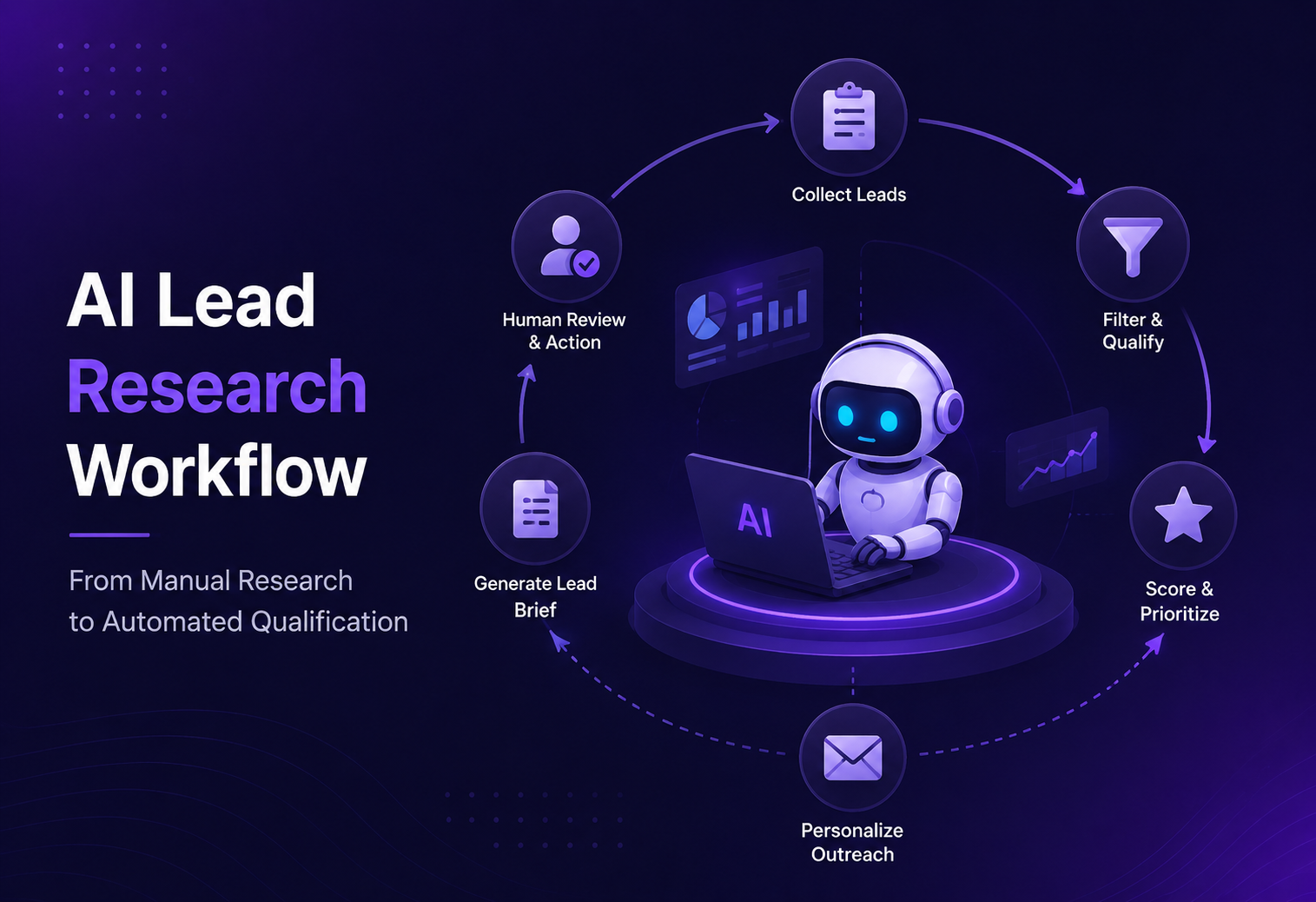
AI Lead Research Workflow: From Manual Research to Automated Qualification
AI lead research workflow is a practical way for sales and business development teams to reduce manual research time, organize lead data, and qualify prospects faster.
Instead of asking sales reps to manually check every company website, LinkedIn profile, industry page, and public signal, AI can help collect, filter, classify, and prepare lead information before the team reaches out.
However, AI should not replace the sales team. The goal is to give salespeople better starting points, cleaner lead lists, and more useful context before they begin a conversation.
This article breaks down how a manual lead research process can become an AI-assisted workflow.
The Problem: Manual Lead Research Is Slow
Manual lead research takes time.
Before contacting a prospect, a salesperson may need to check the company website, understand the business model, find the right contact, review recent activity, identify possible pain points, and decide whether the company is worth reaching out to.
For one or two leads, this is manageable. However, when the list grows to 100 or 500 leads, the process becomes slow and repetitive.
A sales rep may spend hours opening tabs, copying information, writing notes, and deciding which leads are worth attention. As a result, less time is spent on actual selling, discovery calls, and relationship building.
This is especially difficult for small teams because founders, sales managers, and business development teams often need to move fast with limited resources.
What Manual Lead Research Usually Looks Like
A typical manual lead research workflow often starts with a lead list.
First, someone opens each company website and checks what the company does.
Next, they look for decision makers and search for signals such as hiring, product launches, funding, new markets, or recent content.
After that, they write short notes and decide whether the lead is worth contacting.
This process can work, but it has several problems. It is slow, depends heavily on individual judgment, and often produces inconsistent notes.
In addition, important signals can be missed, low-quality leads may waste time, and personalization often becomes rushed.
Because of this, many teams end up with a large lead list but no clear way to prioritize it.
What an AI Lead Research Workflow Changes
An AI lead research workflow changes the process by letting AI handle the first layer of research and organization.
Instead of manually reviewing every lead from zero, the team can use AI to collect information, summarize the company, classify the lead, score the opportunity, and prepare a short outreach angle.
This does not mean the workflow should be fully automated from start to finish.
In most cases, the best setup is:
AI prepares the research.
AI filters and scores the lead.
AI drafts useful notes or outreach angles.
A human reviews the output.
The sales team decides what to do next.
This keeps the workflow fast without removing human judgment.
Before AI: A Manual Lead Research Workflow
Before automation, the workflow usually depends on people doing every step manually.
For example, a sales rep may receive a spreadsheet with company names and websites. The rep opens each website, reads the homepage, checks the service pages, looks for team information, and then searches for possible decision makers.
After that, the rep writes a short note such as:
“Looks like a SaaS company. Might need automation support. Contact founder.”
The problem is that these notes are often too short to be useful. In addition, different team members may evaluate leads differently.
One person may think the lead is high quality. Another person may think it is not a fit.
Without a clear scoring system, lead research becomes inconsistent.
After AI: A Faster Qualification Workflow
With AI, the workflow can become more structured.
A basic AI-assisted lead research workflow may look like this:
Collect lead data from a spreadsheet, CRM, form, website list, or directory.
Use AI to summarize what each company does.
Filter out companies that do not match the target profile.
Score the remaining leads based on clear criteria.
Group leads by priority.
Create a short lead brief for each qualified prospect.
Prepare a personalized outreach angle.
Send the output to a human for review.
This workflow is faster because the team does not start from a blank page.
It is also more consistent because every lead is evaluated using the same criteria.
Data Sources for AI Lead Research
A good AI lead research workflow starts with clear data sources.
The data source does not need to be complex. In many cases, a simple spreadsheet is enough for the first version.
Common data sources include:
Company websites
CRM records
Google Sheets
Airtable
LinkedIn profiles
Industry directories
Form submissions
Event attendee lists
Newsletter signups
Public company databases
Internal customer notes
For example, a team may start with a spreadsheet that includes company name, website, industry, location, and contact person.
AI can then use this information to create a research summary.
However, the data source should be relevant and clean enough to use. If the input list is poor, the AI output will also be weak.
What AI Should Extract From Each Lead
The workflow should not collect random information. Instead, it should focus on details that help the sales team decide whether the lead is worth pursuing.
Useful fields may include company description, industry, target customer, business model, company size, likely decision maker, possible pain points, relevant service need, recent activity, hiring signal, technology signal, outreach angle, and recommended next step.
For example, if Golden Sea is researching companies that may need AI automation, the workflow may look for signs such as manual operations, high-volume support, repeated reporting, lead generation needs, or content production bottlenecks.
If the target is game studios, the workflow may focus on signals related to mobile game production, LiveOps content, casual game assets, Unity development, or UI/UX needs.
As a result, the research becomes more useful for sales.
Lead Filtering: Removing Poor-Fit Prospects
Not every lead should move forward.
A strong AI lead research workflow should remove poor-fit companies before the sales team spends time on them.
For example, the workflow may filter out companies that are too small, outside the target region, in the wrong industry, not relevant to the offer, or unlikely to need the service.
Filtering can be based on simple rules such as:
Industry match
Company size
Location
Business model
Service relevance
Technology need
Recent growth signal
Budget fit
Decision-maker availability
For example, if the target customer is a startup that needs app development, the workflow may prioritize companies that are launching a product, hiring technical roles, or publishing about product growth.
If the target customer is an agency, the workflow may prioritize agencies that offer marketing or design but may need white-label software or automation support.
This helps the team focus on better opportunities.
Lead Scoring Criteria
Lead scoring helps the sales team decide which prospects deserve attention first.
A simple scoring system can use a 1–5 scale across several criteria.
| Criteria | Question | Score |
|---|---|---|
| Fit | Does the company match the target customer profile? | 1–5 |
| Need | Is there a clear reason they may need the service? | 1–5 |
| Timing | Are there signals that the need is active now? | 1–5 |
| Company Size | Is the company large enough to buy? | 1–5 |
| Relevance | Is Golden Sea’s offer relevant to the business? | 1–5 |
| Contact Quality | Is there a clear person to reach out to? | 1–5 |
| Personalization Potential | Can the outreach be specific? | 1–5 |
The total score helps the team prioritize.
For example:
30–35 points: high-priority lead
22–29 points: medium-priority lead
15–21 points: low-priority lead
Below 15 points: not a strong fit
This scoring system does not need to be perfect at the beginning. However, it gives the sales team a better way to compare leads.
Sample AI Lead Research Output
The final output should be short, useful, and easy for a salesperson to review.
A sample lead research output may look like this:
Company summary: A B2B SaaS startup that helps e-commerce brands manage customer support and order tracking.
Possible need: The company may need AI automation for support ticket routing, customer message summaries, or internal reporting.
Fit score: 4 out of 5.
Reason for score: The company works with customer support workflows and may handle repeated customer messages.
Suggested outreach angle: Focus on reducing support workload with AI-assisted ticket classification and response drafting.
Recommended next step: Review the company’s current support workflow and send a short outreach email to the operations lead.
This is much more useful than a basic note like “SaaS company, maybe good lead.”
It gives the sales rep context, reasoning, and a possible angle.
Example Workflow: From Raw Lead List to Qualified Leads
Here is a simple workflow example.
A sales team starts with 300 company websites from a public directory.
First, the AI workflow reads each company website and creates a short business summary.
Next, it filters out companies that do not match the target profile.
After that, it scores each remaining company based on fit, need, timing, and personalization potential.
Then, the workflow groups leads into high, medium, and low priority.
For high-priority leads, AI prepares a short lead brief and outreach angle.
Finally, a human sales rep reviews the top leads and decides which messages to send.
As a result, the team can spend less time on raw research and more time on qualified outreach.
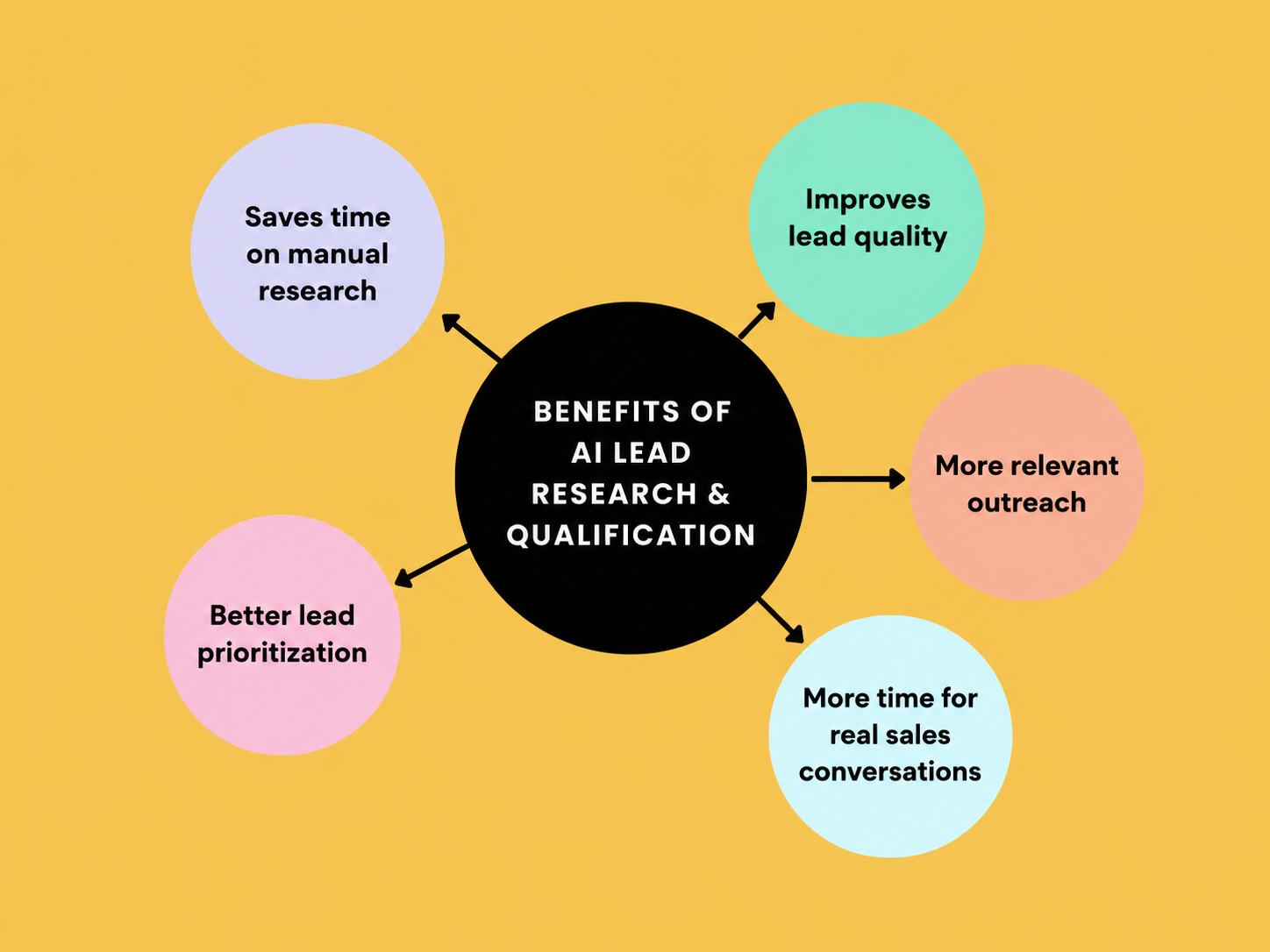
Benefits of AI Lead Research
AI lead research can create several practical benefits.
The first benefit is speed. Sales teams can process more leads in less time.
Another benefit is consistency. Every lead can be evaluated using the same criteria.
In addition, AI can improve personalization because it gives salespeople more context before outreach.
AI can also help managers understand the lead pipeline more clearly. Instead of only seeing a list of names, the team can see fit scores, industries, needs, and recommended next steps.
Overall, the biggest benefit is better use of sales time.
The team can focus on leads that are more likely to matter.
Limits of AI Lead Research
AI lead research has limits.
First, AI can misunderstand information. It may summarize a company incorrectly or make assumptions from limited data.
Second, public data may be incomplete. A company website may not show its real priorities, budget, or internal problems.
Third, scoring is only as good as the criteria. If the scoring rules are weak, the output may not help the sales team.
Finally, AI should not decide the entire sales strategy. It can support research and preparation, but humans still need to manage timing, relationships, messaging, and final decisions.
Because of this, human review is still important.
How to Start With a Simple MVP
A lead research workflow does not need to be complex at first.
A simple MVP can start with one spreadsheet and one clear target profile.
For example, the first version may include:
A spreadsheet of company names and websites
A short target customer profile
A research prompt
A scoring framework
A lead summary output
A human review step
The goal of the MVP is not to build a perfect system. Instead, the goal is to test whether AI can save research time and help the sales team find better leads.
Once the MVP works, the workflow can expand.
Later versions may connect with a CRM, automate follow-up reminders, create email drafts, or generate sales reports.
What a Human Should Still Review
Even with AI, the sales team should still review important outputs.
A human should check:
Whether the company is actually a fit
Whether the AI summary is accurate
Whether the outreach angle makes sense
Whether the contact person is correct
Whether the timing is appropriate
Whether the message feels human
Whether any claim needs verification
This review step protects the quality of the sales process.
The goal is not to send more messages blindly. Instead, the goal is to contact better leads with better context.
How Golden Sea Can Help
Golden Sea can help design an AI-assisted lead research workflow for sales and business development teams.
This can include lead data collection, filtering, scoring, classification, personalization, draft email preparation, CRM updates, and follow-up workflows.
The process can start small with a simple MVP. After that, the workflow can improve over time based on real sales feedback.
If your team spends hours researching leads, Golden Sea can help design a faster AI-assisted workflow.
FAQ
What is an AI lead research workflow?
An AI lead research workflow is a process that uses AI to collect, summarize, filter, score, and prepare lead information before sales outreach.
Can AI replace manual lead research?
AI can reduce much of the manual research work, but it should not fully replace human review. Sales teams still need to check fit, timing, accuracy, and final outreach quality.
What data do I need to start?
A simple starting point is a spreadsheet with company names, websites, industries, and possible contacts. You can also use CRM data, forms, directories, or event lists.
How should leads be scored?
Leads can be scored based on fit, need, timing, company size, service relevance, contact quality, and personalization potential.
What is a good first MVP?
A good first MVP is a workflow that takes a list of companies, summarizes each one, filters poor-fit leads, scores the best prospects, and prepares a short outreach angle.
When should a human review the output?
A human should review the output before any outreach is sent. This helps protect accuracy, tone, brand quality, and relationship context.
Final Thoughts
Manual lead research is slow, repetitive, and difficult to scale.
However, an AI lead research workflow can help sales teams collect information, filter prospects, score opportunities, and prepare better outreach faster.
At the same time, the best workflow should still keep humans in control. AI can prepare the research, but salespeople should review the final output and manage the relationship.
As a result, business development teams get a better balance: faster research, cleaner prioritization, and more time for real conversations.
If your team spends hours researching leads, Golden Sea can help design a faster AI-assisted workflow.
Contact Golden Sea Studios:
Website: goldenseastudios.com
Email: info@goldenseastudios.com
Social Media: @goldenseastudios (Twitter, Instagram, Facebook)
Telegram: @goldenseastudio
We are available online to assist you with any inquiries or collaborations. Reach out to us through these channels and let’s connect!
