
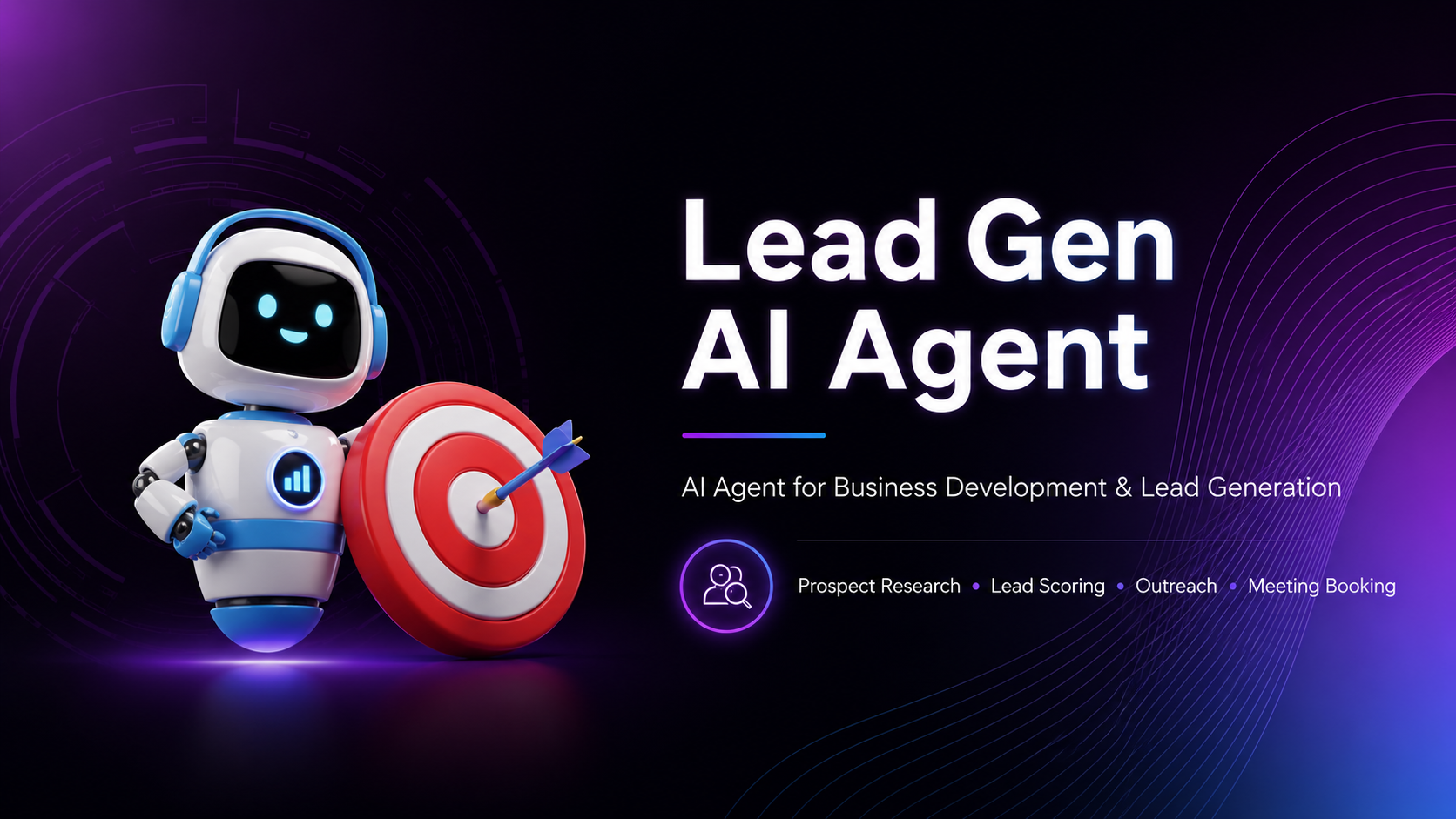
What Is an AI Agent for Business Development?
An AI agent for business development is a system that helps sales and business development teams research leads, score opportunities, personalize outreach, and prepare follow-up actions faster.
It is not a magic tool that sells by itself. Instead, an AI agent supports the repetitive and research-heavy parts of business development so the sales team can spend more time on conversations, relationships, and closing deals.
For example, an AI agent can collect lead information, filter companies by fit, score prospects, draft personalized emails, and remind the team when follow-up is needed. However, humans still need to review the message, approve the strategy, and handle the actual relationship.
What Is an AI Agent?
An AI agent is a system that can take a goal, use available information, follow a process, and complete a task with some level of autonomy.
In business development, this usually means the agent can help with tasks such as research, qualification, writing, routing, and follow-up preparation.
For example, instead of asking a sales rep to manually research 100 companies, an AI agent can help collect public information, summarize each company, identify possible pain points, and prepare a short lead brief.
The sales rep can then review the information and decide which leads are worth contacting.
In simple terms, an AI agent is not just a chatbot. A chatbot usually waits for a question and gives an answer. An AI agent can follow a workflow, use tools, process data, and prepare the next step.
Why Business Development Teams Use AI Agents
Business development teams often lose time on repetitive work.
Before contacting a lead, the team may need to check the company website, review LinkedIn profiles, understand the industry, identify the right contact, search for recent news, write an outreach angle, and prepare a message.
This work is important, but it can take too long when the team has many prospects to process.
Because of this, AI agents are useful for business development teams that want to scale research and outreach without lowering quality.
Instead of replacing salespeople, the agent acts like a research and preparation assistant. It helps the team move faster while keeping humans in control of the final message and relationship.
What Does an AI Agent Do in Business Development?
An AI agent for business development can support different parts of the sales workflow.
It can help find relevant companies, collect information, score leads, personalize outreach, draft emails, summarize calls, and suggest follow-up actions.
Here is a simple overview.
| Business Development Task | What the AI Agent Can Do | Human Role |
|---|---|---|
| Lead research | Collect and summarize company information | Check fit and decide priority |
| Lead filtering | Remove poor-fit companies from the list | Confirm target criteria |
| Lead scoring | Rank prospects based on signals | Adjust scoring rules |
| Personalization | Create outreach angles for each lead | Edit tone and approve message |
| Email drafting | Prepare first email or follow-up draft | Review and send |
| CRM update | Summarize notes and suggest updates | Confirm important fields |
| Follow-up tracking | Suggest next steps and reminders | Manage relationship timing |
This type of workflow helps sales teams reduce manual preparation time.
A Sample AI Agent Workflow for Lead Generation
A practical AI agent workflow for business development can look like this:
Scrape or collect lead data
Filter the leads
Score the opportunities
Personalize the outreach angle
Draft the email
Prepare follow-up tasks
Review before sending
This flow keeps the system useful but safe. The AI agent handles the repetitive preparation, while the sales team still reviews the final output.
Step 1: Collect Lead Data
The first step is collecting lead data from a clear source.
This could include company websites, directories, LinkedIn data, CRM records, form submissions, event attendee lists, or spreadsheet data.
For example, a company may have a list of 500 potential leads from an industry directory. Manually reviewing every company would take a lot of time. An AI agent can help process the list and prepare useful summaries.
However, the data source should be legal, ethical, and relevant. The goal is not to collect as much data as possible. The goal is to collect the right information for business development decisions.
Step 2: Filter the Leads
After collecting the data, the AI agent can filter leads based on target criteria.
For example, a company may want to target SaaS startups, agencies, mobile game studios, e-commerce brands, or businesses with a certain team size.
The agent can remove leads that do not match the target profile.
This step is useful because not every lead deserves attention. If the team spends time on poor-fit prospects, the whole sales process becomes slower.
A good filter can include criteria such as:
Industry
Company size
Location
Business model
Technology used
Hiring signals
Growth stage
Service need
Budget fit
Decision-maker availability
After filtering, the sales team gets a cleaner list to review.
Step 3: Score the Opportunities
Lead scoring helps the team decide which prospects should be contacted first.
An AI agent can score leads based on signals that matter to the business. For example, a lead may score higher if the company is hiring developers, launching a new product, posting about automation, raising funding, expanding into new markets, or showing signs of operational bottlenecks.
The score does not need to be perfect. It only needs to help the team prioritize.
For example, a lead with strong fit, clear pain points, and recent growth signals may be marked as high priority. A lead with weak fit or unclear need may be marked as low priority.
This helps business development teams focus energy where the chance of a useful conversation is higher.
Step 4: Personalize the Outreach Angle
Personalization is where many sales workflows fail.
A generic email often sounds like it was sent to everyone. Because of this, prospects ignore it.
An AI agent can help by creating a specific outreach angle based on the lead’s business, industry, recent activity, or likely problem.
For example, if the lead is a startup building an MVP, the outreach angle may focus on flexible product development support. If the lead is an agency, the angle may focus on white-label execution capacity. If the lead is a game studio, the angle may focus on game UI, art production, or Unity support.
The goal is not to write a long email. The goal is to make the message feel relevant.
A sales rep should still review the final angle because good business development requires judgment. However, AI can make the first version much faster.
Step 5: Draft the Email
Once the lead is researched, filtered, scored, and matched with an outreach angle, the AI agent can draft an email.
A good draft should be short, specific, and easy to edit.
For example, the email may include:
A clear opening line
A reason for reaching out
A short connection to the prospect’s business
A relevant offer or insight
A simple call to action
The AI agent can also create different versions for different channels, such as email, LinkedIn, or a short follow-up message.
However, the final message should not be sent automatically without review. In most cases, a human should approve the message first.
Step 6: Prepare Follow-Up Actions
Business development does not end after the first email.
Many opportunities require follow-up. An AI agent can help by suggesting when to follow up, drafting the next message, summarizing previous interactions, and reminding the sales team what to do next.
For example, if a lead does not reply after five days, the agent can prepare a short follow-up email. If the lead replies with interest, the agent can summarize the response and suggest the next action.
This helps the team avoid missed opportunities.
It also keeps follow-up more consistent.
What Still Needs Human Judgment?
An AI agent can support business development, but it should not replace the sales team.
Humans still need to handle strategy, relationships, negotiation, trust, and final decisions.
For example, AI can suggest that a company is a strong lead. However, a sales manager may know that the timing is not right. AI can draft an outreach message, but a human should check whether the tone feels appropriate. AI can summarize a sales call, but the account owner should decide the next step.
Human judgment is especially important for:
Final outreach approval
Pricing discussions
Complex objections
Partnership decisions
Relationship management
Sensitive customer information
Negotiation strategy
Long-term account planning
The best setup is simple: AI handles preparation, while humans handle trust and decisions.
Common Risks of AI Agents in Business Development
AI agents can be useful, but they also create risks if the workflow is poorly designed.
One common risk is generic outreach. If the agent creates weak messages, the business may send more emails but get fewer useful replies.
Another risk is inaccurate research. AI can misunderstand company information or make assumptions, so important details should be reviewed before outreach.
Poor targeting can also reduce quality. When the lead filtering rules are unclear, the system may generate too many low-fit prospects.
In addition, over-automation can damage the brand. If messages are sent without human review, the outreach may feel awkward, inaccurate, or too generic.
Finally, teams should consider data privacy. Business development workflows should follow legal, ethical, and platform rules when collecting and using information.
How to Reduce Risk
To reduce risk, start with a controlled workflow.
At first, the AI agent should prepare research, lead scores, and draft messages for human review. It should not send outreach automatically until the team has tested the workflow carefully.
For example, the agent can create a lead brief and suggest an outreach angle. After that, a salesperson can review the details, edit the message, and decide whether the lead is worth contacting.
In addition, the team should create clear rules for what the agent can and cannot do.
Useful rules may include:
Do not send messages without approval.
Do not contact leads below a certain score.
Do not use unsupported claims.
Do not invent company information.
Always include the reason for personalization.
Flag uncertain data for human review.
Keep CRM updates visible and editable.
Because of this, the sales team can use AI safely while still keeping control over quality and customer relationships.
How to Deploy an AI Agent MVP
You do not need to build a complex system on day one.
A simple AI agent MVP can start with one clear workflow.
For example, the first version may only help with lead research and email drafting.
The MVP could work like this:
The sales team uploads a list of companies.
The AI agent researches each company.
The system creates a lead summary.
The agent scores each lead based on simple rules.
It drafts a short outreach email.
A sales rep reviews and edits the draft.
The final email is sent manually.
This is enough to test whether the agent saves time and improves outreach quality.
After the MVP works, the workflow can expand into CRM updates, follow-up reminders, reporting, and more advanced personalization.
What Tools Can an AI Agent Connect With?
A business development AI agent can connect with different tools depending on how the sales team works.
For example, a small team may start with Google Sheets, email drafts, and manual review.
As the workflow becomes more mature, the agent can connect with CRM systems, email platforms, Slack, Notion, Airtable, web forms, internal databases, project management tools, and reporting dashboards.
In addition, larger teams may use the agent to update CRM notes, prepare follow-up reminders, and send sales activity summaries to managers.
Because of this, the best tool stack is not always the most complex one. It is the setup that fits the team’s current process and makes the workflow easier to manage.
How to Measure Success
An AI agent should be measured by useful business outcomes, not only by how many tasks it completes.
For example, a team can measure:
Time saved on lead research
Number of qualified leads reviewed
Response rate improvement
Email personalization quality
Reduction in manual CRM updates
Follow-up consistency
Sales team adoption
Meetings booked
Pipeline quality
If the AI agent creates more work for the team, the workflow needs improvement.
The goal is not to generate more noise. The goal is to help the team find better opportunities and move faster.
A Simple Checklist Before Building an AI Agent
Before building an AI agent for business development, start with the part of the workflow that takes the most time.
Then, define the data the agent needs and where that data will come from.
After that, decide how leads should be filtered and what makes a lead high quality.
Next, describe the output the agent should create, such as a lead summary, score, outreach angle, or draft email.
In addition, choose who will review the output before it is used.
Finally, decide which tools need to be connected and how success will be measured.
Example: AI Agent for a B2B Service Company
Imagine a B2B service company that wants to find startup clients.
The company has a list of 300 potential leads. The sales team does not have time to research every company manually.
An AI agent can help by reviewing each company website, summarizing what the company does, identifying possible needs, scoring the lead, and drafting a personalized first email.
The sales team then reviews the top-scoring leads and edits the best emails before sending.
As a result, the team can focus on the most relevant opportunities instead of spending hours on manual research.
Example: AI Agent for an Agency
An agency may want to find companies that need white-label production support.
The AI agent can scan a list of potential agency partners, identify services they offer, detect possible gaps, and prepare a message focused on outsourcing support.
For example, if an agency offers branding and marketing but not software development, the AI agent may suggest an outreach angle around app and web production support.
This helps the agency’s business development team start more relevant conversations.
How Golden Sea Can Help
Golden Sea can help build AI agents that support sales and operations workflows.
For business development, this can include lead research, scoring, personalization, email drafting, CRM updates, follow-up workflows, and reporting.
The goal is not to build a tool that replaces the sales team. Instead, the goal is to build a practical AI agent that helps the team move faster and focus on better opportunities.
Golden Sea can help define the workflow, build the MVP, connect the right tools, and add human review steps where needed.
FAQ
What does an AI agent do in business development?
Can sales teams use AI agents without replacing people?
How can an AI agent support lead generation?
Is it safe to let an AI agent send outreach emails automatically?
Which AI agent MVP should a business build first?
Before building an AI agent, what should a team prepare?
Final Thoughts
An AI agent for business development is not a magic sales machine.
Instead, it is a practical system that helps sales teams research faster, score leads more clearly, personalize outreach, and follow up more consistently.
However, the best AI agent workflows should still keep humans in control. AI can handle the preparation, but people should manage judgment, relationships, and final decisions.
As a result, business development teams can move faster without losing the human touch that sales still needs.
Overall, a good AI agent can become a strong support layer for companies that want to improve lead generation, outreach, and follow-up workflows.
Golden Sea can help build AI agents that support your sales and operations workflows.
Contact Golden Sea Studios:
Website: goldenseastudios.com
Email: info@goldenseastudios.com
Social Media: @goldenseastudios (Twitter, Instagram, Facebook)
Telegram: @goldenseastudio
We are available online to assist you with any inquiries or collaborations. Reach out to us through these channels and let’s connect!
