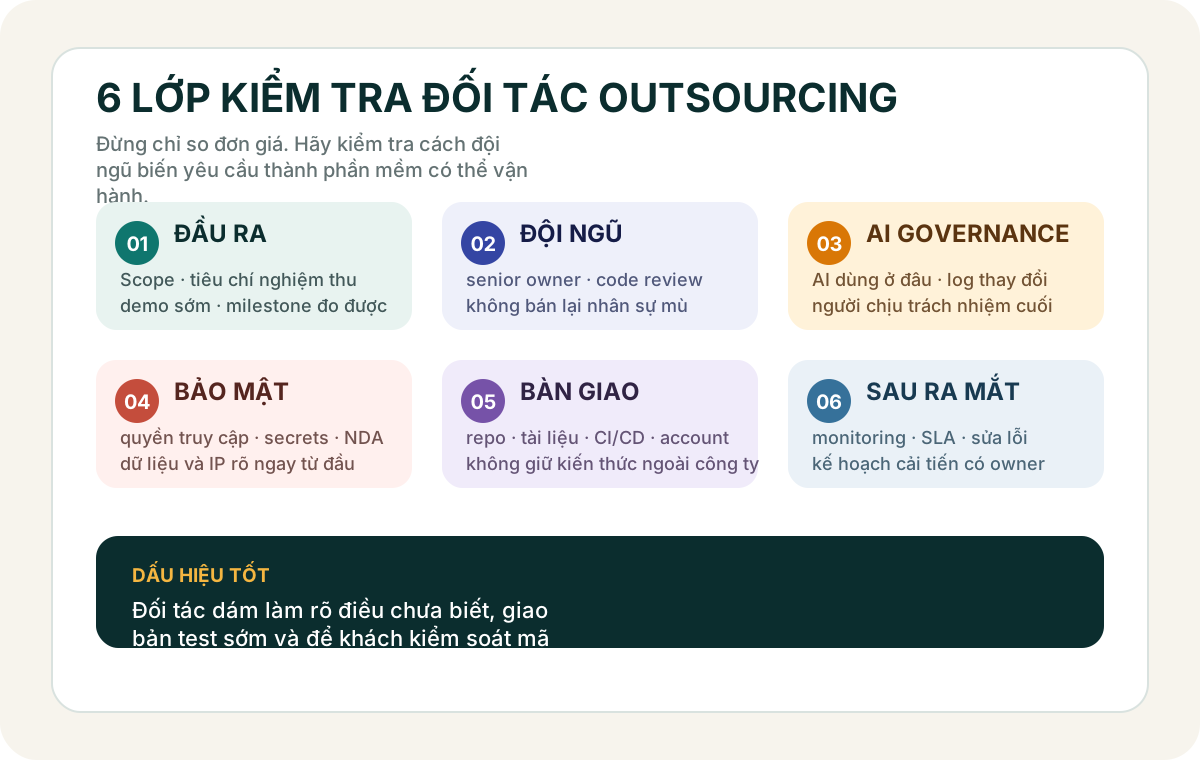

Short answer: To choose a software outsourcing partner in 2026, do not begin with the hourly rate. Evaluate nine things: problem framing, senior technical ownership, AI governance, code review and testing, security, delivery visibility, asset ownership, knowledge transfer, and post-launch operations. AI can accelerate delivery, but it does not replace engineering accountability.
A strong partner does more than implement tickets. It turns an uncertain business need into testable scope, delivers software the client can genuinely own, and remains accountable when the system reaches real users.
Why vendor selection changed in 2026
Software outsourcing did not disappear when AI coding tools became widely available. The evaluation standard changed. A team can now produce more code in less time, but that speed is useful only when architecture, security, testing, and documentation keep pace. Otherwise, clients receive a larger volume of changes without knowing what was reviewed, who approved it, or how maintainable the system will be.
This concern is visible in current buyer conversations. In a recent Reddit discussion about 2026 outsourcing trends, the strongest issue was not whether agents could generate code. It was the oversight gap: when a three-month cycle becomes six weeks, the internal team may lose visibility into exactly what changed across organizational and time-zone boundaries. A separate SaaS discussion repeatedly returned to clear scope, ownership, measurable milestones, and product context. Reddit is qualitative research rather than representative market data, but the buyer language is useful. The question is moving from “what is your hourly rate?” toward “how can I verify that the delivery is correct?”.
Vietnam's market context makes this shift especially relevant. The Ministry of Science and Technology's 2026–2030 digital industry plan targets at least USD 55 billion in annual exports of digital technology products and services by 2030. The plan emphasizes movement into higher-value parts of global supply chains. TNGlobal has also described a change in developer mindset from executing software for others toward product ownership and AI building. Buyers can benefit from Vietnam's delivery foundation while expecting partners to participate more deeply in product outcomes.
First decide which relationship you are buying
Many projects fail because both sides use the word “outsourcing” while imagining different operating models. Staff augmentation works when the client already has a product owner, architecture, backlog, and engineering management. A dedicated product team is more appropriate when the starting point is a business need and the supplier is expected to support discovery, design, engineering, and launch. Managed service is different again: it requires SLAs, monitoring, incident ownership, and continuous improvement.
| Model | What the client needs | Partner responsibility | Risk when mismatched |
|---|---|---|---|
| Staff augmentation | Backlog, product owner, architecture, delivery management | Capability of each added team member | The client expects outcomes while the vendor supplies hours |
| Dedicated product team | Business owner and decision maker | Discovery, design, engineering, QA, milestones | Scope remains vague without acceptance criteria |
| Fixed-scope project | Relatively stable requirements | Agreed deliverables, schedule, and budget | Frequent change creates expensive variation |
| Managed service | Operational goals and service expectations | Monitoring, SLA, maintenance, improvement | Incident ownership is unclear |
Pricing becomes meaningful only after the model is clear. A low staff-augmentation quote cannot be compared directly with a product-team quote that includes discovery, UX, DevOps, QA, warranty, and product management.
Nine criteria for choosing an outsourcing partner in the AI era
1. Can the team convert a need into acceptance criteria?
Give the vendor an imperfect brief and observe the questions they ask. A strong team asks who uses the product, which behavior should change, where data comes from, which failures are most important, and which outcome defines success. They translate the answers into flows, scope, assumptions, risk, and acceptance criteria. If the proposal simply repeats the client's words and attaches person-days, the risk of building the request correctly but the product incorrectly remains high.
2. Is there a real senior technical owner?
Do not evaluate only a stack of CVs. Ask who owns architecture, who approves important pull requests, who responds when performance degrades, and who speaks directly with the client's decision maker. That person should appear in project governance, not only in the sales meeting. AI helps less-experienced developers generate code faster, which makes senior review, boundary design, and technical debt control more important rather than less.
3. Where is AI used, and how is it governed?
A credible answer is more detailed than yes or no. The vendor should explain whether AI supports research, scaffolding, test generation, review, or documentation; which data cannot enter public models; which output requires human approval; and how traceability and licensing are handled. Industry signals point toward human-led, AI-augmented delivery. In its June 2026 collaboration announcement with Microsoft, FPT emphasized human-agent collaboration, reference architectures, cybersecurity readiness, and delivery at scale. For a buyer, this should become a readable policy rather than an “AI-first” slogan.
4. Are code review, testing, and release controls visible?
Ask for a sanitized example of a pull request, branch rules, automated tests, security scans, staging, and a release checklist. An MVP does not need heavyweight enterprise ceremony, but there should be evidence that code does not travel directly from a prompt into production. Ask how the team tests data migration, how rollback works, who can approve production, and how quality expectations vary by system risk.
5. Are security and access designed from day one?
An NDA is only one layer. The client should know who owns the repository, where secrets are stored, how production access is granted, whether real data enters test environments, and how access is revoked when someone leaves. Projects involving customer, payment, health, or internal business data need an appropriate data flow and threat model. A vendor should not promise that incidents are impossible. It should explain how risk is reduced, detected, and handled.
6. Is progress reported through outcomes rather than subjective percentages?
“Eighty percent complete” is difficult to verify. A useful report shows what runs on staging, which decisions are waiting for the client, what may affect the timeline, and what acceptance criteria define the next milestone. Frequent working demos are more valuable than status slides. As AI increases change velocity, changelogs, decision logs, and demonstrations must become clearer so the client retains visibility.
7. Does the client fully own code and operational assets?
The contract should cover source code, design, documentation, infrastructure configuration, cloud accounts, domains, analytics, and purchased assets. The production repository should ideally sit inside the client's organization or transfer on a regular schedule. Ask which dependencies have restrictive licenses, which components are pre-existing vendor assets, and what happens if the engagement ends. The ability to leave a vendor cleanly is evidence of a healthy relationship.
8. Is knowledge transfer part of delivery?
Handover is not a final video call. It includes runnable documentation, architecture maps, environment instructions, incident runbooks, integration inventories, access records, technical backlog, and decision history. Internal teams may also need pairing and module walkthroughs. A SaaS community comment summarized the risk well: when knowledge stays outside the core team, future iteration becomes slower and more expensive. Evaluate documentation in the first sprint, not the last week.
9. Who owns reliability and improvement after launch?
Software begins creating value when real users arrive. Ask which monitoring is enabled, how long logs are retained, what response SLA applies, how defects are classified, and how usage data returns to the backlog. If the vendor can price the build but cannot describe the first week after release, the proposal does not cover the real lifecycle. Golden Sea treats go-live as a milestone, not the end.
Questions to use in a vendor interview
| Question | A strong answer includes | Warning sign |
|---|---|---|
| Who owns architecture and final review? | Name, role, involvement, escalation path | “Our senior team will support” without specifics |
| Where do you use AI in the SDLC? | Use cases, prohibited data, human review, traceability | “AI makes us ten times faster” without policy |
| How do I see progress? | Repository, issue tracker, staging demos, risk and decision logs | A weekly percentage report only |
| What do I receive if the engagement stops? | Code, accounts, documents, infrastructure, transition plan | Repository and cloud remain controlled by the vendor |
| How are production incidents handled? | Monitoring, severity, SLA, rollback, named owner | A generic warranty period |
| Can I inspect sample deliverables? | Sanitized PR, test report, architecture note, runbook | Only polished portfolio images and client logos |
Run a small paid discovery before a large commitment
If confidence is still limited, do not ask the vendor to build a miniature product for free. Buy a one- or two-week discovery sprint with defined outputs: stakeholder map, user flow, preliminary architecture, risk register, prioritized backlog, range estimate, and a prototype or technical spike for the hardest assumption. This tests reasoning, communication, and artifact quality within a bounded investment.
- Days 1–2: align outcome, decision makers, constraints, and available data.
- Days 3–5: map flows, validate assumptions, test the highest technical risk.
- Days 6–8: build a prototype or spike, define acceptance criteria and release path.
- Days 9–10: review artifacts, risks, budget range, and transition plan.
Score the vendor by the quality of decisions and reduction in uncertainty, not by the number of screens produced. Good discovery tells the company what to build, what not to build yet, and which assumptions must be tested first.
Three mistakes that lead to the wrong partner
- Comparing hourly rates instead of total cost of ownership. A low rate becomes expensive when scope is rebuilt, testing is weak, or the client is locked into the vendor.
- Using portfolio as a substitute for process evidence. A portfolio proves the company touched a project category. It does not prove the people in the proposal will work on your project.
- Withholding context until after signature. A vendor cannot own outcomes without access to users, constraints, and decision makers. Effective outsourcing still requires a strong client-side owner.
Conclusion: AI raises the outsourcing standard
Vietnam has an opportunity to move from delivery capacity toward higher-value product and AI partnerships. Buyers benefit only when their evaluation model changes. Do not buy a promise about developer count or coding speed. Buy a system of accountability: testable scope, a senior owner, AI governance, review and testing, security, visibility, ownership, handover, and operations.
Use these nine criteria as a common scorecard for every vendor. Golden Sea provides IT outsourcing, app and web development through an AI-augmented but human-accountable model: AI accelerates repeatable work, while people remain responsible for architecture, quality, and delivery outcomes. Continue with how to evaluate an AI automation partner and why businesses should buy outcomes instead of an AI label.