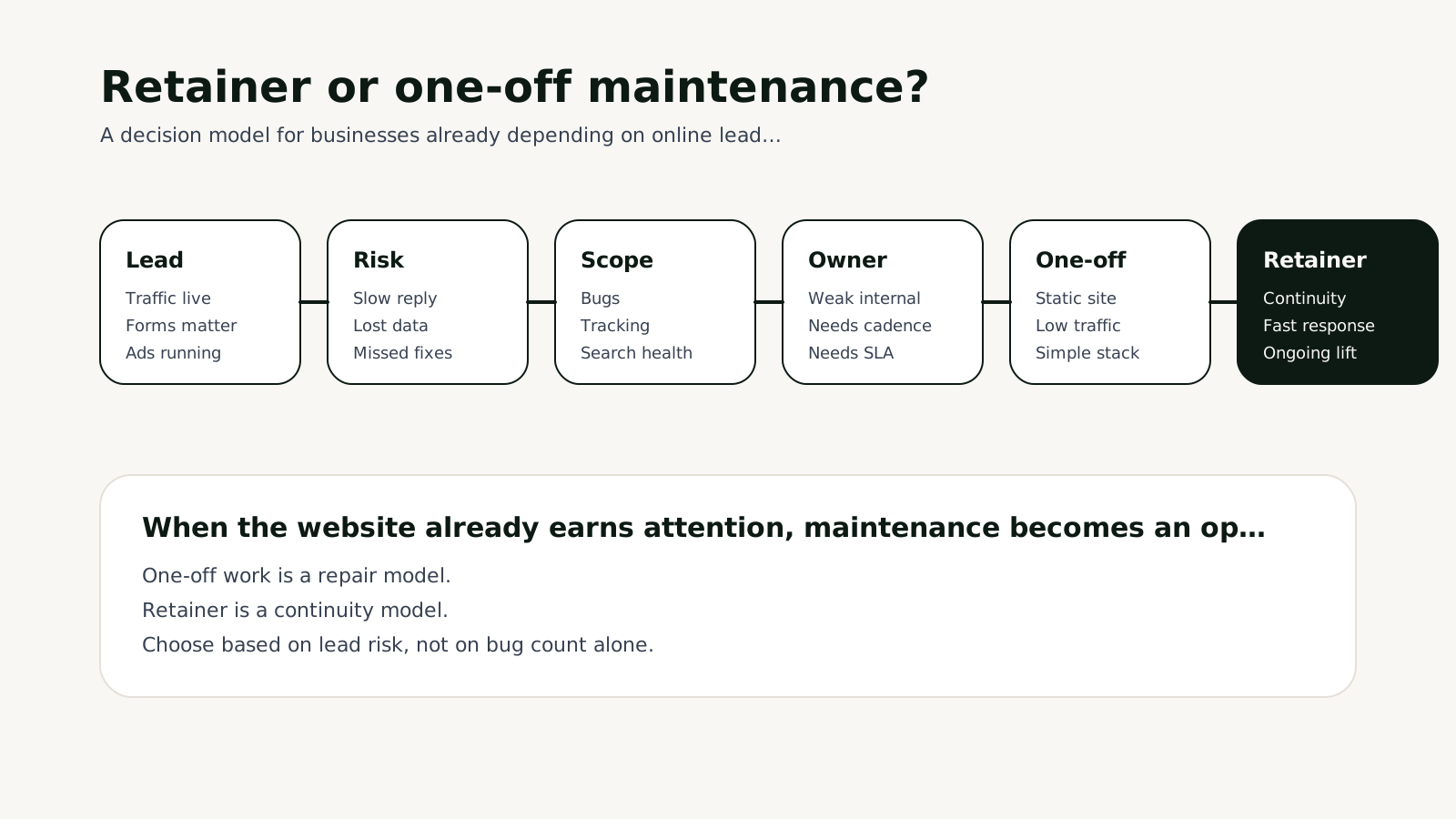

Short answer: If the website already generates leads or supports paid traffic, a retainer is usually safer because the risk lives in response time and continuity, not in the visible ticket count. One-off work only makes sense when the site changes very little, traffic is low, or the company has enough internal ownership to absorb the gaps between fixes.
Why this topic matters on Thursday, August 6, 2026
The current market signal is not just that websites are faster to build. Businesses are also pushing AI, CRM, and content automation into existing touchpoints. Once the website becomes an intake layer for leads, inbox, or bookings, maintenance shifts from occasional fixing to operational continuity.
Two things get conflated here and should not be: warranty and care. Every package in the website design price list carries a 36-month technical warranty, but adding pages, refreshing content, and watching rankings is recurring work quoted separately.
Google continues to emphasize crawlability, duplication control, canonicalization, and content structure in current Search Central guidance. That means a live website needs more than visual bug fixes. It also needs ongoing attention to SEO and GEO layers that owners often do not see at a glance.
At a decision-stage buying moment, this is a sharp intent: the business is no longer asking whether to build a website. It is asking which responsibility model reduces lead risk. That is still undercovered in the current Golden Sea library.
Golden Sea decision framework
| Situation | One-off work | Retainer |
|---|---|---|
| Low traffic, few changes | Can be enough | Often unnecessary if internal ownership is strong |
| SEO or ads already running | Slow response becomes risky | Better fit because continuity matters |
| Many landing pages, forms, integrations | Easy to miss chain reactions | Safer for continuity |
| Weak internal owner | Everything gets delayed until failure | Retainer helps hold rhythm |
| Planned GEO/blog/EN expansion | Turns into many disconnected tickets | Retainer supports cluster-level improvement |
What to lock before implementation
- Review the last 90 days: is the site already producing leads or bookings consistently?
- Count not only bugs but also smaller improvements like CTA, tracking, speed, and metadata.
- If a 2-3 day delay can lose leads, lean toward a retainer.
- If the site is mostly static and low traffic, one-off work may still be enough.
- Lock response SLA, ownership, and in-scope work before signing a retainer.
Where teams usually buy the wrong thing
- Assuming low ticket volume means maintenance is unimportant.
- Buying only technical coverage without someone watching conversion and search layers.
- Failing to define response SLA for forms, tracking, or broken CTA.
- Using one-off work without internal regression checking after fixes.
- Splitting content, plugins, hosting, and analytics across too many disconnected owners.
A practical 30-day rollout
| Week | Action | Output |
|---|---|---|
| Week 1 | Audit bugs, tracking, speed, CTA, and search health | Maintenance baseline |
| Week 2 | Group work into reactive, preventive, and growth tasks | Service scope |
| Week 3 | Lock SLA and ownership under the chosen model | Contract logic |
| Week 4 | Start the fix and improvement backlog | Steady operating rhythm |
A simple real-world diagnosis test
In practice, this kind of problem rarely shows up as a dramatic outage. It usually appears as rising hidden cost: leads that stop halfway, operators doing more manual work than they should, or the same workaround returning every week. For a topic like bao tri website retainer hay thue theo viec, the right question is not whether one screen looks better. The right question is whether the underlying workflow becomes easier to run and easier to improve.
A useful diagnosis is to ask four questions. First, if volume doubled next week, where would the process break first? Second, who owns the outcome rather than merely touching the tool? Third, if a lead or booking disappears, can the team identify the exact step where it was lost? Fourth, which part of the current setup is still temporary but already being treated like long-term infrastructure? Those answers usually clarify the right buy-versus-build direction quickly.
What should be measured after 14 days?
After two weeks, the goal is not a vague feeling that things look smoother. A business should review at least three operating signals. First is speed: response time, handling time, or the time from visit to the primary action. Second is quality: error rate, customer re-question rate, or how often the team must manually override the system. Third is continuity: whether the process still works when the main owner is away for a day.
When speed, quality, and continuity improve together, the decision is probably working. If speed improves while rework climbs, that is not real efficiency. If the page looks better but lead signal does not improve, that is surface change only. For SEO and GEO-oriented topics, teams should also check whether titles, FAQ, CTA, and internal-link paths now make the page easier for both people and AI systems to understand.
What breaks when teams choose the fastest-looking option
A lead-generating website does not fail only when it goes fully down. It also loses money quietly when forms break, tracking drifts, pages slow down, CTA weakens, or canonical and metadata issues stay unresolved for weeks.
If the company uses a one-off model while the real need is continuity, the visible cost may look lower. The opportunity cost of slow reaction and weak ownership is usually higher.
Golden Sea point of view
Golden Sea treats website maintenance more like an operating service than a file-fixing service. Once a site sits on the lead path, the real question is not bug count. It is detection speed, fix speed, and continuity of improvement.
That is why retainers usually fit live lead-generating sites, while one-off work fits static, lower-risk properties better.
FAQ
Read next: IT Outsourcing service · Staff augmentation vs packaged team · What Google actually says about GEO