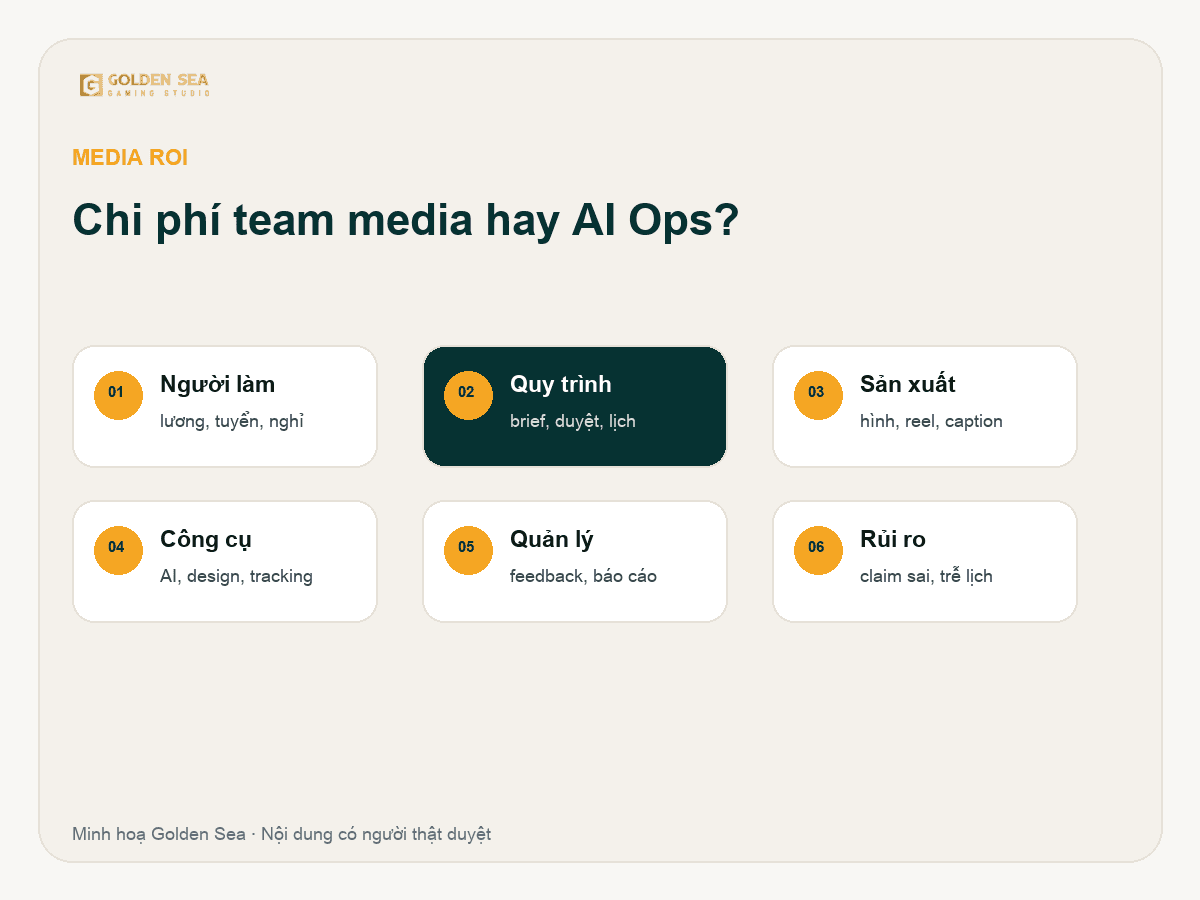

Short answer: To compare a media team with AI media operations, do not count posts. Compare operating output: consistent content, brand-safe visuals, video, approval, reporting, and a follow-up flow when customers respond.
This article targets the primary keyword media team cost, supported by AI media operations, outsourced media team, content production cost, AI marketing for SMEs. The search intent is commercial investigation: the reader is trying to understand the problem before buying, so the article must be useful first and sales-driven second.
Compare outputs, not AI versus one employee
The right question is not how much cheaper AI is than a person. The right question is what roles the business needs to maintain consistent content, on-brand visuals, short videos, scheduling, inbox response, and reporting. A small media team is not only a writer; it may include planning, design, editing, publishing, customer response, and measurement.
AI media operations works when repetitive steps can be consolidated into a templated workflow with human approval.
Hidden costs
Beyond salary or agency fees, there are costs from poor briefs, repeated revisions, late publishing, missing sources, off-brand design, untracked content, and leads nobody follows up with. These costs do not appear in a quote but reduce performance.
If the business only compares price per post, it may buy a cheap option without an operating system.
When AI Ops fits
If the business needs steady weekly content, basic visuals, short videos, and reporting, AI Ops can replace part of a small media team. If the brand is repositioning, launching a major creative concept, producing TVCs, or requiring advanced art direction, a specialist creative team is still needed.
AI Ops is strong at consistent operations. It should not pretend to be a high-end creative agency.
How to calculate budget
Separate the budget into setup, monthly production, and operations/SEO. Setup includes templates, prompts, source folders, and tracking. Production includes posts, visuals, clips, and scheduling. Operations includes approval, reporting, optimization, and lead handling.
This makes it easier to see whether the business is buying deliverables, operations, or long-term growth.
Quick implementation checklist
- Define the inputs: owner, source material, offer, and channel.
- Break the workflow into accountable steps instead of placing everything inside one AI box.
- Set review standards for claims, visuals, brand voice, CTA, and personal data.
- Track real actions such as phone clicks, messaging clicks, forms, downloads, and bookings.
- Review after two to four weeks using lead quality and response speed, not only publishing volume.
How Golden Sea frames this problem
Golden Sea does not treat AI as decoration. For AI media operations and monthly SEO, the real purchase is a clearer operating flow: the website creates signal, content uses real source material, leads get classified, risky outputs are reviewed by humans, and data returns to reporting. If the business lacks a strong web foundation, start with website design and tracking. If leads exist but handling is fragmented, consider AI automation. If the business needs custom software, dashboards, or deep integrations, IT outsourcing is the right layer.
What should a fair cost comparison include?
A fair cost table should include content planning, caption writing, visual design, short video editing, scheduling, inbox response, reporting, revisions, and source management. If the only row is “number of posts per month”, the business is buying volume rather than operations.
AI Media Operations should be priced as a system: templates, prompts, voice, source library, approval process, publishing schedule, reporting, and optimization. This is why twenty posts per month can have very different value. One supplier delivers files. Another keeps the whole content rhythm running.
When is a monthly operations package worth it?
A monthly package is worth it when it removes the pressure of many small roles: topic planner, writer, designer, basic video editor, scheduler, report reader, and follow-up reminder. It does not need to replace a large agency. It needs to stop the owner from pushing every post, visual, and caption manually.
The condition is clear standards: how many image posts, how many clips, where sources come from, who approves, how many revision rounds, which metrics are reported, and where leads go after content performs. Without standards, a monthly package becomes a black box.
Conclusion
Useful content does not need exaggerated selling. It helps business owners see where value is leaking, understand why the problem happens, and identify a small next step. When website, content, and automation are connected into one workflow, Golden Sea earns natural consulting opportunities without forcing the sale.