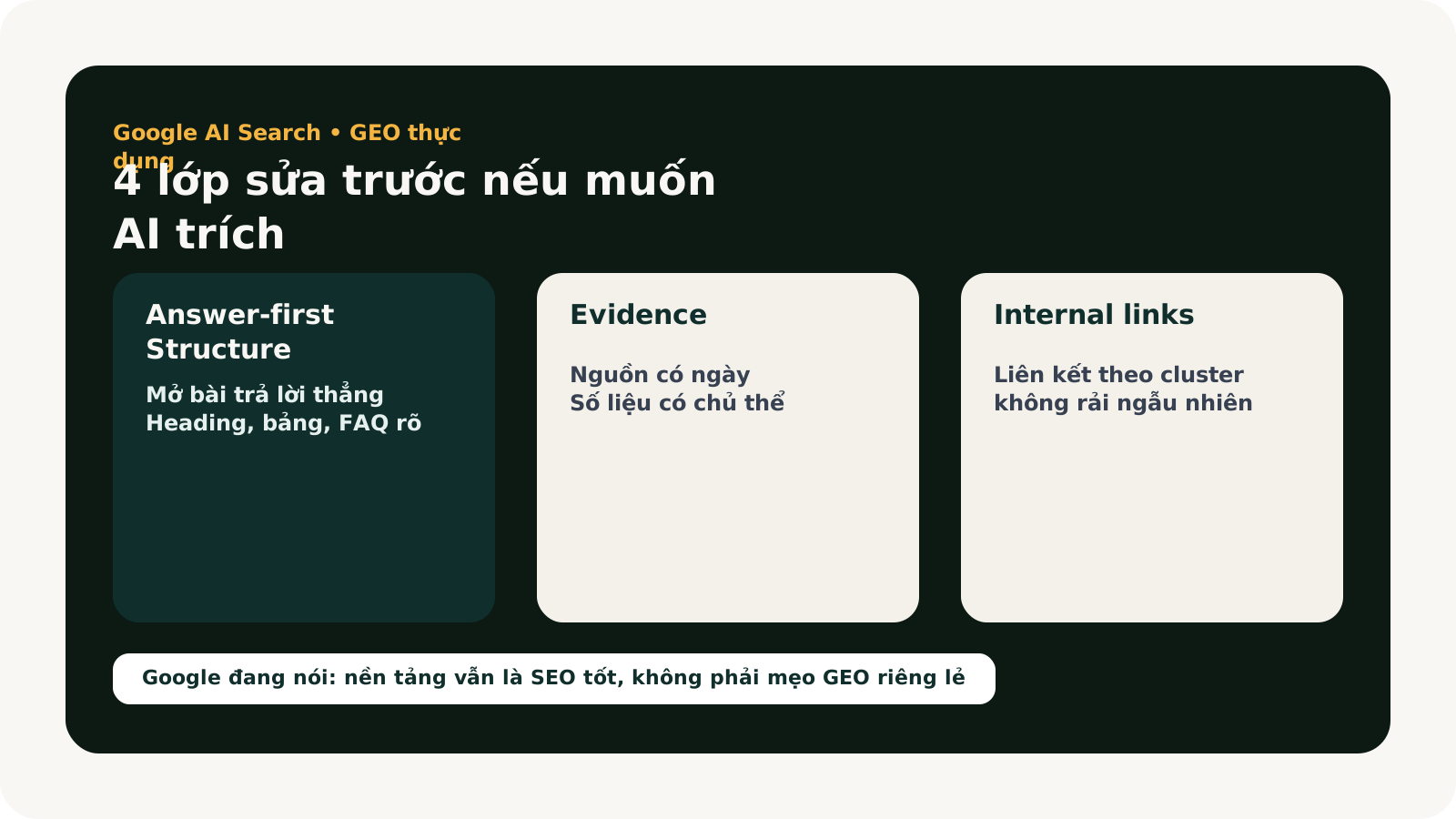

Short answer: Google's latest guidance is straightforward: showing up in AI Overviews or AI Mode still starts with strong SEO fundamentals, useful content, and clean structure. For SMEs, the first fixes are not a bag of GEO hacks. They are four core layers: answer-first passages, extractable structure, evidence that can be cited, and internal links that make the topic cluster legible to both humans and AI systems.
What the market is actually signaling about GEO right now
Google now has a dedicated guide on optimizing sites for generative AI features in Search. The most important signal is not a secret AI tactic. It is the explicit reminder that optimization for generative AI in Google Search is still optimization for Search. If a site is weak on clarity, source quality, structure, or topical coverage, relabeling the effort as GEO does not solve the underlying problem.
That matters because much of the market currently sells GEO as if it were a detached playbook. In practice, AI Search simply punishes ambiguity more aggressively. If the page does not answer directly, lacks descriptive headings, or provides no evidence, both people and AI systems struggle to extract a reliable response.
The four layers to fix first
| Layer | What to fix | Why AI Search cares | Common failure |
|---|---|---|---|
| Answer-first | Lead with a direct 50-80 word response | AI can cite a clean passage | Long warm-up without answering |
| Structure | Clear H2/H3, tables, FAQ blocks | Supports query fan-out | Vague headings and dense paragraphs |
| Evidence | Dated sources and attributable numbers | Increases trust and citation value | Unsupported claims |
| Internal linking | Link by cluster, not randomly | Helps engines map topic depth | Isolated standalone posts |
What Google is correcting that many GEO vendors ignore
Google's May 2026 Search Central blog post pushes back on the idea that websites need a separate species of AI-only content. The better interpretation is simpler: write for people, organize for extractability, and avoid low-value pages produced only to bait summaries.
For Golden Sea, that means GEO should be treated as a content-operations upgrade. The work includes answer blocks, bilingual metadata, strong evidence, healthy internal links, and locale-correct canonical and hreflang behavior—not just prompt-shaped copy.
A 30-day plan for SMEs
| Week | Action | Output |
|---|---|---|
| Week 1 | Test 5 priority queries across AI interfaces | AI visibility baseline |
| Week 2 | Upgrade 3 service-adjacent articles | Extractable article set |
| Week 3 | Audit internal links, schema, canonical, hreflang | Cleaner bilingual cluster |
| Week 4 | Publish one new comparison or checklist spoke | A fresh high-citation candidate |
The small mistakes that quietly weaken GEO work
A common issue is weak bilingual metadata. A site may have both Vietnamese and English URLs, but if the English page is only partially localized, AI systems may retrieve the URL without trusting it as the best citation candidate for English-language queries.
The second issue is evidence that exists in the research process but not in the visible content. Writers may have read several sources, yet the page still presents claims with no visible attribution anchor. That weakens both human trust and citation readiness.
The third issue is random internal linking. A site can technically have plenty of links while still failing to show cluster depth. For AI retrieval, that means the page looks like an isolated article rather than part of a coherent service-adjacent knowledge system.
A quick checklist before assigning GEO work
If Golden Sea were handed an SME website for SEO and GEO work, the first week would not begin with AI hacks. It would begin with five questions: which pages are closest to real services, which queries carry true buyer intent, which locale paths still have weak metadata or linking, which cited sources are too old, and which topic clusters have hubs without enough spoke depth. Those answers make the GEO backlog far less emotional.
The backlog should also be prioritized by business impact, not by technical novelty. Upgrading three service-adjacent pages often matters more than creating twenty detached FAQ fragments. Likewise, fixing canonical, hreflang, and related-path coherence can create more citation value than publishing a distant thought-leadership piece.
FAQ
Read next: Build an AI content engine · Content approval matrix for AI · How fragmented data blinds enterprise AI