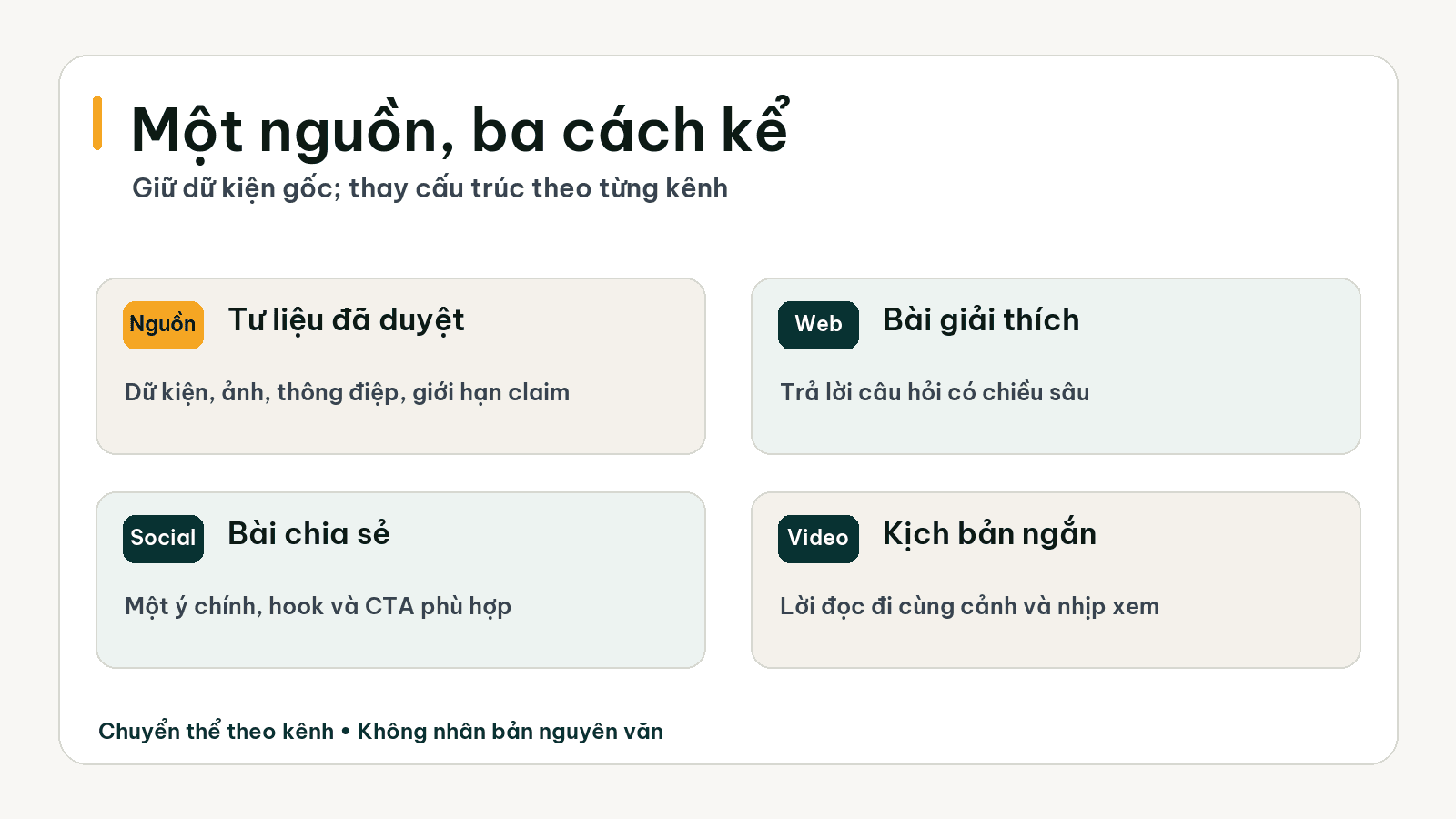

Short answer: AI-assisted content repurposing turns one verified source into several stories designed for different channels. An expert interview can become a website explainer, a Facebook post, and a short video script. The underlying facts, rights, and message remain stable; the opening, depth, imagery, and call to action change with the audience. Copying one paragraph into three places creates three posts, but rarely three better conversations.
Choose a valuable source before asking AI to write
The source might be a customer interview you have permission to use, product instructions, an expert's notes, project photographs, recurring sales questions, or an existing web article. A good source has an owner, an update date, checkable facts, and boundaries on what may be published. An anonymous draft or social post is not automatically a source of truth. AI can summarize quickly, but an error in the source can spread to every derivative version.
Before production, split the source into four parts: approved facts, the business's explanation or opinion, images and clips with usage rights, and points still awaiting verification. Mark expiration dates for prices, offers, and policies. A concise source sheet saves the writer from asking “Where did this figure come from?” for each format. It also helps reviewers distinguish an expert's statement from an AI suggestion.
Keep one message, then change the structure by channel
Keep a central idea so the versions do not contradict one another. Illustrative example: customers frequently ask why authentic photographs matter before using AI to make a product video. The central idea is that real images and approved information help preserve product accuracy. A web article can explain image requirements, common errors, and an approval checklist. A Facebook post can open with a label that AI rendered incorrectly and ask where the team checks it. A short video can show the source image, a draft shot, and the correction. Each channel uses the same source to answer a different need.
Do not paste the whole web article into a caption and cut it down. Someone searching on Google needs a full answer and a path to deeper information. Someone scrolling a feed needs one idea quickly. Someone watching a video needs visuals and spoken words to align over time. Write a brief for each channel: audience, question, one message, required assets, call to action, length or duration, and approver. AI can draft against these briefs; an editor decides which versions are worth publishing.
A repurposing example that can be checked
Suppose Golden Sea has an internal note about product-video approvals, several licensed illustrative photos, and a list of errors its own team has encountered. The web article answers “What should a team prepare to make a video from product photos?” through steps and conditions. The Page post chooses one error: a polished clip in which the logo is misspelled. The reel script shows the original image alongside the shot requiring correction, and narration explains that one issue. This is an editorial example, not a customer case or performance result.
Each output should identify its source and any new information added. If a post introduces a promise absent from the original document, it needs a new source and another approval. If a video uses a different image set, check those image rights independently. This keeps “repurposing” from becoming “inventing extra claims.” The product photo to video guide goes deeper into motion content; the content engine guide covers the broader production flow.
The flow from source to three drafts
First, store the source where it can be traced: document, images, date, supplier, and rights status. Second, the owner selects the central idea and business goal. Third, AI makes a source-linked summary and proposes separate structures for the web, social, and video. Fourth, an editor checks any statements missing from the source, clarifies ambiguity, and removes generic filler. Fifth, a designer or editor produces visuals using suitable assets. Then the versions go through a recorded approval process.
Do not merge content approval and permission to publish into one vague decision. A subject specialist verifies facts; a brand owner approves voice and imagery; a channel owner confirms timing, context, and call to action. In a small team, one person can hold several roles, but the record should still say which decision they made. If someone changes a claim or image after approval, that version must return to review. This rule prevents a published asset from drifting away from what was signed off.
How much should the team automate?
AI is useful for extracting ideas from source material, suggesting outlines, preparing format-specific drafts, comparing versions for consistency, and flagging missing images or approvers. People should decide offers, product promises, sensitive opinions, real-person imagery, and publishing rights. If the source is a customer conversation, handle personal data and usage permission before sending it to a tool. Speed adds little value when a published asset must be removed because its source or rights are wrong.
Start with one source and three formats a week rather than forcing every item onto every channel. Expand only when the team sees which outputs it actually uses. A sound system has exception states: insufficient source material, unclear image rights, figures without a baseline, changed product policy, or a video that alters product details. In such cases AI should pause and alert the owner. A target like “many posts from every source” can reward volume over usefulness, so usable quality must remain the release criterion.
Measure the team's workload directly
Before a pilot, record a few weeks of manual work: time from source receipt to brief, first draft, approved version, and export. Count handoffs, revision rounds, errors requiring removal, and the work editors must still do. After the pilot, compare sources of similar difficulty. If drafting time falls while correction time rises, the workflow has not really removed work. A social draft produced quickly and never published is not a valuable deliverable either.
There is no single time-saving figure that applies to every business. A team with a clean asset library, clear brand guidance, and a responsive approver operates differently from a team that must hunt for source material every time. When you hear “one article becomes ten posts,” ask whether those ten versions serve different channels, have been approved, and answer real customer questions. These questions assess a service or tool more fairly than the count of exported files.
Choose the operating model that fits your team
If marketing already has an operator and wants to own the system, AI Content System helps design source management, briefs, templates, approval steps, and tracking for the team to run itself. If the business wants a partner to carry a continuous production rhythm, AI Media Room takes in assets, prepares drafts, requests approval, and tracks deliverables within an agreed scope. The difference is who operates the flow after setup; choose according to the owner capacity inside the business.
To test the idea, pick one approved document with enough sources and illustrative assets. Ask AI for three outlines before allowing it to produce three complete drafts. The owner should select each outline for a different audience need and only then request a draft. Starting small exposes missing sources, images, or decisions before the team commits to a large multi-channel schedule.
Frequently asked questions
Is repurposing the same as posting the same text on several channels?
No. The core facts can remain the same, while structure, examples, visuals, and calls to action should change for the way each channel is used.
Must a web article exist before social and video versions?
No. The source could be an interview or product material. What matters is that it is verifiable and cleared for use.
How can a team prevent AI from inventing claims during repurposing?
Keep the original source, flag unsupported statements, compare every claim with the source document, and require an owner to approve the final version.