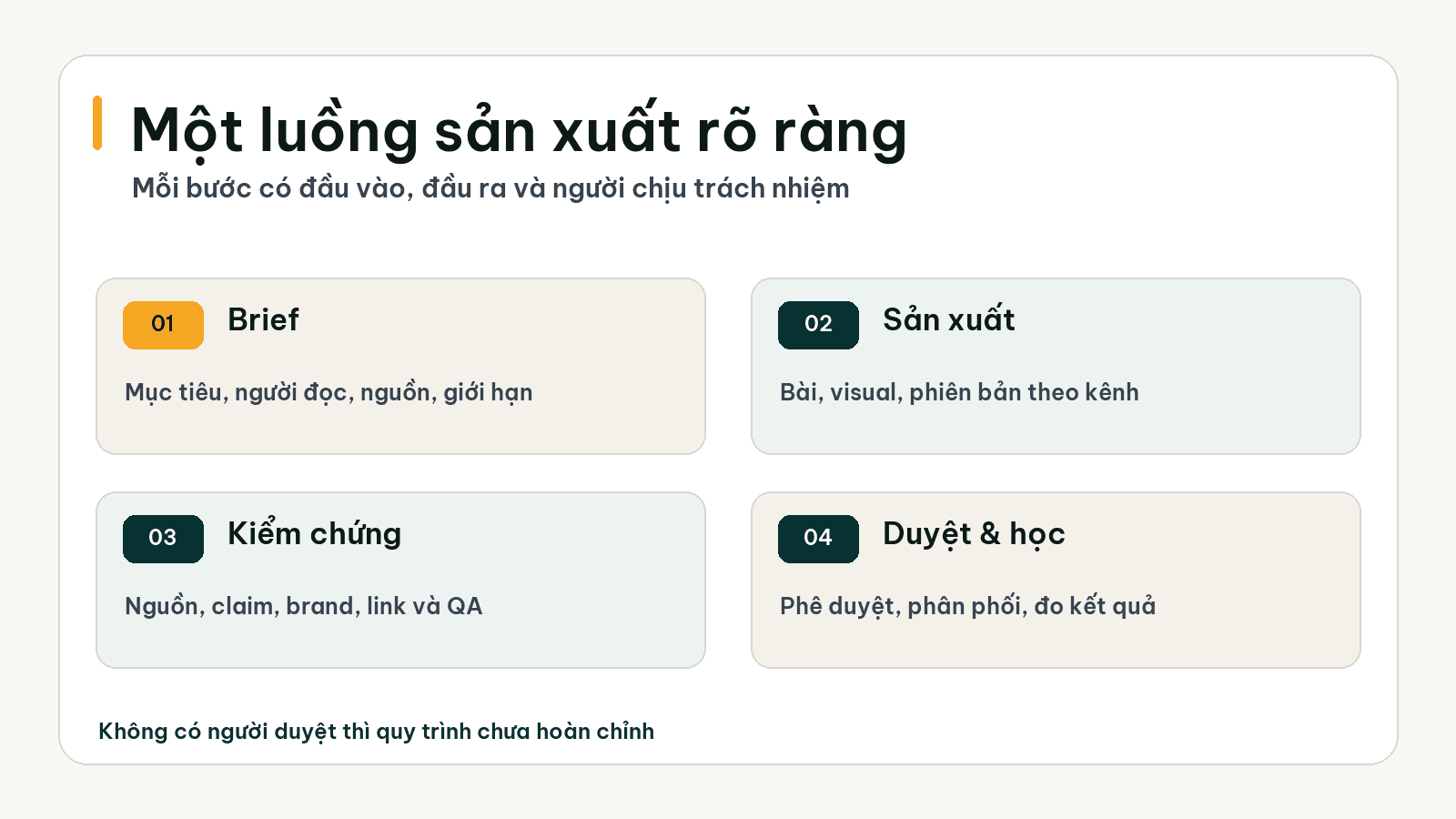

Short answer: An AI content engine is a production flow with sources, a brief, drafts, images or video, fact checks, human approval, distribution, and measurement. AI handles steps that can be standardized; an owner decides the message and publishing rights. To measure real workload reduction, track time from brief to approved version and revision rounds rather than only counting generated posts.
Many businesses use AI in a fragmented way: brainstorming ideas in one chat window, writing in another, copying into a document, pinging a reviewer, then publishing manually. Each step gets faster, yet the calendar still slips, sources are still missing and nobody knows which version is final. The content engine solves that operational layer.
What does a content engine consist of?
A minimal system has seven stages: research, brief, draft, fact-checking, approval, distribution and measurement. AI can assist at every stage, but the degree of automation differs. Research needs sources; drafts need standards; distribution needs approval; measurement needs clean data.
1. Research: start with customer questions
The best input is not a generic list of trends. Combine sales questions, objections, search queries, website data, forums, competitor content and industry changes. A research Agent can group questions into topic clusters, spot gaps and keep track of where each insight came from.
Every idea should have a reason to exist: search demand, shareability, a customer question or a direct connection to the product. Without one, AI will happily generate topics that look like a thousand other websites.
Research outputs
- A specific problem or question.
- The audience and buying stage.
- The primary keyword plus fan-out queries.
- The brand's differentiated point of view.
- Primary sources and data to verify.
- Its role within the topic cluster.
2. The brief: a quality contract
The brief is where humans decide what the content must accomplish. It includes the goal, the argument, the structure, the evidence, the CTA, internal links and the no-go list. When the brief is weak, even a long prompt only produces text that reads smoothly but says nothing.
AI can propose briefs, but an expert must review the search intent and the point of view. For Golden Sea, briefs must speak like an operations advisor to SME owners, avoid "cheap" language, never invent case studies, and always hold to the principle: AI assists, humans stay in control.
3. Drafting: create content blocks you can inspect
Instead of asking for 1,500 words in one shot, the Agent can generate section by section from the brief and sources. Each section opens with a direct answer, followed by explanation, examples and action steps. This structure is easier to read and helps both search engines and AI extract the right meaning.
Drafts should never invent numbers the sources don't contain. For quantitative claims, the system must store the URL, date and supporting sentence. If no source can be found, downgrade the claim to a qualitative statement or flag it for verification.
4. Fact-checking and the quality gate
The quality gate checks claims, sources, duplication, tone, headings, links and CTAs. Structure can be checked automatically, but judging the point of view and usefulness requires a human. Grammatically correct doesn't mean strategically correct.
Pre-approval checklist
- Does the opening paragraph answer the question directly?
- Does every statistic have a source and a date?
- Is anything posing as first-hand experience that isn't?
- Does each section carry one clear main idea?
- Do images and alt text add real meaning?
- Are internal links natural and useful?
- Does the CTA match the reader's stage?
5. Human approval: keep judgment where it belongs
Reviewers shouldn't be fixing every comma in a chaotic document. The workflow must surface the brief, sources, changes and checklist, so they can focus on the argument, the facts, the brand and the risks.
Design clear states: draft, fact-check, expert review, approved, scheduled and published. Any change after approval must create a new version or return to review. This prevents a late AI-added paragraph from going straight to the public.
6. Multi-channel distribution is not copy-paste
One blog post can become a LinkedIn post, a carousel, an email, a video script and an FAQ, but each channel behaves differently. The Agent should keep the argument and the evidence while swapping the hook, length, structure and CTA.
Never post the same text everywhere. Blogs serve search and depth; LinkedIn wants a point of view; Facebook needs a familiar, personal context; video needs pacing and visuals. "Multi-channel" means restructuring, not cloning.
7. Measurement and the learning loop
A content engine is only complete when data flows back in. Track impressions, clicks, read time, scroll depth, internal clicks, leads and sales feedback. For GEO, track which pages AI cites for your priority question set.
The Agent can summarize trends and propose updates, but it shouldn't declare cause and effect on its own. A traffic spike may be seasonality or an algorithm change. Humans form the hypotheses and decide what to test.
The minimum data architecture
- Product marketing context as the positioning source.
- A brand voice library with qualifying examples.
- A topic map with keyword mapping.
- A repository of approved sources.
- A content calendar with workflow statuses.
- An asset library with usage rights, alt text and captions.
- A dashboard for output and performance.
Every source needs an owner and a last-updated date. If the old price list still sits next to the new one, the Agent can pick the wrong one no matter how good the prompt is.
SEO and GEO inside the content engine
SEO starts with intent, structure, internal links and genuine quality. GEO adds self-contained answer blocks, comparison tables, FAQs, sources and citable facts. The two don't conflict when content is written for people and clearly organized.
Don't create one page per keyword variant. Cover one topic in real depth and build a cluster that answers the related queries. That is the approach that matches query fan-out in AI search.
Three levels of automation
| Level | AI does | Humans do |
|---|---|---|
| Assist | Ideas, outlines, drafts | Coordinate every step |
| Workflow | State transitions, checks, reformatting | Review strategy and quality |
| Operations | Orchestrate from research to reporting | Set goals, handle exceptions, improve |
Inputs, outputs, and owners at each stage
Research receives customer questions, search queries, and industry material; its output is a sourced topic with clear intent, selected or rejected by the content owner. The brief receives that topic and produces the goal, audience, message, evidence, call to action, and required visuals. Production takes an approved brief and makes channel-specific drafts with source notes. Verification compares claims, images, and links with the source; a specialist decides exceptions. Approval records the version and sign-off owner. Distribution uses only approved assets, while measurement brings channel signals back to the content plan.
Visual work is often overlooked. A web article needs relevant imagery with clear rights. A social post may require an approved template. Video needs a script that matches shot pacing. If the formats share a source, the AI repurposing workflow keeps facts aligned while changing the story by channel. When the source is a product photo set, the photo to video guide covers visual QA, claims, and approval.
Operate in-house or ask a partner to run the cadence?
A business with an editor, source library, and calendar owner can build an AI Content System for its own team to run. If it needs recurring output and a partner to receive assets, produce drafts, request approval, and track status, AI Media Room is a better fit. Either way, define the formats, revision rounds, asset-supply duties, and publication rights. Without those decisions, a workflow built from many tools still breaks at handoff.
Conclusion
A good content engine doesn't turn your brand into a word factory. It removes busywork so people can spend their time on insight, argument and quality. AI creates leverage; process creates consistency; humans create judgment.
To start, automate from approved brief to draft and quality checklist first. Once the data is stable, connect distribution and reporting. Read more on why fragmented data leaves your company's AI blind.
Read next: Content approval matrix: AI drafts, who reviews, and who owns the risk? · Media Team or AI Operations? How to Calculate the True Total Cost