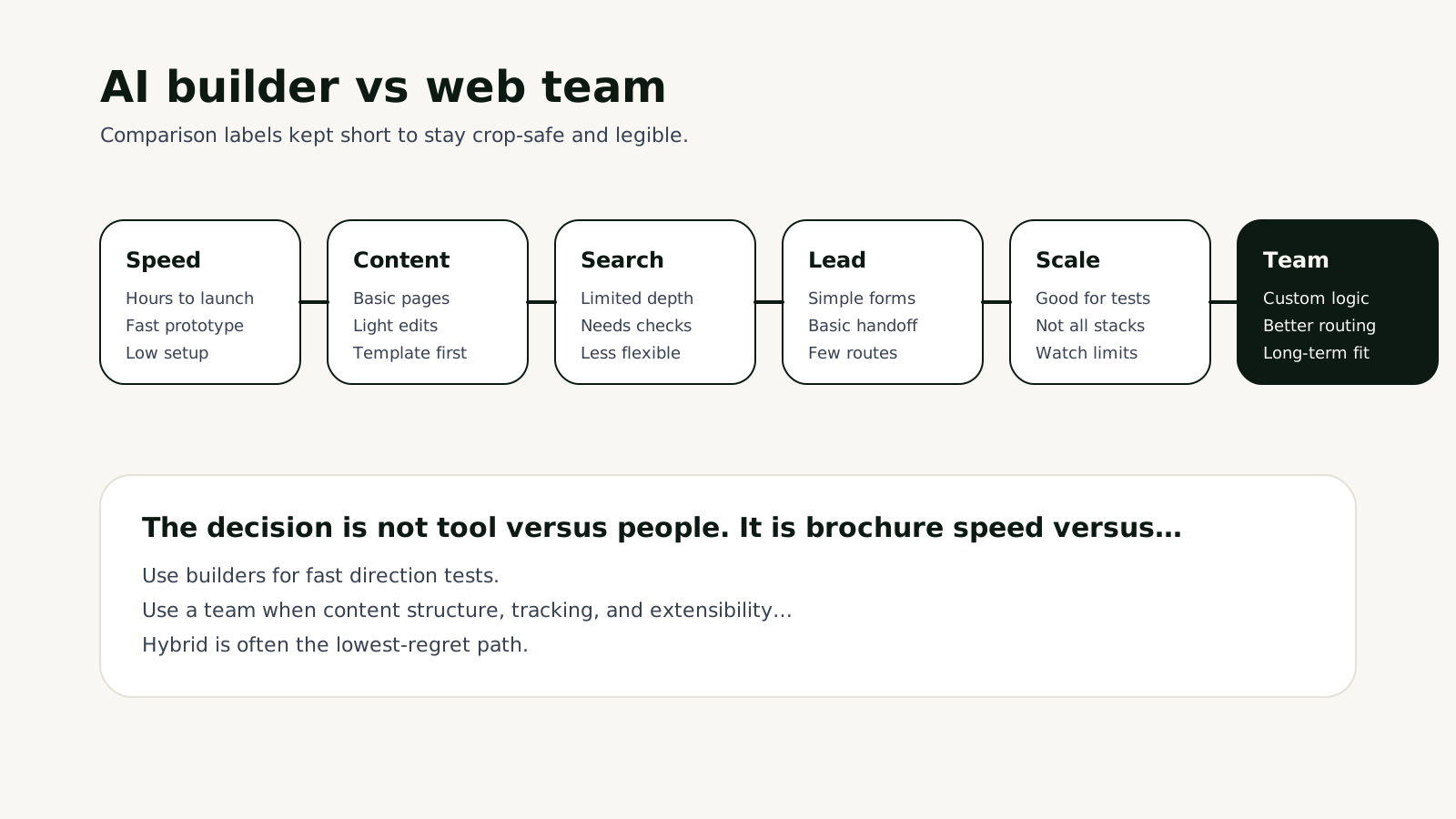

Short answer: If the business only needs a basic brochure site, an AI website builder can be fast enough and cheap enough. But when the goal is real lead generation, service-specific content, SEO/GEO, multilingual routes, tracking, and long-term extensibility, a web team still wins because the hard part is not layout creation. It is turning the website into an operating system for growth.
Why this topic matters on Thursday, August 6, 2026
The global signal has been visible for a while, but by 2026 it clearly touches SMEs: Wix, WordPress.com, and no-code platforms keep pushing AI builders forward. The question of whether companies still need developers is no longer theoretical.
There is a third option between the two in this article: a pre-built layout with people doing the content and the build. That is how the website template library works, at published prices per package.
At the same time, Google keeps reinforcing crawlability, clear structure, useful content, and verifiable data for AI Search. That creates a real gap: building a page quickly is getting easier, but building one that ranks, gets cited, and connects to lead workflows is still not a one-click problem.
Indie Hackers also keeps surfacing the same qualitative pattern this week: technical SEO infrastructure and AI workflows need to move together. That is exactly the SME reality. It is easy to launch a page. It is harder to launch one that actually produces measurable pipeline.
Golden Sea decision framework
| Criteria | AI builder fits better | A web team fits better |
|---|---|---|
| Starting speed | You need a simple brochure site in hours or days | You need content architecture and conversion paths from day one |
| Service content | Few pages and simple copy | Multiple service pages, FAQ, proof, and intent-based CTA |
| SEO + GEO | Basic level is acceptable | You need schema, clusters, bilingual routes, and stronger internal links |
| Tracking + CRM | A simple form is enough | You need lead routing, UTM logic, event tracking, and CRM integration |
| Extensibility | Very little changes expected | You will add blogs, landing pages, automation, or a portal later |
What to lock before implementation
- If you use an AI builder, lock title, hero, CTA, and structure for the 3 most important pages first.
- Do not let the platform generate all service copy without human editing.
- Verify how flexible metadata, schema, redirects, and internal links really are.
- If English server-rendered routes may matter later, avoid a platform that complicates `/en/` paths.
- Test forms, thank-you states, and tracking before sending traffic.
Where teams usually buy the wrong thing
- Confusing page-launch speed with lead-generation speed.
- Using unedited AI-generated copy that sounds generic and lacks a Golden Sea point of view.
- Ignoring export and migration constraints.
- Overlooking technical-SEO limits in script-heavy builder environments.
- Forgetting that local and service SEO require more than a homepage.
A practical 30-day rollout
| Week | Action | Output |
|---|---|---|
| Week 1 | Use an AI builder to test sitemap and messaging | Prototype direction |
| Week 2 | Decide what can remain templated and what must be custom | Build plan |
| Week 3 | Rewrite copy, metadata, FAQ, and CTA around real queries | Conversion-ready content |
| Week 4 | Connect forms, tracking, CRM, and mobile QA | Lead-ready website |
A simple real-world diagnosis test
In practice, this kind of problem rarely shows up as a dramatic outage. It usually appears as rising hidden cost: leads that stop halfway, operators doing more manual work than they should, or the same workaround returning every week. For a topic like ai website builder hay thue doi lam web, the right question is not whether one screen looks better. The right question is whether the underlying workflow becomes easier to run and easier to improve.
A useful diagnosis is to ask four questions. First, if volume doubled next week, where would the process break first? Second, who owns the outcome rather than merely touching the tool? Third, if a lead or booking disappears, can the team identify the exact step where it was lost? Fourth, which part of the current setup is still temporary but already being treated like long-term infrastructure? Those answers usually clarify the right buy-versus-build direction quickly.
What should be measured after 14 days?
After two weeks, the goal is not a vague feeling that things look smoother. A business should review at least three operating signals. First is speed: response time, handling time, or the time from visit to the primary action. Second is quality: error rate, customer re-question rate, or how often the team must manually override the system. Third is continuity: whether the process still works when the main owner is away for a day.
When speed, quality, and continuity improve together, the decision is probably working. If speed improves while rework climbs, that is not real efficiency. If the page looks better but lead signal does not improve, that is surface change only. For SEO and GEO-oriented topics, teams should also check whether titles, FAQ, CTA, and internal-link paths now make the page easier for both people and AI systems to understand.
What breaks when teams choose the fastest-looking option
The biggest AI-builder risk is not ugliness. It is a site that looks good enough to create false confidence while search, tracking, and workflow foundations remain weak.
The opposite risk is assuming a web team automatically fixes everything. If the brief is vague, content is weak, and ownership is unclear, even a strong team can deliver a site that stays hard to extend.
Golden Sea point of view
Golden Sea does not treat AI builders as something to dismiss. They are useful for fast direction testing. But once a website must function as a durable sales asset with service POV, SEO/GEO, multilingual routes, and tracking, real implementation work still matters.
The most practical path is often hybrid: use fast tools to test direction, then let a build team harden the layers that need to survive beyond one campaign.
FAQ
Read next: App & Web Development service · What Google actually says about GEO · MVP in 8 weeks