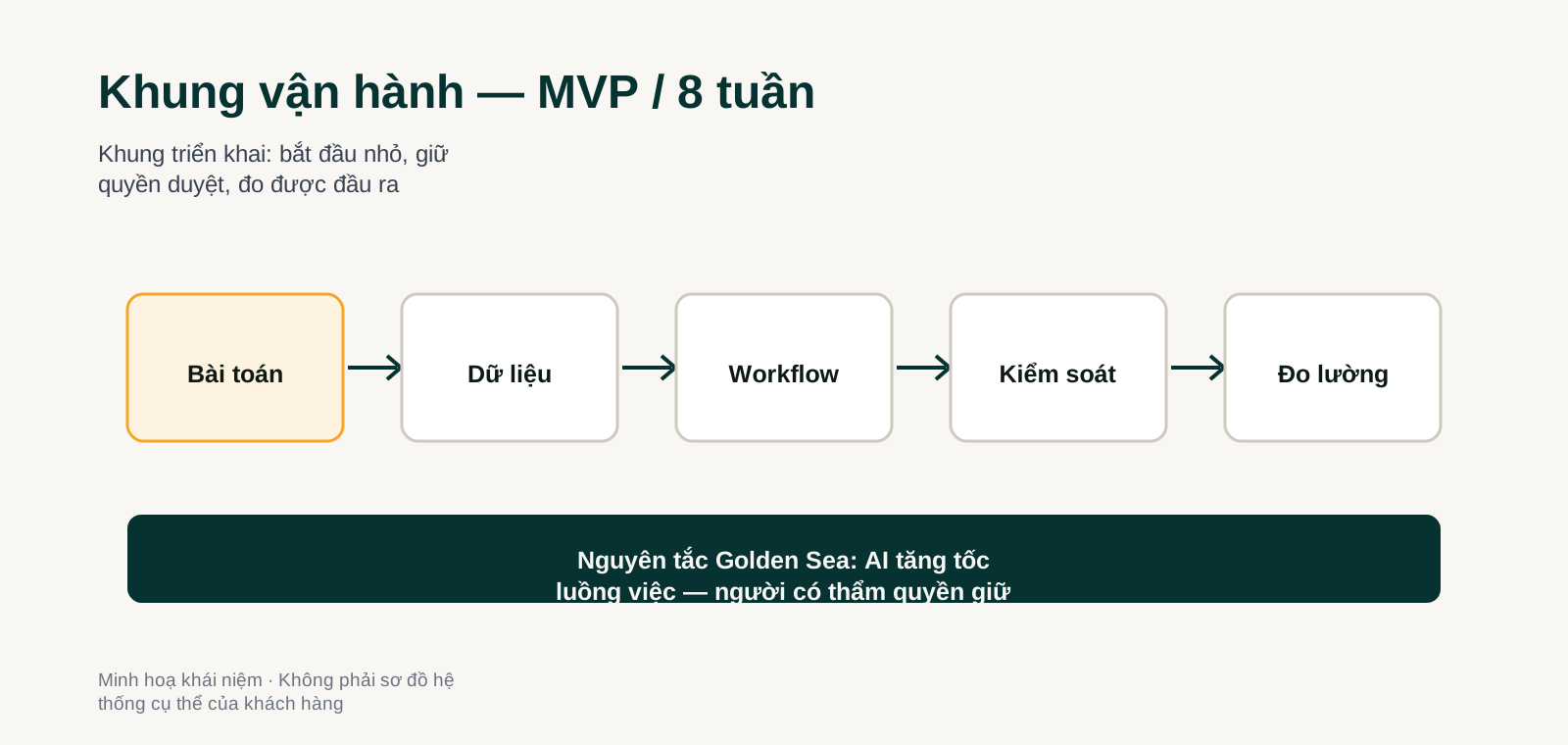
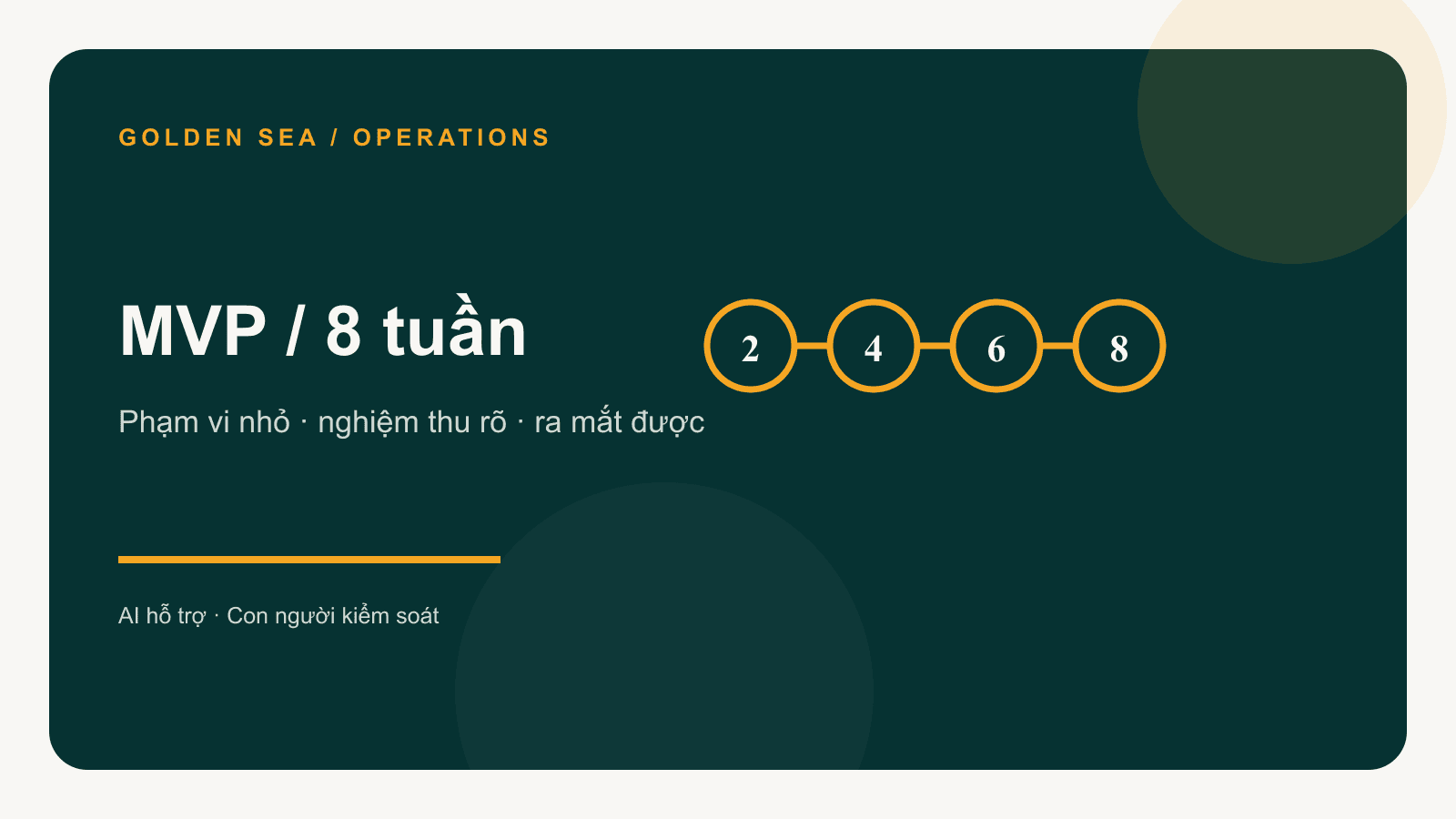
Short answer: An MVP in Eight Weeks: Scope, Delivery Plan and Acceptance Criteria should begin with one measurable operating problem, a named process owner, reliable source data and a human approval path. The goal is taking one narrow product hypothesis to a working, tested and ownable release rather than promising every feature. Technology is selected after the workflow and risk boundaries are clear.
Golden Sea operating principle: AI accelerates information and repetitive actions; accountable people retain authority over consequential decisions.
1. Outcome and scope
Start by describing outcome and scope through a real case: what triggers it, who receives it, where the data comes from and what completion means. For taking one narrow product hypothesis to a working, tested and ownable release rather than promising every feature, this definition matters more than model selection because it determines whether the system solves the right problem or simply adds another interface.
What automation can support
Suitable automation here validates inputs, retrieves approved context and prepares the next action. AI may classify or summarize, but it must not invent missing fields; missing required data should create an owner task rather than a guess. For this article, the design target is taking one narrow product hypothesis to a working, tested and ownable release rather than promising every feature.
Control and evidence
The business owner defines correctness; the technical owner maintains reliability and recovery. Metrics should include missing data, returned records and owner wait time—not only processed volume. Apply that control specifically to an eight-week MVP, rather than copying a generic AI policy.
4. Core build
Do not begin core build by asking what AI can write. Define the normal case, the missing-data case and the high-consequence case, then assign allowed actions to each. This structure gives an eight-week MVP speed without hiding accountability.
What automation can support
Divide actions into three levels: autonomous for low risk, approval required for medium risk and recommendation only for high risk. This is more practical than one AI switch for the entire process.
Control and evidence
Set acceptance thresholds before the pilot and rerun the same test set after every prompt, rule or integration change. If serious failures repeat, rollback should be a normal operating action rather than an emergency project.
5. Integration
At the integration layer, the minimum dataset should let a new operator understand status and next action without asking through chat. If the knowledge still lives in one person's head, automation scales dependency rather than removing it.
What automation can support
The workflow should retrieve only the data required for the task instead of exposing the entire information estate to a model. Task-level access reduces noise and makes the output easier to explain.
Control and evidence
Track quality with cycle time. A faster workflow that increases rework, complaints or management review has not created real ROI; the full control cost belongs in the calculation.
6. QA and security
QA and security should be designed around exceptions, not only the happy path. Use cases returned, delayed or heavily revised during the latest operating cycle as a test set; they are practical evidence for taking one narrow product hypothesis to a working, tested and ownable release rather than promising every feature.
What automation can support
Run in shadow mode first: the system recommends without affecting the live process. Comparing proposals with staff decisions separates data, rule, model and handoff failures.
Control and evidence
QA samples must cover common, exceptional and dangerous cases. For technical, HSE or medical decisions, AI prepares information only; conclusions remain with qualified and authorized people.
7. Launch and handover
Before scaling launch and handover, answer three questions: who may change the rule, where the change is tested and how it is rolled back. Those answers turn an eight-week MVP from a personal experiment into a maintainable operating capability.
What automation can support
Once this stage is stable, connect it to the next stage through an explicit contract for schema, state and retry behavior. Do not scale simply because a first demo handled a few clean cases.
Control and evidence
Scale only when quality clears the threshold, staff use the flow correctly and a named owner maintains it. Without all three, higher volume only makes failures harder to trace.
A 30-day pilot scorecard
| Area | Question | Evidence |
|---|---|---|
| Value | Did cycle time, loss or capacity improve? | Baseline and pilot result |
| Quality | Which errors remain and how serious are they? | Reviewed sample and error log |
| Control | Can every action be traced and stopped? | Audit trail and kill switch |
| Adoption | Does the team use the workflow correctly? | Usage and intervention log |
Conclusion
The durable advantage does not come from adding an AI label. It comes from redesigning the handoff, making ownership visible and preserving evidence for every important decision. Golden Sea recommends starting with one narrow workflow, running it beside the current process, reviewing errors every week and expanding only after quality and control meet the agreed threshold.
Continue: Related operating guide 1 · Related operating guide 2 · Related operating guide 3