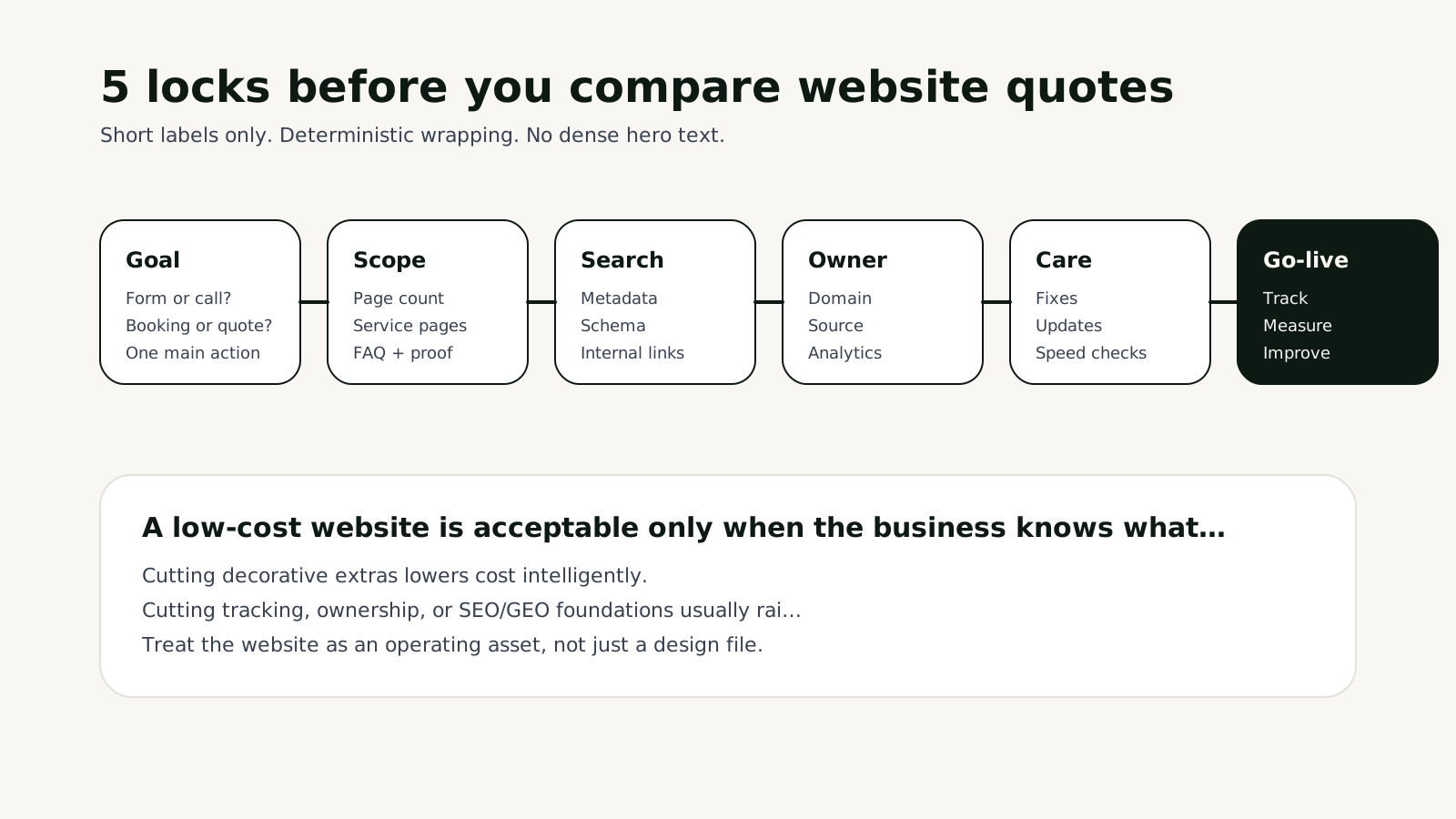

Short answer: If a business compares website vendors only by the opening quote, it will usually buy the wrong thing. The smarter move is to lock the conversion goal, page scope, ownership of source and content, delivery speed, and how the site will support SEO and GEO after launch. A low-cost website can make sense, but only when cost is removed from waste instead of from the foundation.
Why this topic matters on Thursday, August 6, 2026
This week's market signal is that lean teams want more output without expanding headcount. Salesforce's small-business post from August 5, 2026 shows how compact teams are pushing AI into CRM and revenue workflows. That makes the website less of a static brochure and more of an intake layer for leads, forms, inbox, and follow-up.
The fastest way out of price ambiguity is to look at the numbers: the website design price list publishes four packages and what each covers, while the template library lets you open the interface before paying a deposit.
At the platform layer, WordPress lowered the creation barrier with an AI website builder and then added an in-product AI assistant in February 2026. That matters because page production is cheaper now, but information architecture, tracking, lead routing, and local SEO still require judgment.
Google's current AI-search guidance reinforces the same point: useful content, clean structure, accurate metadata, and crawlability still matter. In 2026, the real low-cost website question is not whether the quote is low. It is whether the site is strong enough to be found, cited, and converted into business.
Golden Sea decision framework
| What to lock | If handled well | If ignored |
|---|---|---|
| Conversion goal | The team knows whether the site should drive forms, calls, or bookings | The site looks fine but nobody knows what to measure |
| Content scope | Landing pages, service pages, FAQ, blog, and proof are planned early | Every new page becomes scope creep |
| SEO + GEO | Titles, descriptions, schema, internal links, and answer-first blocks are built in | The site launches looking polished but stays hard to find |
| Ownership | Source, hosting, CMS, assets, and copy are clearly handed over | The business becomes dependent on the vendor for every small change |
| Maintenance | There is a real plan for fixes, updates, performance, and tracking | Leads drop and nobody owns the operating layer |
What to lock before implementation
- Define one primary action for each page before discussing aesthetics.
- Ask for a scope sheet that names page count, template count, and content ownership.
- Lock domain, hosting, source-code, and analytics ownership inside the proposal.
- Plan Vietnamese and English route structure early if bilingual expansion is likely.
- Require a clear description of tracking, forms, CTA, and lead handoff.
Where teams usually buy the wrong thing
- Buying page count instead of buying a business outcome.
- Letting the vendor decide headings, CTA, and schema without service context.
- Failing to define who can edit content after launch.
- Optimizing only for desktop aesthetics while mobile forms stay weak.
- Launching without a blog or FAQ layer for long-term SEO and GEO growth.
A practical 30-day rollout
| Week | Action | Output |
|---|---|---|
| Week 1 | Lock the site goal, 3 priority queries, and page structure | Mini brief + sitemap |
| Week 2 | Write answer-first copy for the homepage and 2 service pages | Core page copy pack |
| Week 3 | Design, build, and wire tracking, forms, and CTA | Working site beta |
| Week 4 | Check speed, metadata, schema, internal links, and mobile QA | Launch-ready site |
A simple real-world diagnosis test
In practice, this kind of problem rarely shows up as a dramatic outage. It usually appears as rising hidden cost: leads that stop halfway, operators doing more manual work than they should, or the same workaround returning every week. For a topic like thiet ke website gia re, the right question is not whether one screen looks better. The right question is whether the underlying workflow becomes easier to run and easier to improve.
A useful diagnosis is to ask four questions. First, if volume doubled next week, where would the process break first? Second, who owns the outcome rather than merely touching the tool? Third, if a lead or booking disappears, can the team identify the exact step where it was lost? Fourth, which part of the current setup is still temporary but already being treated like long-term infrastructure? Those answers usually clarify the right buy-versus-build direction quickly.
What should be measured after 14 days?
After two weeks, the goal is not a vague feeling that things look smoother. A business should review at least three operating signals. First is speed: response time, handling time, or the time from visit to the primary action. Second is quality: error rate, customer re-question rate, or how often the team must manually override the system. Third is continuity: whether the process still works when the main owner is away for a day.
When speed, quality, and continuity improve together, the decision is probably working. If speed improves while rework climbs, that is not real efficiency. If the page looks better but lead signal does not improve, that is surface change only. For SEO and GEO-oriented topics, teams should also check whether titles, FAQ, CTA, and internal-link paths now make the page easier for both people and AI systems to understand.
What breaks when teams choose the fastest-looking option
The cheapest quote usually becomes cheap by deferring the hard layers: copy, tracking, metadata, multilingual structure, or maintenance. The total cost then rises because the business pays for patches after launch.
If the goal is both search visibility and AI-search extractability, skipping FAQ, internal links, schema, and evidence early weakens the project fast. Those pieces can be added later, but retrofitting them is always more expensive.
Golden Sea point of view
At Golden Sea, a low-cost website only makes sense when the team knows what it is removing. Cutting decorative extras is cost optimization. Cutting structure, tracking, and ownership is simply buying risk.
That is why Golden Sea approaches web work as an operating system for leads, content, SEO/GEO, and post-launch iteration, not just a design milestone.
FAQ
Read next: App & Web Development service · What Google actually says about GEO · MVP in 8 weeks