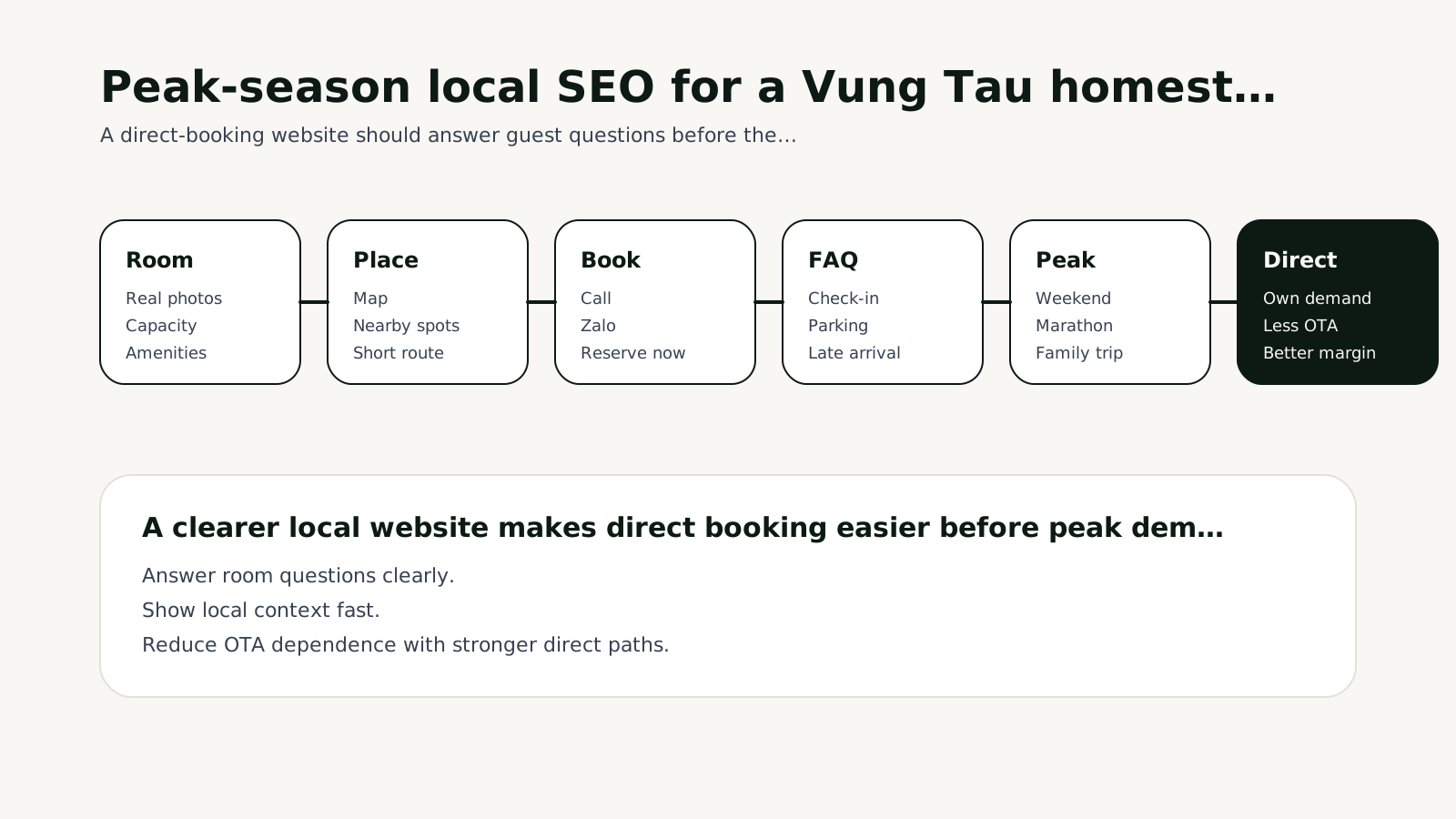

Short answer: Before peak season, a Vung Tau homestay website should focus on very practical local SEO: clear room pages or sections, understandable map and nearby-area context, FAQ around check-in and policy, strong mobile booking CTA, and content that reflects real seasonal demand instead of copying OTA descriptions.
Why this topic matters on Thursday, August 6, 2026
Early August is a good moment for this topic. VnExpress published an August 3, 2026 article about check-in spots for runners and families ahead of the late-August VnExpress Marathon in Vung Tau. That is an event-driven demand signal and a good reason for local hospitality operators to tighten website and booking paths before search volume rises further.
The Coastal Homestay template already has the seasonal rates and hold-a-room form described here; Pine Hill Retreat is the multi-page version for longer stays. Costs for either sit in the price list.
VnExpress also reported on August 1, 2026 that a high-speed vessel to Con Dao returned after a technical issue shortly after leaving Vung Tau. It is not a tourism-growth source, but it does highlight a practical local behavior: travel plans can change quickly, and guests need clear information about rooms, contact options, check-in, and access.
On the SEO and GEO side, Google still rewards useful, clearly structured, easily extractable content. For a small hospitality website, good local SEO does not need to be complex. It simply needs to answer the questions people are already typing before they message or call.
Golden Sea decision framework
| Checklist item | What should exist | Why it matters |
|---|---|---|
| Room pages | Room name, real photos, capacity, amenities, indicative price | Makes the offer understandable to guests and AI systems |
| Location context | Map, distance to key spots, short access notes | Improves local relevance and reduces repeated questions |
| Booking path | Book-now, call, Zalo, response window | Keeps direct leads and reduces OTA dependence |
| FAQ | Check-in/out, extra fees, parking, cancellation or rescheduling | Removes friction before messaging |
| Seasonal content | Weekend, marathon, holiday, family-angle content | Matches real search intent more closely |
What to lock before implementation
- Do not copy OTA room descriptions into your own site.
- Use real room and neighborhood photos whenever possible.
- Write FAQ from the questions guests actually ask, not from a brochure.
- Place a clear mobile booking CTA and an after-hours contact path.
- If you have multiple room types, separate them clearly instead of using one long block.
Where teams usually buy the wrong thing
- A website with only one generic overview page.
- No location context relative to beaches, event spots, or food areas.
- Booking CTA sits too low or works well only on desktop.
- FAQ misses operational questions like late check-in or parking.
- Content never adapts to seasonal demand or local events.
A practical 30-day rollout
| Week | Action | Output |
|---|---|---|
| Week 1 | Refresh real photos and collect frequent guest questions | Content assets |
| Week 2 | Write room sections, FAQ, and local context | SEO-ready copy |
| Week 3 | Fix the mobile booking path | Direct-booking page |
| Week 4 | Add map, metadata, schema, and test before peak season | Peak-ready local site |
A simple real-world diagnosis test
In practice, this kind of problem rarely shows up as a dramatic outage. It usually appears as rising hidden cost: leads that stop halfway, operators doing more manual work than they should, or the same workaround returning every week. For a topic like website homestay vung tau local seo, the right question is not whether one screen looks better. The right question is whether the underlying workflow becomes easier to run and easier to improve.
A useful diagnosis is to ask four questions. First, if volume doubled next week, where would the process break first? Second, who owns the outcome rather than merely touching the tool? Third, if a lead or booking disappears, can the team identify the exact step where it was lost? Fourth, which part of the current setup is still temporary but already being treated like long-term infrastructure? Those answers usually clarify the right buy-versus-build direction quickly.
What should be measured after 14 days?
After two weeks, the goal is not a vague feeling that things look smoother. A business should review at least three operating signals. First is speed: response time, handling time, or the time from visit to the primary action. Second is quality: error rate, customer re-question rate, or how often the team must manually override the system. Third is continuity: whether the process still works when the main owner is away for a day.
When speed, quality, and continuity improve together, the decision is probably working. If speed improves while rework climbs, that is not real efficiency. If the page looks better but lead signal does not improve, that is surface change only. For SEO and GEO-oriented topics, teams should also check whether titles, FAQ, CTA, and internal-link paths now make the page easier for both people and AI systems to understand.
What breaks when teams choose the fastest-looking option
When a homestay website is too thin, the operator becomes more dependent on OTA platforms or manual chat. That hurts both margin and long-term brand demand.
If the owner waits until peak season has already arrived, all website changes happen under pressure. Doing the work a few weeks earlier is almost always cheaper and more effective.
Golden Sea point of view
Golden Sea sees a local homestay website as a direct-booking and GEO asset, not merely a place to repeat information. The more clearly the site answers guest questions before they message, the better its direct-lead retention becomes.
This also opens a new Vung Tau cluster for Golden Sea: not only AI operations for bookings, but also local web and search foundations for hospitality businesses.
FAQ
Read next: Which booking data should be standardized before AI? · After-hours booking-flow audit for Vung Tau · App & Web Development service