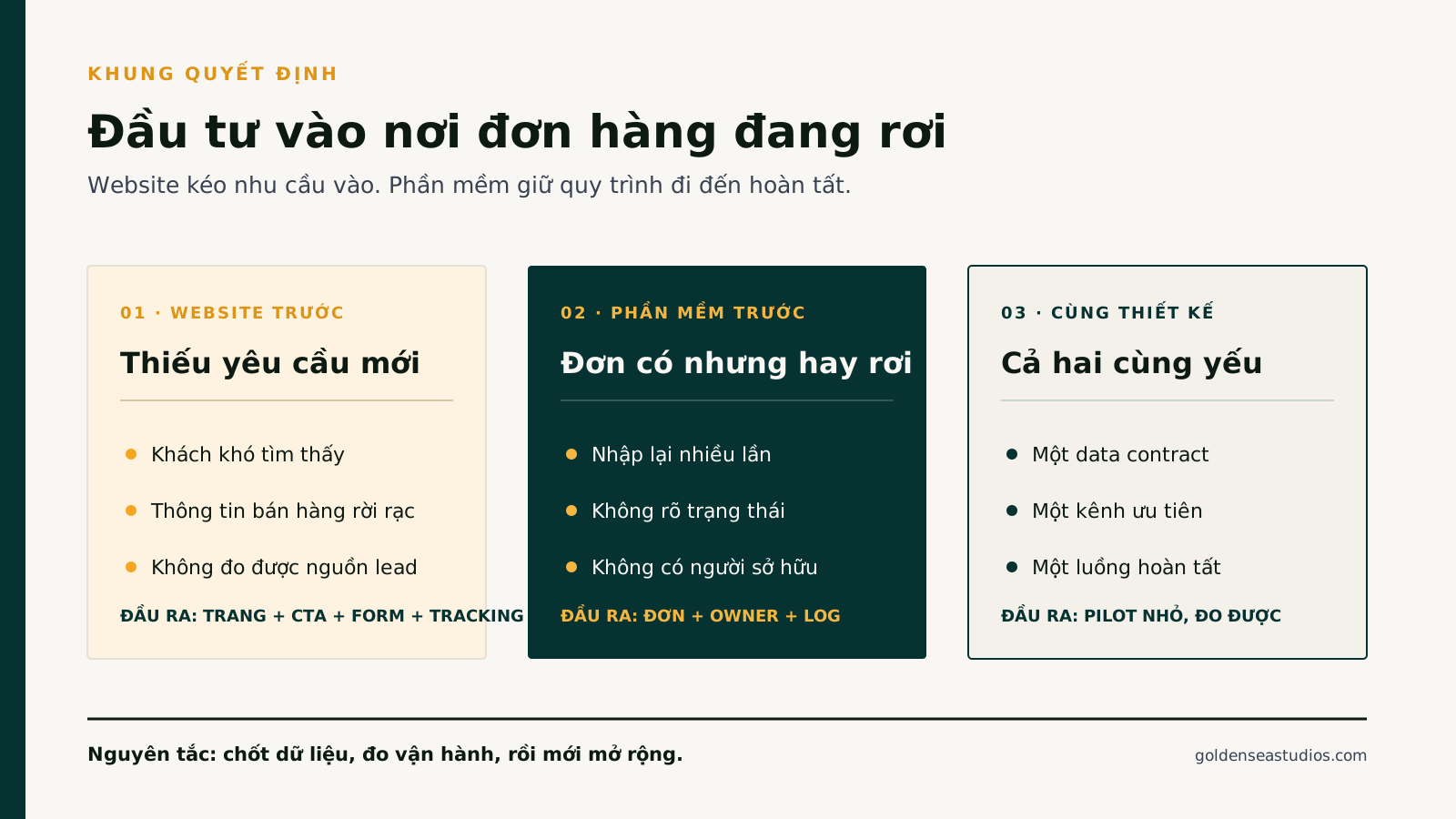

A Vung Tau business should build the website first when the main problem is that customers cannot find, understand, or submit a useful request to the company. It should prioritize order management software when orders already arrive through Facebook, Zalo, phone, or a physical location but staff re-enter data, miss statuses, and cannot see who owns the next action. If both sides are weak, define one shared order data structure and release one measurable workflow rather than building two disconnected systems.
A website and order management software solve different bottlenecks
The website is customer-facing. It helps the business get discovered, explain products or services, build trust, and capture a structured request. Order management software is operational. It keeps the order state from intake through confirmation, payment, preparation, delivery, or service completion.
The two systems can connect, but they cannot replace each other. A polished website does not fix orders lost in group chats. Strong internal software does not create demand when customers cannot find the company or understand how to order. The first decision is to identify whether orders are being lost before or after the customer shares their details.
When should a Vung Tau business build the sales website first?
Prioritize the website when customers repeatedly ask for information that should be available without a conversation: product fit, price or quote process, service area, delivery time, returns, and the next contact step. That pattern shows the information layer before the order is incomplete.
- The business has no official URL explaining its products or services.
- Search visitors must message the team to learn basic information.
- The catalog is fragmented across images, PDFs, and old social posts.
- The team cannot measure which page, product, or campaign created an inquiry.
- B2B buyers need capabilities, process, or proof before contacting sales.
The first release does not need to be a large ecommerce platform. For many SMEs, clear product or service pages, a short form, call or Zalo actions, tracking, and a defined response process are enough to test real demand. Golden Sea's website design service starts from the commercial objective and inquiry path rather than a list of visual effects.
When should order management software come first?
Prioritize order software when the business already has demand but lacks one reliable operating state. A customer may appear under several names, the same order may be copied into a notebook, Zalo, and Excel, sales may say it is confirmed while inventory has not received it, and the owner must ask several people to understand what remains open.
- Each channel uses a different order code or no code at all.
- Staff repeatedly copy customer, product, and delivery details.
- New, confirmed, awaiting payment, preparing, delivering, and completed orders are not clearly separated.
- A shift change removes the context needed to continue the work.
- The business cannot trace who changed a price, status, or cancellation.
- End-of-day reporting requires manual consolidation from several files.
Adding a new website at this point may simply send more demand into a broken process. A better first step is to standardize the order record and state model, then build a small order-management MVP. Golden Sea's app and web development service fits cases where business logic, permissions, or integrations exceed what a simple spreadsheet can support.
Quick decision table: where should the first investment go?
| Current signal | Priority | Phase-one output |
|---|---|---|
| Few new inquiries and fragmented product information | Website first | Product/service pages, CTA, form, and tracking |
| Steady orders with omissions and duplicate entry | Order software first | One order list, state model, owner, and history |
| A website exists but forms disappear into a shared inbox | Connect the flow first | Form creates a record and assigns an owner |
| Acquisition and operations are both weak | Design together, release in phases | One data contract, one channel, one product group |
Google explains that search engines understand ecommerce site structure through crawlable links between categories and products, with structured data adding machine-readable context. On the operational side, Odoo's order-handling documentation separates sales orders, delivery orders, and invoices. These sources do not require an SME to adopt a specific platform. They illustrate why the public storefront and internal operations need distinct structures connected by reliable data.
What should a minimum order record contain?
Before choosing technology, agree on the smallest useful order record. This data contract lets the website, Zalo, sales team, inventory, and delivery operation speak the same language.
- Order ID and source: website, Facebook, Zalo, phone, or in-store.
- Customer: name, preferred contact channel, and only the fulfillment details that are needed.
- Need: product, variant, quantity, or service scope.
- State: a finite list with a completion definition for each step.
- Owner: the person accountable for the next action.
- Timestamps: creation, last update, and response deadline.
- Exceptions: stock shortage, address change, price approval, return, or cancellation.
- History: who changed important fields and why.
Not every order step needs AI. Deterministic rules should handle required fields, state changes, and notifications. AI is more useful for reading free text, summarizing conversations, or suggesting classification. Pricing, commitments, and high-impact exceptions still need authorized human approval. The guide to order automation with logs and approval explains this boundary in more detail.
If both systems are needed, release one vertical slice
Building both does not mean signing two large projects at once. A useful slice can cover one product group, one intake channel, and one completion point. For example, a customer sees a product on the website and submits a request; the system creates an ID; one employee confirms it; inventory updates the state; and the owner sees all unfinished work.
- Review the latest 20–30 orders to find repeated entry, long waits, and common exceptions.
- Choose a baseline such as incomplete orders, time to first confirmation, or orders without an owner.
- Define the data contract and state list before designing screens.
- Release the website page or form for one priority need.
- Connect that form to the order list without automating every decision.
- Run briefly alongside the old process, review errors, and expand only after the flow is stable.
How should SEO and GEO connect to product data?
A sales website needs product or service pages reachable through real links, indexable main content, unique titles and descriptions, accurate image alt text, and consistent information. If a page supports direct purchase, Product and Offer structured data must match the visible price, availability, and offer. Do not mark up information that users cannot see.
For AI search, concise answer blocks, descriptive headings, comparison tables, and FAQs make passages easier to extract. GEO cannot compensate for an inaccurate catalog or delayed stock updates. Keep one product source of truth, then let the public website and internal order system read only the fields each needs. This is where search meets operations: public information helps buyers make a decision, while internal data enables the team to fulfill the promise.
Three mistakes that make the project cost twice
- Building from a feature list: website, CRM, inventory, accounting, and AI are grouped into one quote without selecting the first workflow.
- Creating two data sources: the website shows one price, the internal file another, and staff must reconcile both manually.
- Measuring screens instead of operations: more pages and dashboards do not prove that orders move with clearer ownership.
A small system with ownership, state, and history is often more useful than a broad platform that nobody maintains. If the team currently uses Zalo and Excel for customer records, the Vung Tau customer-management app decision guide adds a framework for choosing no-code, automation, or a custom app.
How Golden Sea approaches the problem in the Vung Tau market
Golden Sea does not assume every business needs custom software. The first step is to audit one live flow: where customers come from, where data is recorded, who receives it, what completion means, and which error creates the most work. That evidence determines whether the team should improve the website, connect existing tools, or build an app.
The first scope may be a lead-generating website, one order-management screen, basic permissions, an audit log, and the necessary report. If AI is included, it receives only tasks that can be checked. Golden Sea's AI Automation service follows process and data; it is not a reason to enlarge the project beyond the actual need.
Conclusion
The answer is not that a website or order system is universally more important. The website solves discovery and inquiry creation; order software solves intake and completion. Invest first where the business loses the most orders, while designing the data so the other side can connect later. For a Vung Tau business, a small slice that can be measured and used every day is a stronger foundation than a long, all-at-once rebuild.