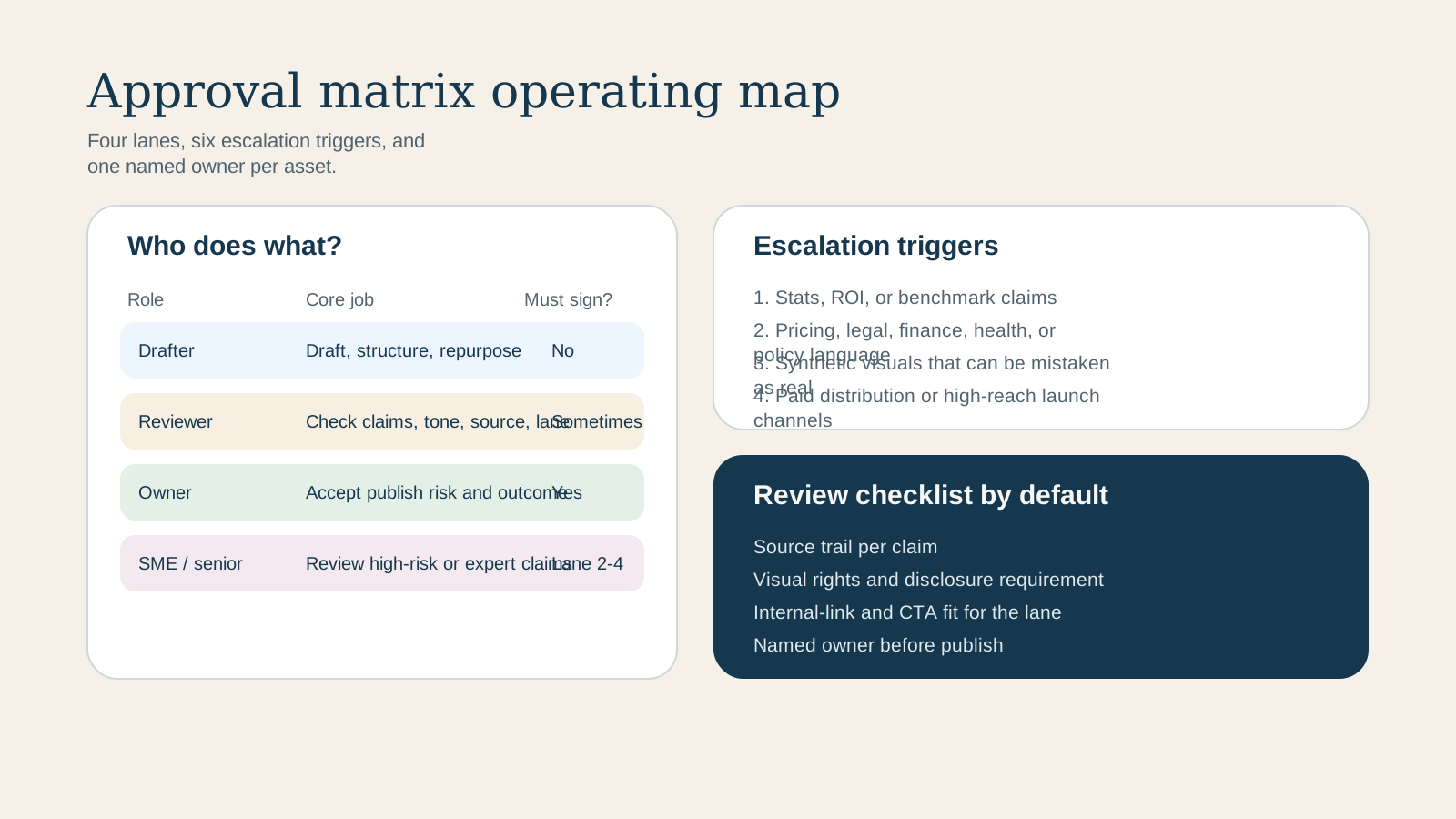

Short answer: Once AI is inside your content workflow, a single-step approval model like 'the marketing manager checks everything' stops working. You need a matrix that separates what AI may only draft, what requires editor or subject-matter review, what must stay human-led, and who is accountable when a claim, visual, or disclosure goes wrong. The July 20-23, 2026 signal set shows this is now an operations problem, not a tooling preference.
Golden Sea's operating view: AI should accelerate research, drafting, and repurposing, but the authority to publish and the responsibility for claims, context, legal exposure, and brand trust must stay attached to a real person, not to a prompt.
Why move this topic up right now?
On July 20, 2026, the European Commission updated both the Code of Practice and the Guidelines for Article 50 of the EU AI Act. The official materials make two points that matter immediately: the transparency obligations apply from August 2, 2026, and beyond machine-readable marking for AI-generated or manipulated content, deployers must pay attention to text publications on matters of public interest when they do not undergo human review and editorial control. That is a regulatory fact from primary sources, not market interpretation.
Platform behavior is moving in the same direction. On July 10, 2026, TikTok said it had labeled more than 3 billion AIGC videos and was improving detection against accounts dedicated to AI-generated spam in areas that could affect public trust or well-being, including politics, finance, and medical topics. On July 21, 2026, Substack introduced Scan for AI text so readers can estimate how much of a post was human-written or AI-assisted, and gave writers a place to explain how they used AI. X's July 2026 Media Literacy Action Plan also says the platform has expanded 'Made with AI' labels for manipulated and AI-generated media. YouTube, for its part, has already shifted its monetization language from 'repetitious content' to 'inauthentic content' and continues to require disclosure when AI-generated or altered content looks realistic.
Vietnam is not outside this shift. LuatVietnam's English legal update says the 2025 Artificial Intelligence Law took effect on March 1, 2026 and requires AI-generated images and videos to be labelled in an easily recognizable manner. Znews then provided a concrete local example on July 17, 2026: a book-selling video that appeared AI-generated reportedly showed the wrong title and misleading product details, which immediately turned the discussion toward accountability. From a content-operations perspective, that is the real issue. The failure is no longer just that content 'sounds AI-written'; it is that incorrect content can still pass through a workflow.
Qualitative community research supports the same conclusion. A recent Reddit discussion in r/DigitalMarketing argues that agencies are still treating Article 50 as a visible checkbox, while machine-readable disclosure is more technical than that. On Indie Hackers, the founder building an AI-powered bilingual newsroom ends up asking the same question that SMEs should ask: will readers trust a transparent, human-reviewed editorial workflow? I also scanned Hacker News and X for language patterns and operator concerns, but I treat them as qualitative context only. The article's factual claims are anchored to official or large-publisher sources.
What is an approval matrix, really?
An approval matrix is not just a sign-off table at the end. It is a way to distribute authority across content types using two axes: claim risk and distribution irreversibility. A lightweight LinkedIn teaser and an AI-assisted product video with a shopping cart may both use AI, but the cost of being wrong is not the same. If they share one review lane, the business will either move too slowly or take on avoidable risk.
Golden Sea usually recommends four lanes instead of one shared lane. Those lanes do not depend on which model you use. They depend on whether the asset contains concrete claims, touches pricing or sensitive policy, requires disclosure, and creates expensive cleanup if it is wrong.
| Lane | What AI may do | Who reviews | Typical use |
|---|---|---|---|
| Lane 1: Draft support | Research, outline, first draft, repurposing | Content editor or content ops | Search blog posts, social teasers, lower-risk nurture email |
| Lane 2: Expert-reviewed | Draft plus suggested visuals or FAQs | Editor plus domain reviewer | Service-linked playbooks, comparison pieces, data-backed guidance |
| Lane 3: Human-led with AI assist | Source summaries, structure suggestions, consistency checks | Marketing lead | Landing pages, paid ads, pricing notes, ROI-sensitive claims |
| Lane 4: Human-only or disclosure-first | Back-office support only, such as transcription or tagging | Senior owner or founder | Public-interest content, crisis messaging, high-risk synthetic media, executive statements |
The higher the lane, the more you need an audit trail: which source was used, what the model produced, what a human changed, who approved it, and which version went live. Without that trail, a business does not really have editorial control. It only has the feeling that someone glanced at the work.
AI drafts, but who reviews and who owns the outcome?
Many teams stop at saying 'AI is just a tool.' That statement is true but not operationally useful if the workflow never binds accountability to a person. For SMEs, you do not need enterprise RACI theater. But you do need at least three roles: drafter, reviewer, and owner. The owner is not necessarily the person who writes the most. The owner is the person whose name comes up first when a claim, brand message, or disclosure fails.
| Content type | Drafter | Reviewer | Final owner |
|---|---|---|---|
| Informational SEO or GEO blog post | AI plus content ops | Editor | Marketing lead |
| Service playbook or comparison | AI plus writer | Editor plus service lead | Service owner |
| Landing page, ad copy, pricing note | Writer or marketer using AI assist | Marketing lead | Founder or revenue owner |
| AI-assisted image or video for a public campaign | Designer or content ops | Brand reviewer | Campaign owner |
| Policy, health, finance, or other sensitive subject | Human primary author | Subject-matter or legal reviewer | Senior owner |
This looks heavier than it is. In practice it makes teams faster because low-risk work stops waiting for senior review, while high-risk work stops slipping through casual approval. That is the difference between content slop and a durable workflow: slop optimizes output speed; a real workflow optimizes decision speed while preserving responsibility.
Which assets should jump lanes immediately?
A good approval matrix defines the default path, but it also defines escalation triggers. Golden Sea recommends hard-coding at least six:
- There is a statistic, benchmark, or performance promise.
- The content touches pricing, policy, legal interpretation, finance, health, or other advice-like territory.
- The visual or media could reasonably be mistaken for a real person, place, or event.
- The asset will run in paid distribution or large-scale public channels where cleanup costs exceed review costs.
- The piece is repurposed from many sources and claims are hard to trace back.
- The topic is emotionally sensitive, complaint-related, or reputationally charged.
If any one of those triggers is present, do not process the asset as filler content. Raise the lane, raise the reviewer bar, and raise the requirement for traceability.
A 30-day playbook for SMEs building the matrix
| Week | What to do | Minimum output |
|---|---|---|
| Week 1 | List every content type currently produced: blog, social, ads, email, video, visuals, chatbot snippets. | A content inventory plus the person currently creating each type. |
| Week 2 | Map each type into four lanes using claim risk and distribution risk; define escalation triggers. | Approval matrix v1. |
| Week 3 | Standardize per-lane checklists for sources, brand voice, disclosure, internal links, CTA, visual rights, and version notes. | Separate checklists for each lane, not one universal checklist. |
| Week 4 | Run the system on 5-10 live assets and log where the matrix is too loose or too heavy. | A revision log, turnaround time, and number of issues blocked before publication. |
During the first 30 days, do not automate publishing. Automate state changes, source capture, checklist generation, and reviewer reminders first. Once review discipline is stable, then you can accelerate lane 1 and lane 2 safely.
Five mistakes that make the matrix useless
- One reviewer for everything. That creates a bottleneck and still lets high-risk content get shallow review because the reviewer is overloaded.
- No claim-level source logging. A post may have a source list, but nobody can tell which number came from which URL.
- Treating disclosure as decoration. If the team cannot say which asset was AI-generated, AI-assisted, or fully human-edited, it will fail the moment a platform, client, or regulator asks for specifics.
- Confusing draft-first with auto-publish. Those are completely different risk levels.
- No visual owner. Many teams review copy but ignore synthetic images, video, voice, or mockups where trust risk actually lives.
How does this connect to Golden Sea's real service layer?
Automation Operations is not just about producing more content faster. If the Auto-Content module creates outputs while the business cannot say who reviewed them, which visual needs a label, or which claim required human verification, then automation is accelerating risk rather than throughput. That is why the approval matrix sits between the draft engine and the publishing engine as a required operating layer.
This also connects naturally to Golden Sea's existing cluster on fragmented data, AI customer-service QA, and building an AI content engine. They all point to the same operating truth: AI only creates leverage when workflow, ownership, source control, and review loops already exist.
Conclusion
An approval matrix for AI content is not bureaucracy designed to slow a marketing team down. It is the cheapest way to avoid the three most expensive failures: publishing inaccurate claims, losing trust on distribution platforms, and not knowing who must step in when something goes wrong. For most SMEs, four lanes, six escalation triggers, and three clear roles are enough to move from 'anyone can publish if it looks okay' to a workflow that is actually defensible.
Read next: Building an AI content engine · How fragmented data makes business AI go blind · Why businesses buy outcomes, not AI agents · How to evaluate an AI automation partner · AI customer service QA checklist