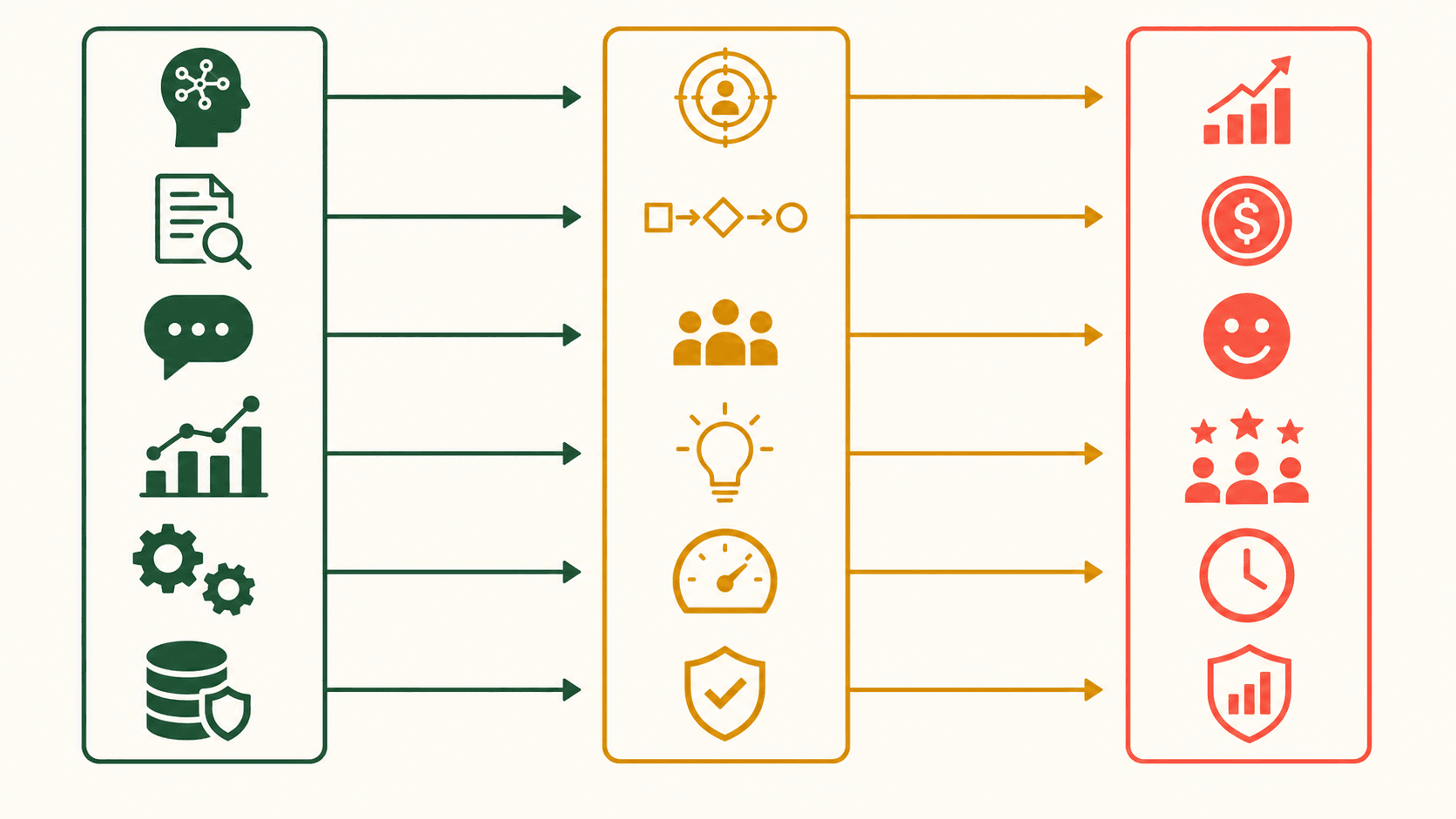

Short answer: B2B buyers evaluate outcomes, risk and adoption. Translate AI features into an operating offer that is clear and credible. Recent Reddit discussions suggest operators care more about repetitive work, reliability and implementation than technology labels. Reddit is qualitative research, not a representative SME sample, so these concerns frame questions rather than market statistics.
Guiding principle: start with observable leakage, design human control and expand only when evidence shows the workflow outperforms the old process.
Features do not create value by themselves
A strong model, many integrations and fast responses remain capabilities until they change an operating metric. Value should tie back to a concrete outcome such as saved leads, lower SLA risk, higher throughput or fewer mistakes, not just the feeling of less work.
The risk to confront
Long feature lists make it hard to picture a changed workday. The risk is converting benefits into money too optimistically, even when the team has no proven habit of turning saved time into better work.
Recommended action
Map feature to capability to workflow to outcome. Attach each benefit to a metric that can be checked after the pilot, such as response time, lead retention or hours saved and redeployed elsewhere.
Buyers purchase confidence
SME owners need ownership, failure handling and time to first evidence. Value should tie back to a concrete outcome such as saved leads, lower SLA risk, higher throughput or fewer mistakes, not just the feeling of less work.
The risk to confront
Claiming AI does everything increases anxiety rather than reducing friction. The risk is converting benefits into money too optimistically, even when the team has no proven habit of turning saved time into better work.
Recommended action
Sell a clear scope, pilot and decision gate. Attach each benefit to a metric that can be checked after the pilot, such as response time, lead retention or hours saved and redeployed elsewhere.
Outcomes must be measurable
Improve efficiency is vague; reduce time to first response has a baseline and owner. Value should tie back to a concrete outcome such as saved leads, lower SLA risk, higher throughput or fewer mistakes, not just the feeling of less work.
The risk to confront
Unmeasurable outcomes turn projects into subjective debates. The risk is converting benefits into money too optimistically, even when the team has no proven habit of turning saved time into better work.
Recommended action
Choose one leading metric and one business metric. Attach each benefit to a metric that can be checked after the pilot, such as response time, lead retention or hours saved and redeployed elsewhere.
Adoption is part of the product
A workflow creates value only when employees trust, understand and use the new path. Value should tie back to a concrete outcome such as saved leads, lower SLA risk, higher throughput or fewer mistakes, not just the feeling of less work.
The risk to confront
Good technology that requires duplicate entry will be abandoned. The risk is converting benefits into money too optimistically, even when the team has no proven habit of turning saved time into better work.
Recommended action
Design inside existing tools and reduce user steps. Attach each benefit to a metric that can be checked after the pilot, such as response time, lead retention or hours saved and redeployed elsewhere.
A proof hierarchy matters
A demo proves possibility; a pilot proves fit; production evidence proves durability. Value should tie back to a concrete outcome such as saved leads, lower SLA risk, higher throughput or fewer mistakes, not just the feeling of less work.
The risk to confront
Presenting a demo as a case study creates false expectations. The risk is converting benefits into money too optimistically, even when the team has no proven habit of turning saved time into better work.
Recommended action
Label assumptions, experiments and real results clearly. Attach each benefit to a metric that can be checked after the pilot, such as response time, lead retention or hours saved and redeployed elsewhere.
A good offer describes the operating model
Buyers need to understand data flow, AI actions, human approvals and reporting. Value should tie back to a concrete outcome such as saved leads, lower SLA risk, higher throughput or fewer mistakes, not just the feeling of less work.
The risk to confront
Pricing without scope makes vendor comparison unreliable. The risk is converting benefits into money too optimistically, even when the team has no proven habit of turning saved time into better work.
Recommended action
Package discovery, setup, pilot, operation and optimization. Attach each benefit to a metric that can be checked after the pilot, such as response time, lead retention or hours saved and redeployed elsewhere.
Decision checklist
- Does the problem occur frequently enough and cause visible loss?
- Are inputs, outputs, owners and exceptions documented?
- Is there a system of record and least-privilege access?
- Are human gates, logs and rollback defined?
- Will baseline and pilot results use the same measurement?
Conclusion
Why Businesses Buy Outcomes, Not AI Agents becomes an advantage only when the business has discipline around data, ownership and measurement. The better starting question is not which AI to buy, but which workflow deserves redesign first. Golden Sea approaches Automation Operations as audit, standardize, pilot, measure and scale—with AI assisting and humans retaining authority over consequential decisions.
Continue with: Businesses Do Not Need an AI Agent — They Need Less Leakage · Why AI Automation Creates More Work Instead of Less · Is AI Automation Really Worth the Cost for an SME?