
Short answer: AI automation can amplify messy processes, poor data and unclear ownership. Seven causes and a practical recovery plan. Recent Reddit discussions suggest operators care more about repetitive work, reliability and implementation than technology labels. Reddit is qualitative research, not a representative SME sample, so these concerns frame questions rather than market statistics.
Guiding principle: start with observable leakage, design human control and expand only when evidence shows the workflow outperforms the old process.
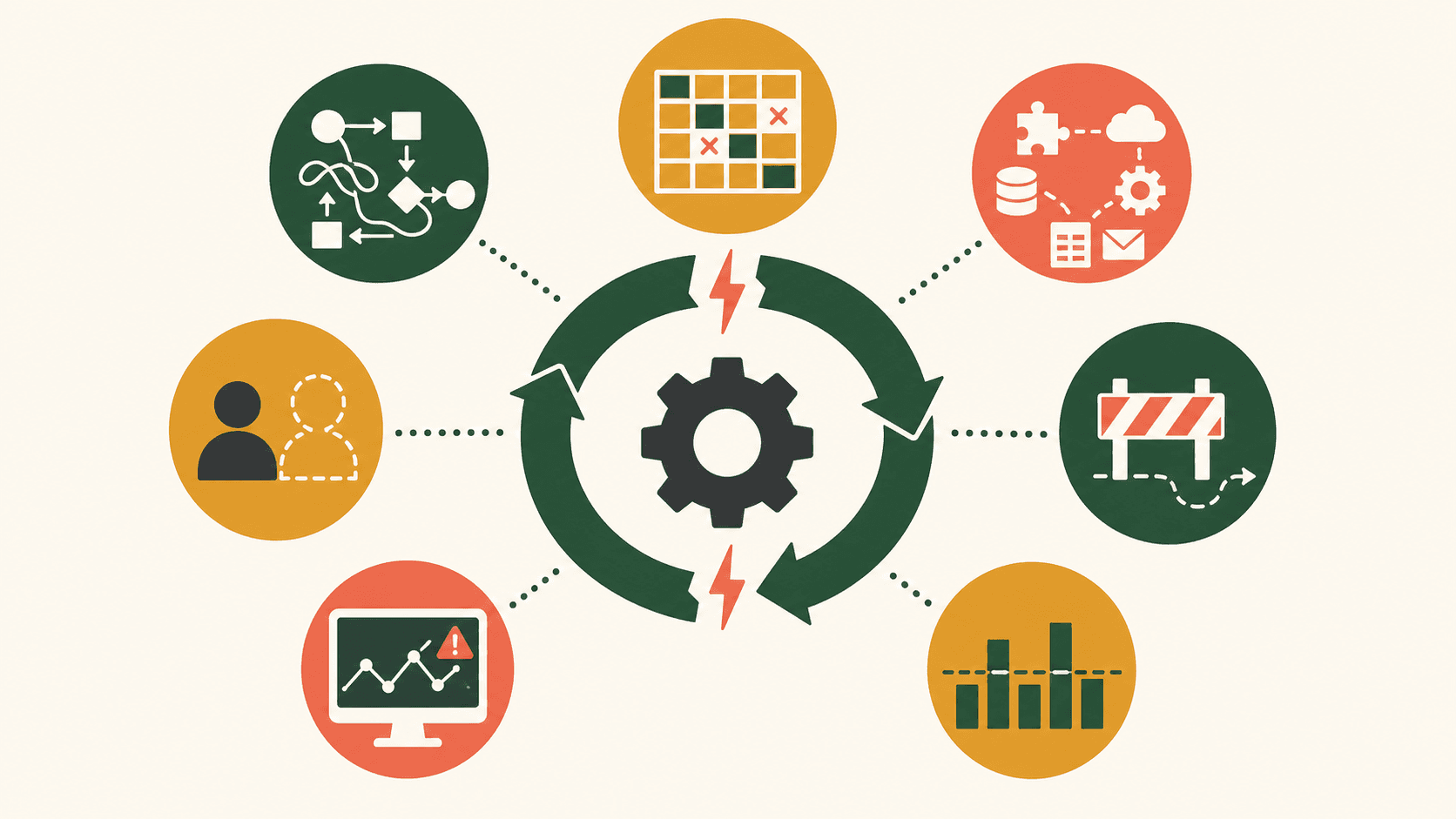
The original process is already messy
Faster automation is not better automation. If every employee handles a case differently, the system merely scales inconsistency. The right sequence is usually standardize first and automate second, because automation only scales what already exists in the process.
The risk to confront
Errors become harder to notice because they occur faster and at greater scale. The risk is automating a process with unclear ownership, unclear exceptions and unclear measurement, then scaling disorder instead of control.
Recommended action
Observe the real process before drawing the ideal flow. Map the process, remove unnecessary steps, standardize the inputs and only then add automation to the last layer.
Data lacks a source of truth
CRM, spreadsheets and inboxes often contain three different versions of the same customer. The right sequence is usually standardize first and automate second, because automation only scales what already exists in the process.
The risk to confront
AI cannot decide which record is authoritative without ownership and update rules. The risk is automating a process with unclear ownership, unclear exceptions and unclear measurement, then scaling disorder instead of control.
Recommended action
Choose a system of record and synchronization rules before connecting a model. Map the process, remove unnecessary steps, standardize the inputs and only then add automation to the last layer.
Tool sprawl creates an integration tax
Every new tool adds accounts, permissions, webhooks, bills and maintenance points. The right sequence is usually standardize first and automate second, because automation only scales what already exists in the process.
The risk to confront
A small API change can stop the chain with no clear place to investigate. The risk is automating a process with unclear ownership, unclear exceptions and unclear measurement, then scaling disorder instead of control.
Recommended action
Reduce the stack to the minimum components needed for one outcome. Map the process, remove unnecessary steps, standardize the inputs and only then add automation to the last layer.
No accountable owner
Cross-functional workflows fail when everyone uses them but nobody owns definitions, changes and output quality. The right sequence is usually standardize first and automate second, because automation only scales what already exists in the process.
The risk to confront
When errors occur, tickets bounce among marketing, sales and engineering. The risk is automating a process with unclear ownership, unclear exceptions and unclear measurement, then scaling disorder instead of control.
Recommended action
Assign a process owner with decision rights and a technical owner with repair rights. Map the process, remove unnecessary steps, standardize the inputs and only then add automation to the last layer.
Exceptions have no designed path
Rare but consequential cases should not be forced through the happy path. The right sequence is usually standardize first and automate second, because automation only scales what already exists in the process.
The risk to confront
An AI forced to finish everything may invent answers, make unauthorized promises or update the wrong record. The risk is automating a process with unclear ownership, unclear exceptions and unclear measurement, then scaling disorder instead of control.
Recommended action
Define stop conditions, an escalation packet and a takeover SLA. Map the process, remove unnecessary steps, standardize the inputs and only then add automation to the last layer.
No baseline or monitoring
Without before-and-after measurement, teams know the system is busy but not whether it creates value. The right sequence is usually standardize first and automate second, because automation only scales what already exists in the process.
The risk to confront
Silent failures accumulate until a customer complains. The risk is automating a process with unclear ownership, unclear exceptions and unclear measurement, then scaling disorder instead of control.
Recommended action
Monitor volume, latency, completion, exceptions and error rate on one dashboard. Map the process, remove unnecessary steps, standardize the inputs and only then add automation to the last layer.
Decision checklist
- Does the problem occur frequently enough and cause visible loss?
- Are inputs, outputs, owners and exceptions documented?
- Is there a system of record and least-privilege access?
- Are human gates, logs and rollback defined?
- Will baseline and pilot results use the same measurement?
Conclusion
Why AI Automation Creates More Work Instead of Less becomes an advantage only when the business has discipline around data, ownership and measurement. The better starting question is not which AI to buy, but which workflow deserves redesign first. Golden Sea approaches Automation Operations as audit, standardize, pilot, measure and scale—with AI assisting and humans retaining authority over consequential decisions.
Continue with: Businesses Do Not Need an AI Agent — They Need Less Leakage · Is AI Automation Really Worth the Cost for an SME? · Five AI Workflows That Still Create Value After 90 Days