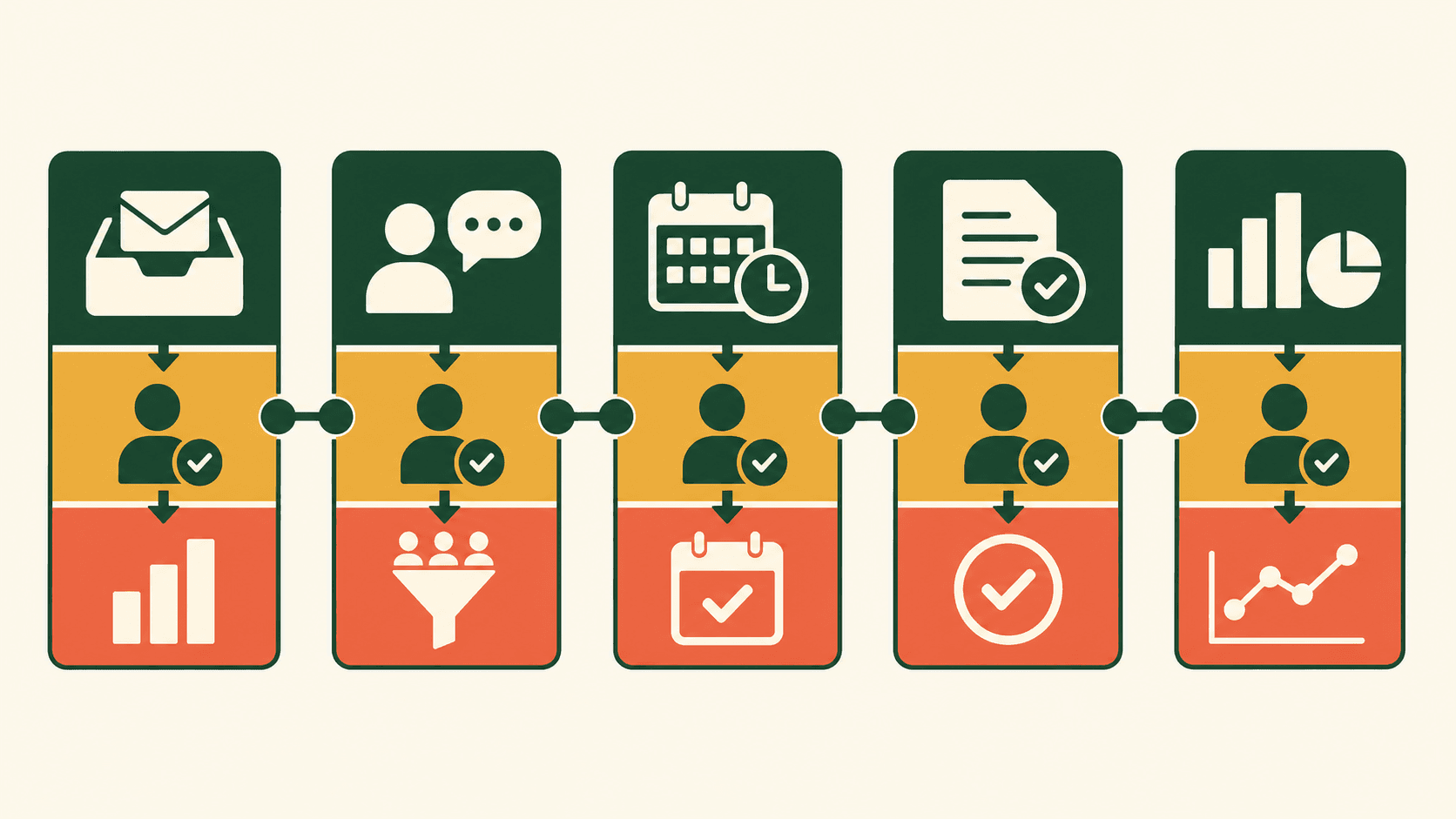

Short answer: Five durable SME workflows for inbox, follow-up, booking, approved content and reporting, with metrics and failure modes. Recent Reddit discussions suggest operators care more about repetitive work, reliability and implementation than technology labels. Reddit is qualitative research, not a representative SME sample, so these concerns frame questions rather than market statistics.
Guiding principle: start with observable leakage, design human control and expand only when evidence shows the workflow outperforms the old process.
Inbox triage and routing
AI classifies intent, urgency and basic facts to route conversations into the right queue. The baseline should separate volume, waiting time, error rate and handoff friction so the team can see what automation actually changes.
The risk to confront
Answering everything increases risk; durable value often comes from classification and context preparation. The risk is converting benefits into money too optimistically, even when the team has no proven habit of turning saved time into better work.
Recommended action
Measure time to first response, routing accuracy and reassignments. Attach each benefit to a metric that can be checked after the pilot, such as response time, lead retention or hours saved and redeployed elsewhere.
Conditional lead follow-up
The workflow follows up with the right person at the right time based on status, not a rigid sequence. The baseline should separate volume, waiting time, error rate and handoff friction so the team can see what automation actually changes.
The risk to confront
Over-messaging damages trust and increases opt-outs. The risk is converting benefits into money too optimistically, even when the team has no proven habit of turning saved time into better work.
Recommended action
Set frequency caps, stop conditions and a send-reason log. Attach each benefit to a metric that can be checked after the pilot, such as response time, lead retention or hours saved and redeployed elsewhere.
Booking and reminders
Booking has clear inputs, rules and outcomes, making it easier to test than creative work. The baseline should separate volume, waiting time, error rate and handoff friction so the team can see what automation actually changes.
The risk to confront
Wrong time zones, services or assignees create poor experiences. The risk is converting benefits into money too optimistically, even when the team has no proven habit of turning saved time into better work.
Recommended action
Use two-way calendar sync and preserve a human rescheduling path. Attach each benefit to a metric that can be checked after the pilot, such as response time, lead retention or hours saved and redeployed elsewhere.
Approved content drafting
AI combines briefs, sources and templates into drafts while humans retain authority over claims, voice and publication. The baseline should separate volume, waiting time, error rate and handoff friction so the team can see what automation actually changes.
The risk to confront
Publishing unchecked output creates consistency at the expense of brand depth. The risk is converting benefits into money too optimistically, even when the team has no proven habit of turning saved time into better work.
Recommended action
Track brief-to-approval time, major-revision rate and claim errors. Attach each benefit to a metric that can be checked after the pilot, such as response time, lead retention or hours saved and redeployed elsewhere.
Data reconciliation and reporting
The workflow collects defined system data, flags discrepancies and produces reports consistently each cycle. The baseline should separate volume, waiting time, error rate and handoff friction so the team can see what automation actually changes.
The risk to confront
A polished dashboard cannot rescue incorrect source data. The risk is converting benefits into money too optimistically, even when the team has no proven habit of turning saved time into better work.
Recommended action
Assign an owner to every metric and link back to source records. Attach each benefit to a metric that can be checked after the pilot, such as response time, lead retention or hours saved and redeployed elsewhere.
Why these workflows endure
They recur frequently, produce observable outputs, contain handoffs and support before-and-after measurement. The baseline should separate volume, waiting time, error rate and handoff friction so the team can see what automation actually changes.
The risk to confront
Flashy but infrequent workflows quickly lose ownership and budget. The risk is converting benefits into money too optimistically, even when the team has no proven habit of turning saved time into better work.
Recommended action
Prioritize pain, frequency and measurability—not technological novelty. Attach each benefit to a metric that can be checked after the pilot, such as response time, lead retention or hours saved and redeployed elsewhere.
Decision checklist
- Does the problem occur frequently enough and cause visible loss?
- Are inputs, outputs, owners and exceptions documented?
- Is there a system of record and least-privilege access?
- Are human gates, logs and rollback defined?
- Will baseline and pilot results use the same measurement?
Conclusion
Five AI Workflows That Still Create Value After 90 Days becomes an advantage only when the business has discipline around data, ownership and measurement. The better starting question is not which AI to buy, but which workflow deserves redesign first. Golden Sea approaches Automation Operations as audit, standardize, pilot, measure and scale—with AI assisting and humans retaining authority over consequential decisions.
Continue with: Businesses Do Not Need an AI Agent — They Need Less Leakage · Why AI Automation Creates More Work Instead of Less · Is AI Automation Really Worth the Cost for an SME?