Short answer: 80/20 is a design heuristic, not a universal ratio. Use risk and confidence to build a safe human-in-the-loop system. Recent Reddit discussions suggest operators care more about repetitive work, reliability and implementation than technology labels. Reddit is qualitative research, not a representative SME sample, so these concerns frame questions rather than market statistics.
Guiding principle: start with observable leakage, design human control and expand only when evidence shows the workflow outperforms the old process.
80/20 is a heuristic
The ratio reminds teams not to force AI through every exception; the real split must be measured per workflow. The real question is where AI may run on its own and where a human gate is still mandatory, not how neatly the work can be split into a fixed 80/20 rule.
The risk to confront
Turning 80% into a hard KPI encourages unsafe containment. The risk is giving too much autonomy to the machine where judgment still matters, or keeping people in every step and making automation pointless.
Recommended action
Start conservatively and expand autonomy when evaluation supports it. Design the human gate up front: what the AI may do alone, what must be approved, and what must be logged for traceability.
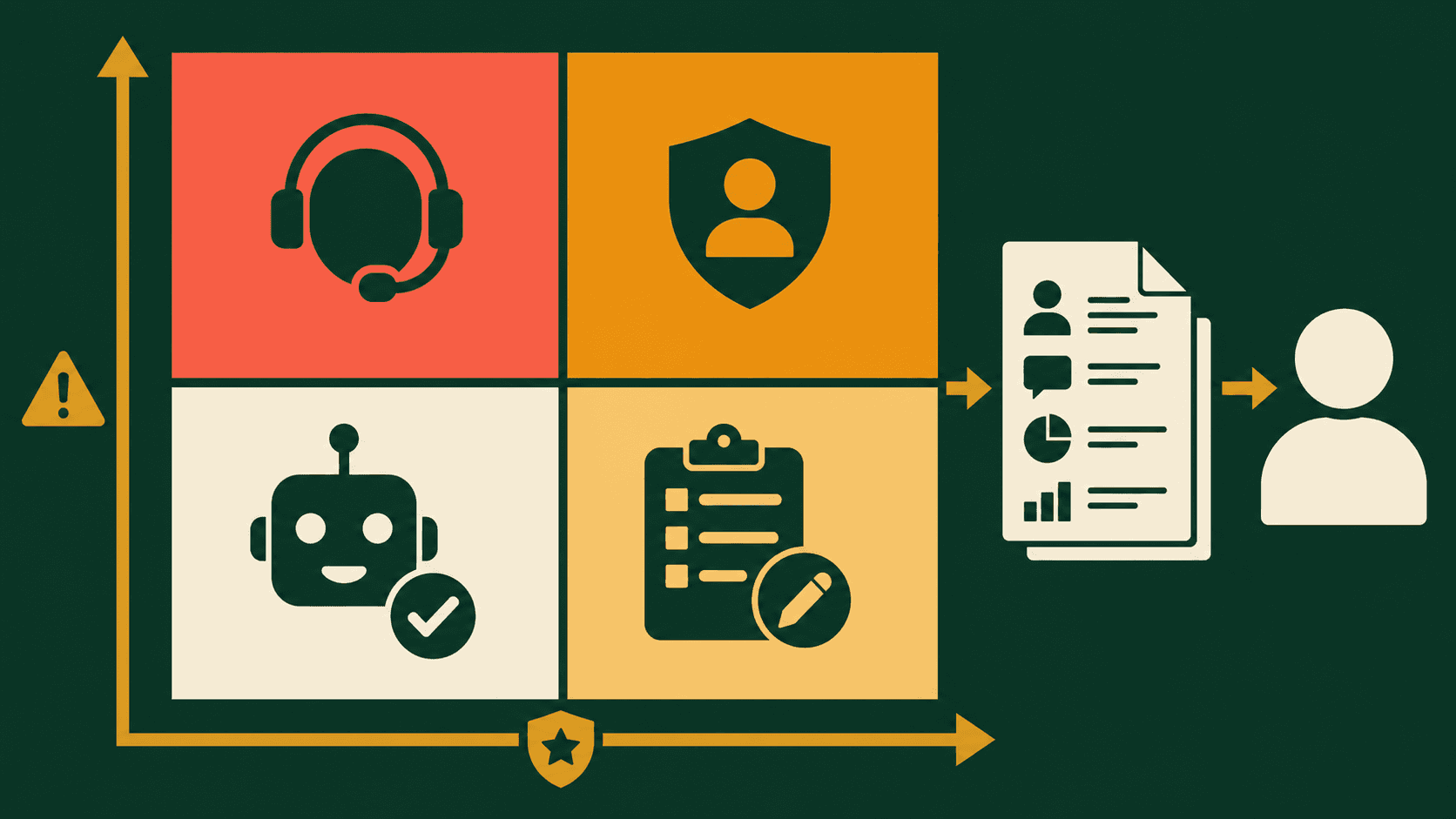
The risk-by-confidence matrix
Confidence estimates certainty; risk estimates consequences when wrong. The real question is where AI may run on its own and where a human gate is still mandatory, not how neatly the work can be split into a fixed 80/20 rule.
The risk to confront
Confidence alone ignores action sensitivity. The risk is giving too much autonomy to the machine where judgment still matters, or keeping people in every step and making automation pointless.
Recommended action
Use auto, auto-and-log, approval and human-only zones. Design the human gate up front: what the AI may do alone, what must be approved, and what must be logged for traceability.
The human gate must not become a new bottleneck
If every case waits for one approver, the queue merely moves from inbox to a dashboard. The real question is where AI may run on its own and where a human gate is still mandatory, not how neatly the work can be split into a fixed 80/20 rule.
The risk to confront
Long approval SLAs erase automation's speed advantage. The risk is giving too much autonomy to the machine where judgment still matters, or keeping people in every step and making automation pointless.
Recommended action
Delegate by risk tier and use batch approval for low-risk cases. Design the human gate up front: what the AI may do alone, what must be approved, and what must be logged for traceability.
The context packet determines takeover speed
The reviewer needs the situation, actions taken, sources used and pending decision. The real question is where AI may run on its own and where a human gate is still mandatory, not how neatly the work can be split into a fixed 80/20 rule.
The risk to confront
Missing context forces the reviewer to redo the work. The risk is giving too much autonomy to the machine where judgment still matters, or keeping people in every step and making automation pointless.
Recommended action
Standardize summary, evidence, recommendation and audit trail. Design the human gate up front: what the AI may do alone, what must be approved, and what must be logged for traceability.
Measure human and machine quality
Review correction rate shows model gaps; takeover time shows escalation quality. The real question is where AI may run on its own and where a human gate is still mandatory, not how neatly the work can be split into a fixed 80/20 rule.
The risk to confront
Containment-only metrics reward keeping cases rather than resolving them correctly. The risk is giving too much autonomy to the machine where judgment still matters, or keeping people in every step and making automation pointless.
Recommended action
Track accuracy, severity, correction, takeover and customer outcome. Design the human gate up front: what the AI may do alone, what must be approved, and what must be logged for traceability.
Expand autonomy with evidence
Autonomy should expand by proven intent, not globally. The real question is where AI may run on its own and where a human gate is still mandatory, not how neatly the work can be split into a fixed 80/20 rule.
The risk to confront
A model update can change behavior in untested areas. The risk is giving too much autonomy to the machine where judgment still matters, or keeping people in every step and making automation pointless.
Recommended action
Version prompts, evaluations and policies with clear rollback. Design the human gate up front: what the AI may do alone, what must be approved, and what must be logged for traceability.
Decision checklist
- Does the problem occur frequently enough and cause visible loss?
- Are inputs, outputs, owners and exceptions documented?
- Is there a system of record and least-privilege access?
- Are human gates, logs and rollback defined?
- Will baseline and pilot results use the same measurement?
Conclusion
Automate 80%, Route the Remaining 20% to a Human becomes an advantage only when the business has discipline around data, ownership and measurement. The better starting question is not which AI to buy, but which workflow deserves redesign first. Golden Sea approaches Automation Operations as audit, standardize, pilot, measure and scale—with AI assisting and humans retaining authority over consequential decisions.
Continue with: Businesses Do Not Need an AI Agent — They Need Less Leakage · Why AI Automation Creates More Work Instead of Less · Is AI Automation Really Worth the Cost for an SME?