Short answer: If an SME plans to let AI handle inbox, email, or lead follow-up, the first step is not choosing a stronger model. It is building a clear QA checklist. Signals from Microsoft, Salesforce, and Zendesk in July 2026 suggest the market is moving from flashy agent demos toward quality review, trusted data, and evaluation frameworks. Reddit is used here only as qualitative research to understand pain points, not as market statistics.
Guiding principle: let AI handle only the work that has clear right-or-wrong criteria, sufficiently clean data, and a well-defined human handoff path.
Why a QA checklist is no longer optional
Early July 2026 signals from major vendors are unusually aligned. Microsoft Learn describes a Quality Evaluation Agent that can automatically score service cases against business-defined criteria. Microsoft has also extended the same logic to customer emails, including emails written by humans with AI assistance. Zendesk placed “quality review” directly inside its July release notes for Forethought AI agents. Salesforce continues to argue that AI customer service is only as strong as the data behind it, and says 44% of service leaders admit fragmented systems have delayed or limited their AI projects.
This is not proof for every SME market, but it is a strong signal: the conversation is shifting from “can the bot answer?” to “who scores the answer, who owns the risk, and what data is the bot grounded on?”. For Golden Sea, that is the right kind of buyer maturity to serve. Businesses are starting to ask about scorecards, sampling, SLAs, handoff rules, and logs instead of asking only about price or channel coverage.
Another useful data point comes from Microsoft Source Asia: tiket.com says its AI-powered service layer automates up to 87% of customer inquiries, equal to about 65,000 conversations per month, while reporting a CSAT score of 84.6%. The important reading is simple: real service outcomes are the metric that matters. No one buys a bot because it sounds modern. They buy because it increases throughput without breaking the customer experience.
The Vietnamese SME context makes QA even more practical. According to a July 16, 2026 Nhà Đầu Tư article citing VCCI data, around 70% of businesses have capital below VND 10 billion, average profit margins are about 2.2%, and only 37.9% of businesses have reached a medium-or-higher level of digital adoption. When margins are thin and data is still messy, a bot that answers incorrectly or drops a lead is not a small error. It is real revenue leakage.
The 12-point QA checklist before AI touches the front line
| Check | What to verify | Common failure |
|---|---|---|
| 1. Intent scope | Which question types can the bot handle, and which must be routed to humans immediately? | The bot is given a scope so wide that it answers sensitive cases. |
| 2. Knowledge source | Are FAQ, policy, pricing, business hours, and service conditions stored in one authoritative and updated source? | The bot uses outdated or conflicting versions of the truth. |
| 3. Customer context | Does the bot know interaction history, lead status, acquisition channel, and owner? | It replies generically and asks customers to repeat themselves. |
| 4. Policy guardrails | Have you defined what the bot must never promise, assume, or confirm on its own? | The bot commits to pricing, timelines, or policies outside its authority. |
| 5. Handoff trigger | Which cases require escalation: complaints, refunds, vulnerable situations, or low-confidence answers? | Escalation happens too late, or not at all. |
| 6. Lead capture fields | Are name, phone, need, budget, timing, and source captured in the right format? | The conversation happens, but CRM still lacks follow-up data. |
| 7. Follow-up logic | After a missed call or after-hours inquiry, what is sent, when, through which channel, and when should it stop? | Follow-up is too frequent, mistimed, or ownerless. |
| 8. Outbound approval | Do email, quotes, or outbound messages need approval before sending? Who approves? | AI sends text that looks polished but violates policy. |
| 9. QA scorecard | Do you have explicit scoring criteria for accuracy, tone, policy compliance, completeness, and next-step clarity? | You measure response speed but not real quality. |
| 10. Logging and traceability | Do you keep logs of prompts, knowledge sources, actions taken, fields updated, and final outcomes? | No one can explain what the bot saw or why it replied that way. |
| 11. SLA and ownership | Who owns a bot failure, and how fast must a human take over? | Leads get stuck between automation and the sales team. |
| 12. Pilot metrics | Do you already have a baseline and clear go or no-go thresholds? | Decisions are made by gut feel instead of comparison. |
If the business cannot answer at least eight of these twelve questions concretely, it should not turn on full AI at the front line yet. At that point, the real task is not choosing a bot. It is standardizing data, accountability, and human intervention thresholds.
A simple 100-point scorecard
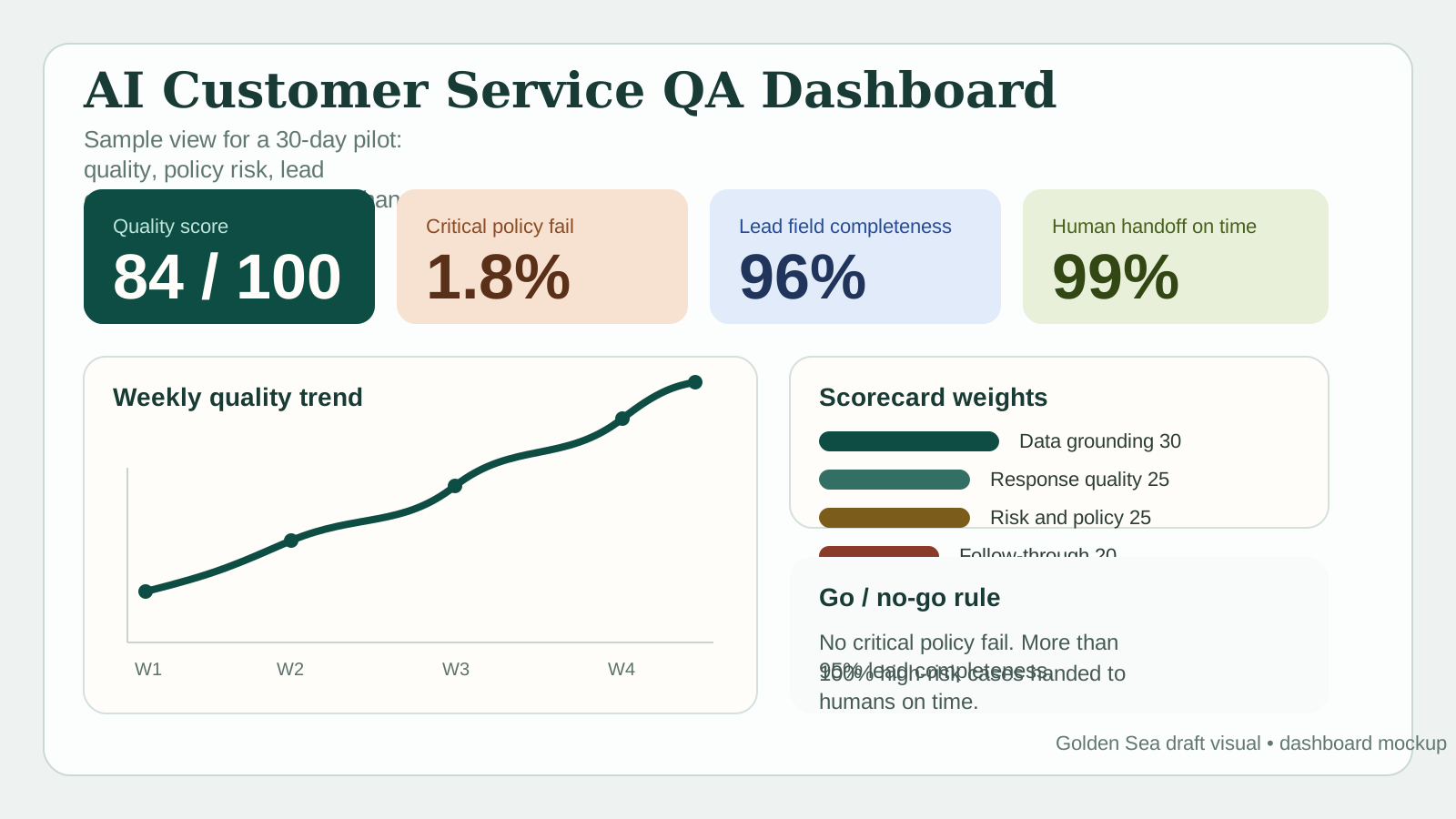
To keep the checklist operational, it needs a short scorecard the team can use every week. Golden Sea typically separates it into four groups. The key is to prevent average scores from hiding critical failures. A case can score 85 overall and still fail if it violates policy.
| Score group | Weight | What it measures |
|---|---|---|
| Data grounding | 30 | Did the bot use the right knowledge source, customer context, and CRM fields? |
| Response quality | 25 | Was the answer correct, complete, clear, and did it move the case forward? |
| Risk & policy | 25 | Did the bot exceed authority, violate policy, miss a sensitive signal, or fail to escalate? |
| Operational follow-through | 20 | Was the lead logged, assigned, followed up on time, and closed with a known status? |
Safe operating thresholds should be defined before the pilot begins. For example, a business might require zero critical policy failures, Data grounding of at least 24 out of 30, more than 95% of leads with all required fields, and 100% of high-risk cases escalated to humans. The numbers vary by industry, but the logic should stay the same: do not expand volume while the system still leaks on data or ownership.
How to run a 30-day pilot that reveals reality
- Week 1: capture the baseline. Record current response time, missed-lead rate, forgotten inboxes, email revision rounds, and missing CRM fields.
- Week 2: limit the intent scope. Let AI handle repetitive questions such as business hours, basic policy, initial triage, or after-hours follow-up. Escalate sensitive cases immediately.
- Week 3: turn on QA sampling. Review random samples and risk-based samples. If AI helps draft outbound email or messages, enforce a clear approval path.
- Week 4: make a go or no-go decision. Compare pilot performance against the baseline using the same measurement method: response speed, complete lead capture, escalation rate, policy error rate, and post-resolution satisfaction.
A short pilot forces the business to look at real throughput instead of a product demo. A fresh July 18, 2026 thread on r/smallbusiness about an AI receptionist with WhatsApp follow-up shows the pain both builders and buyers still care about is basic and operational: missed calls, forgotten follow-up, and uncertainty about whether lead details are captured correctly. Reddit does not represent the whole market, but it is useful as a reminder that real pain is often boring.
Five risks that show up immediately when QA is skipped
- Answers sound fluent but break policy. This is the most dangerous failure because it looks good on the surface.
- Leads get answered but not logged properly. The sales team thinks automation is working while CRM is still missing critical fields.
- Handoff has no owner. The case is escalated, but nobody picks it up inside the promised SLA.
- Outdated data keeps feeding the bot. Policies change, but the bot continues using the old version because no one owns the update.
- You cannot audit a complaint later. Without logs, it is hard to explain what the bot saw and what it actually did.
When should you avoid full AI for customer service?
Do not turn it on if the business is missing one of these four building blocks: an authoritative knowledge source, minimum CRM field discipline, human handoff rules for sensitive cases, and a clear owner for each channel. Without those pieces, AI does not make the business faster. It makes mistakes faster. That is also why many buyers say they “tried a bot and it never stuck.” Often the bot is not the entire problem. The operating layer behind it is not ready.
Conclusion
The right question is not “is this bot smart?” It is “is our QA system tight enough to let the bot touch customers yet?”. A strong QA checklist lets SMEs keep two things at once: service speed and managerial control. That is also how Golden Sea approaches AI Operations: not by selling the illusion of full autonomy, but by designing an operating layer with data, scorecards, handoff rules, and ownership that is clear enough to scale safely.
Read next: AI customer service 24/7 without losing trust · Automate 80%, hand the remaining 20% to humans · How fragmented data makes business AI go blind · How to evaluate an AI automation partner before signing · The true cost of a lead lost after the first inbox response