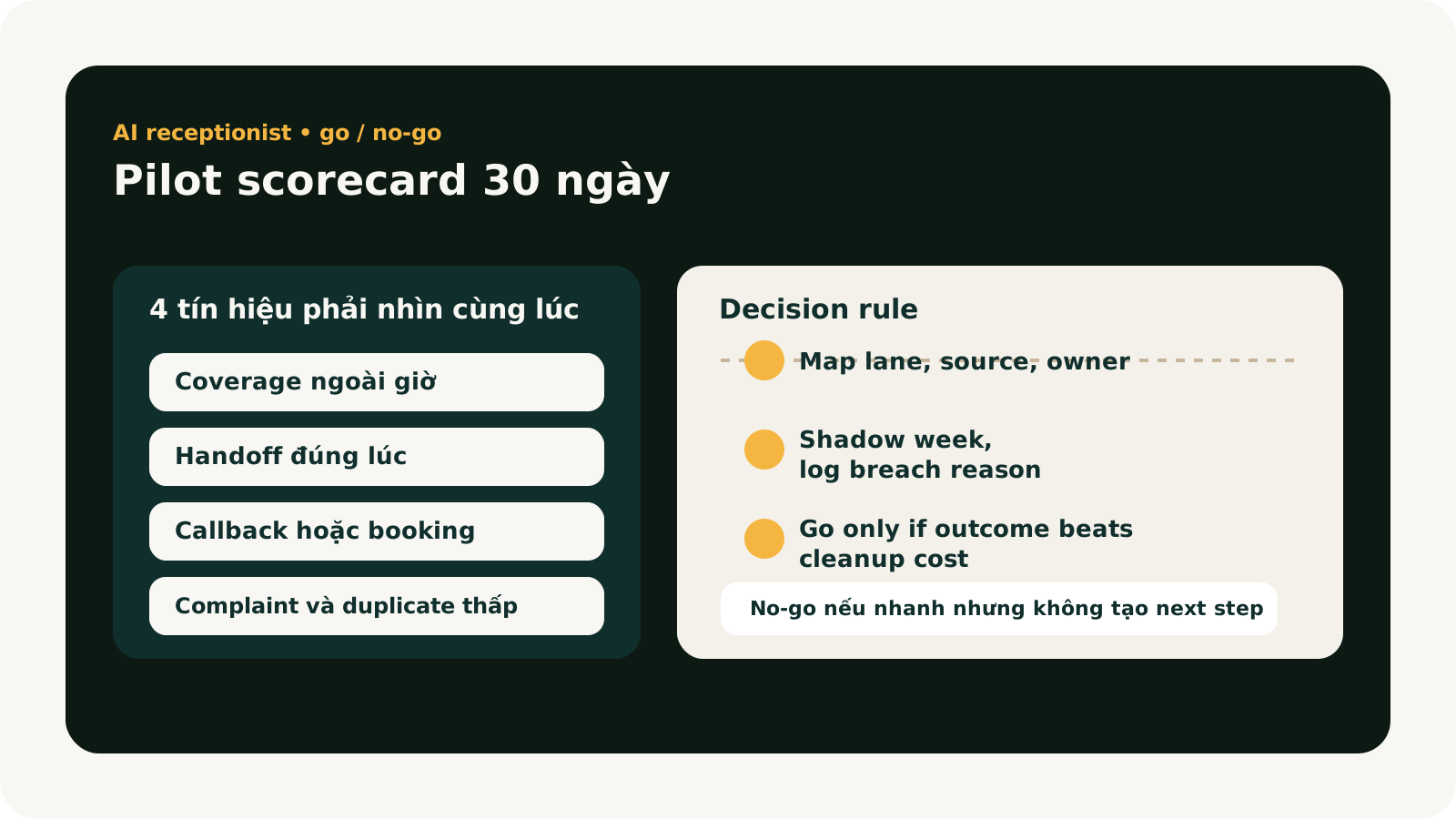

Short answer: A 30-day AI receptionist pilot is not trustworthy just because the bot sounds natural. For SMEs, the pilot is only decision-ready when it measures four layers at once: outside-hours coverage, timely handoff, real next-step creation, and customer-risk signals. If one of those layers is missing, the business is testing a feeling, not an operating system.
Why the pilot question matters before the scale question
Zendesk's AI agent buyer's guide, updated on July 8, 2026, makes the right operational point: teams should define goals, success metrics, a scoped prototype, and human oversight before they chase expansion. That fits the SME reality. Most companies do not lack demos. They lack proof that a new workflow is safe enough to run every day.
Salesforce's CRM-native agent guide reinforces the same principle from a systems angle. If an agent touches real operations, it should react to real events such as lead-score changes, SLA thresholds, or case status transitions. That means the pilot cannot stop at “can the bot answer?” It has to ask whether the workflow acts at the right moment, with the right permissions, and routes the case to the right owner.
The four KPI layers that make a 30-day pilot meaningful
| KPI layer | Question | Suggested pilot threshold | If weak, inspect |
|---|---|---|---|
| Coverage | How much outside-hours demand actually enters the flow? | At least 80% of target cases land in the right queue | Triggers, source routing, fallback queue |
| Control | How often are sensitive cases handed off on time? | At least 90% of high-risk cases follow the handoff rule | Escalation triggers, blocked topics, sentiment |
| Commercial outcome | How often does the flow create a real next step? | More confirmed callbacks or bookings | Owner assignment, script quality, speed-to-lead |
| Risk | How many complaints, broken promises, or duplicate touches appear? | Keep low and audit each incident | Knowledge quality, policy logic, override record |
The pilot becomes useful only when these four layers move together. Coverage without control simply creates more cleanup work. Low complaint volume without commercial progress may mean the system is polite but not useful.
A practical week-by-week pilot cadence
| Week | Objective | Work | Output |
|---|---|---|---|
| Week 1 | Map the flow | Document channels, peak times, sensitive cases, and human-only lanes | Queue map and trigger list v1 |
| Week 2 | Run in shadow mode | Let AI draft and triage while humans keep final control for risky lanes | Intent-error, missing-context, and handoff-delay log |
| Week 3 | Controlled live use | Activate for low-risk and outside-hours lanes with a clear fallback | Coverage, handoff, and booked-next-step report |
| Week 4 | Go/no-go review | Compare baseline vs pilot and audit each breach | Expand, hold, or stop decision |
Decision metrics beat vanity metrics
- Vanity metrics: total bot replies, average response time without lane separation, longer conversation count.
- Decision metrics: outside-hours callbacks completed, booking conversion, missed-call recovery, wrong-owner rate, escalation delay.
- Guardrail metrics: complaint rate, duplicate-contact rate, human-override rate, blocked-topic breaches.
Recent Indie Hackers operator discussions put this well: skeptical buyers care less about how “smart” the AI sounds than whether the workflow is reversible, inspectable, and boring enough to run every week.
A realistic scoring example for a 30-day pilot
Imagine a clinic or spa receives 120 after-hours leads in 30 days: 90 from inbox, 18 from missed calls, and 12 from a booking form. If the team tracks only “first reply within five minutes,” the pilot may look healthy. But a deeper review may show that only 68 cases had a real morning owner within the first 15 minutes of the next shift, 21 cases were called back twice, and 9 messages promised something the daytime team could not actually deliver. At that point the fix is not “make the bot sound better.” The fix is ownership, callback queues, and stronger limits for sensitive cases.
A proper pilot review table should include total outside-hours demand, the number of cases caught in the right lane, cases that created a real callback, cases that created a booking, complaint count, duplicate handling count, missing-context count, and the top three breach reasons. If a team cannot produce that table, it should not scale the flow yet.
Three mistakes that make a pilot look good while staying unsafe
- Starting with lanes that are too broad. If the same bot touches new leads, complaints, and policy-heavy cases at once, the metrics become noisy and hard to interpret.
- No clear definition of done. Is success a reply, a callback, a booking, or a handoff? Without a shared definition, the dashboard can look strong while the business result stays weak.
- Comparing against memory instead of baseline data. Teams need a short baseline or at least a shadow week to understand where leads leaked before the pilot changed anything.
The minimum data checklist before making a go/no-go call
- Is there one shared case ID across call, inbox, and callback?
- Can the team see where the lead entered and who touched it first?
- Are complaints, hot leads, and vague inquiries separated into different lanes?
- Can the business identify cases that received a reply but never produced an outcome?
Without that minimum dataset, a go/no-go decision is easily distorted by subjective impressions.
Read next: AI receptionist for SMEs: start with calls or inbox? · 15-minute missed-call follow-up playbook · Inbox SLA for AI customer service · The minimum log stack for AI customer service