Short answer: For spas, clinics, and showrooms, a missed phone call is often a hotter lead than a casual inbox question. Based on research reviewed on July 20, 2026 and 2026 phone-lead benchmarks, Golden Sea recommends a very explicit workflow: acknowledge within 60 seconds, capture two or three minimum fields, assign an owner immediately, and have a human call back within 15 minutes during working hours. That 15-minute mark is Golden Sea’s operating recommendation, not a universal law.
If a missed call does not enter a queue with a named owner, it is not a lead waiting to be handled. It is already revenue leaking out.
Why move this topic up today?
The newest signal is blunt. In a Reddit r/smallbusiness thread accessed on July 20, 2026, a service-business owner described reviewing one month of call logs and realizing that calls missed while onsite, driving, or slightly after closing time were creating a visible revenue leak. The replies repeated the same pattern from operators: people rarely leave voicemail anymore; they call the next option. An auto-text or answering layer helps only if someone still owns the follow-up queue.
The quantitative signal points the same way. Invoca’s 2026 benchmark article, based on 70 million phone calls, says 38% of answered calls from digital marketing are genuine leads, and 42% of those phone leads convert during the call itself. The sector breakdown matters even more for this article’s audience: healthcare sits at 43% lead rate, home services at 38%, and automotive at 53%. In other words, in verticals where the phone call often arrives late in the buying journey, missing the call is a meaningful operating failure, not a minor inconvenience.
The infrastructure side has also changed. Microsoft Learn now frames real-time agents as a conversational layer that works across voice and digital messaging. OpenAI’s voice-agent guide explicitly recommends attaching tools, handoffs, and guardrails to the same agent definition. In Vietnam, Zalo OA now combines chat, automation, API integration, and voice calling inside one stack, while FPT AI Engage is already selling voice-first customer service with concrete performance claims. The real question is no longer “can we automate this?” It is “which part should automation handle, within which SLA, and who owns the final handoff?”
A Hacker News thread on Asterisk AI Voice Agent also surfaces a useful showroom-style example: an AI layer answers immediately, handles a narrow booking task, and escalates when needed. That is exactly the right frame for spas, clinics, and showrooms. Use automation to keep the lead alive at the top of the funnel. Do not use it to replace every frontline judgment call.
Why 15 minutes instead of 5 minutes or 1 hour?
HubSpot, in a lead-management article updated on December 31, 2025, still recommends contacting new leads within five minutes. That remains the ideal. But real SMEs are run by people who are in treatment rooms, with patients, with showroom visitors, or driving between jobs. Golden Sea therefore uses 15 minutes as a more realistic control point: still fast enough to keep the buyer from fully drifting to a competitor, but realistic enough for a lean team to enforce consistently.
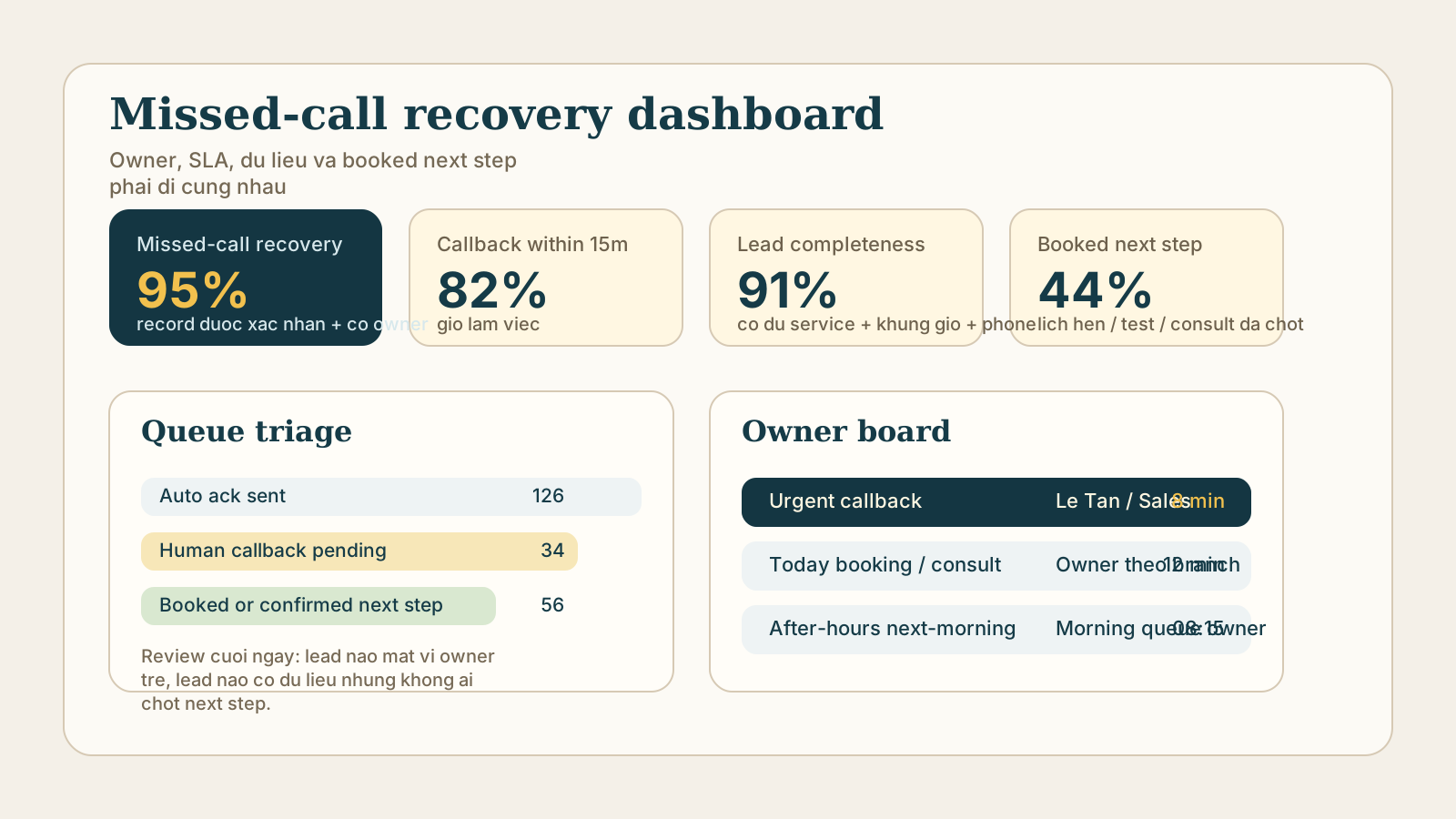
It is important to separate fact from inference here. The fact is that faster follow-up usually wins and phone leads are valuable. Golden Sea’s inference is that if a small team cannot reliably hit five minutes yet, it should at least build a system where no missed call goes longer than 15 minutes without an owner, a status, and a defined next step. For after-hours calls, the SLA should change from a vague promise to “acknowledge now, call back before 8:15 AM on the next business day.”
Who should use this playbook and who should not?
| Good fit | Not a direct fit |
|---|---|
| Spas, clinics, showrooms, consultative service teams, appointment-led businesses, and local operators that depend on fast response | Complex refund disputes, heavy complaints, medical diagnosis, or pricing that requires deep technical assessment |
| Lean teams losing leads while onsite, with customers, or after hours | Businesses with no CRM discipline or no named owner for inbound calls |
| Inbound driven by hotline, click-to-call, maps, ads, or Zalo OA | Models where every single call is extremely high-stakes and cannot tolerate even a narrow automation layer |
| Teams willing to let AI hold the lead, gather data, and route the right human | Teams hoping a bot will autonomously replace the full frontline workflow |
If the business belongs in the left column, missed-call recovery should be treated as a revenue-operations workflow, not a side feature of telephony. If it belongs in the right column, stop at ownership and callback reminders before expanding to voice agents.
The 15-minute workflow from missed call to controlled callback
| Time window | What the system should do | Owner |
|---|---|---|
| 0-60 seconds | Log the missed call, create a record, and send a short acknowledgment via SMS or Zalo when the channel allows it. The message should do only two things: confirm receipt and ask one or two questions that help with prioritization. | Automation |
| 1-5 minutes | Tag the record by source, service interest, desired timing, and urgency. If the caller replies by text, append it to the same record instead of opening a second thread. | Automation + CRM |
| 5-15 minutes | Assign an owner and create a callback task. The owner must see enough context before calling back: what the caller needs, where the call came from, what they replied, and whether the case is urgent. | Sales / receptionist / advisor |
| 15-60 minutes | If human callback has not happened yet, send a second nudge with explicit options: book now, leave details, or choose a callback time. Stop messaging if the person has declined or has already been handled. | Automation with guardrails |
| End of day | Review the full missed-call queue: which calls were lost, which callbacks were late, and which records had enough data but still failed to produce a next step. | Queue owner / manager |
The key is ownership. One highly upvoted Reddit reply made the point clearly: a shared inbox does not solve anything when nobody truly owns the follow-up list. The tool only keeps the SOP alive on busy days. It does not replace operating discipline.
The script must change by vertical
| Vertical | Minimum data to capture | Escalate immediately when |
|---|---|---|
| Spa / beauty | Requested service, preferred branch, desired time slot, new or returning customer | Post-treatment complaints, refund requests, side effects, or deeper specialist consultation |
| Clinic | Specialty or appointment type, urgency, preferred time, confirmed callback number | Acute symptoms, urgent pain, medical questions needing a clinician, prescription changes, or complex insurance handling |
| Showroom | Product or model of interest, test or visit intent, location, target visit window | Complex pricing, trade-in negotiation, post-sale complaints, or deal exceptions |
For spas, the winning move is often simple: preserve the booking opportunity and do not let the caller drift away. For clinics, the bot should do intake and routing only, not pseudo-diagnosis. For showrooms, callback works best when the rep already knows context such as which product page or ad triggered the call.
The first acknowledgment should be short and useful
Do not send a vague message like “We received your call and will get back to you soon.” It is polite, but it does not help the team prioritize. A better message asks for exactly one thing that improves routing.
- Spa: “We saw your missed call. Which treatment are you trying to book, and what time today or tomorrow works best?”
- Clinic: “We received your missed call. Which specialty do you need, and is this something you need handled today?”
- Showroom: “We just saw your missed call. Which model are you interested in, and when would you like to visit or test it?”
If the caller has already replied by text, the human callback should not restart the conversation from zero. That is one of the fastest ways to destroy the benefit of fast response.
The minimum system architecture behind the workflow
- One record per lead. The missed call, auto-reply, callback, and appointment should all live on one timeline.
- One owner per case. Automation should not end in a situation where several people “could” handle it.
- Explicit guardrails. Sensitive cases must hand off immediately. Both OpenAI’s voice-agent guidance and Microsoft’s real-time agent material make handoff part of the design, not an afterthought.
- A single source of truth. If hotline, Zalo, forms, and booking history live in different systems, the workflow will slow down. This is exactly the kind of failure described in the fragmented-data article.
- A callback script with a job to do. The owner should call back to secure a next step, not only to apologize for the missed call.
If Zalo is already the primary channel, OA pricing and features now support a pragmatic first layer for many Vietnamese SMEs without forcing an enterprise-grade stack on day one.
Which KPIs matter every day?
| KPI | Why it matters | Suggested starting threshold |
|---|---|---|
| Missed-call recovery rate | The share of missed calls that receive an acknowledgment and a named owner | 95%+ |
| Callback within SLA | The share of missed calls called back by a human within 15 minutes during business hours | 80%+ in the first phase |
| Lead completeness | The share of records with service interest, timing, and contact details captured correctly | 90%+ |
| Booked next step | The share of missed calls that lead to an appointment, test drive, consultation, or confirmed next contact | Track against your own baseline |
| Wrong escalation | Cases routed to the wrong person or wrong urgency level | As close to zero as possible |
If the business already runs a more mature phone operation, Salesforce’s 80/20 service-level idea and 70-75% FCR range can be useful reference points. But for a small spa or showroom, the immediate win is still much simpler: stop letting hot leads die anonymously inside call logs.
Six mistakes that turn missed-call recovery into a new spam layer
- Making the acknowledgment too long. Ask one thing that helps route the case. Do not send a brochure.
- Failing to disclose automation clearly. HN discussions show strong resistance when people feel they are being tricked into talking to a fake human.
- No final owner. The system messages the lead, but nobody ever calls back.
- Calling back without context. The customer has to repeat everything, so speed becomes meaningless.
- Using one script across every vertical. Spa, clinic, and showroom have different risks and different minimum data needs.
- Skipping end-of-day review. Missed-call recovery is a learning loop. If nobody reviews the queue, the same leak repeats every week.
Conclusion
A missed call should not be treated as a minor receptionist problem. In spas, clinics, and showrooms, it is often the exact moment a customer is ready to move forward if someone can hold the conversation properly. Golden Sea’s 15-minute playbook does not require a large contact center. It requires four simple disciplines: acknowledge fast, capture the right data, assign the right owner, and make the callback purposeful. A small team that does those four things already outperforms many competitors still letting call logs become graveyards for hot leads.
Read next: The true cost of ignored leads · Should SMEs start with calls or inbox? · AI customer service QA checklist · Automate 80%, hand 20% to humans · How fragmented data makes business AI go blind