
Short answer: If your chatbot keeps answering incorrectly or too vaguely, the problem usually is not the model first. It is the knowledge base. SMEs should clean up six document groups before anything else: core company facts, policy and promise guardrails, booking or purchase flows, high-volume FAQs, human-handoff criteria, and critical after-sales knowledge. Do not dump your entire Google Drive or internal folder structure into the bot on day one.
Golden Sea's operating view: bots rarely answer badly because they are 'dumb' from the start. They usually answer badly because the company feeds them a messy mix of outdated files, drafts, marketing pages, and policy documents.
Why is this more important than switching models?
When businesses first launch a chatbot or AI agent, the reflex is often to ask which model to use or which prompt to improve. But Microsoft's documentation on knowledge sources is direct: agent performance is strongly tied to the quality of the knowledge the system can access. Zendesk also emphasizes that content for generative AI should stay focused on the topic, provide complete answers, remain self-contained, and use clear concise wording. So if the input knowledge is ambiguous, duplicated, or fragmented, wrong answers are the natural outcome.
This matches what Golden Sea sees in Vietnamese SMEs. Many businesses technically have enough documentation, but they do not have a clean knowledge layer for machines to consume. One old PDF, a few outdated Facebook posts, three versions of a price sheet, a Google Sheet full of operational notes, and dozens of Zalo threads get treated as if they are already a knowledge base. In reality, that is only a document pile waiting for editorial cleanup.
Zendesk also recommends starting AI answer flows from questions users ask regularly and that can be resolved without a human agent taking action. That is a practical sequencing rule. It means the order of cleanup should follow repeated questions, low-risk cases, and visible workload reduction, not simply whichever files happen to exist already.
What layers belong in a minimum chatbot knowledge base?
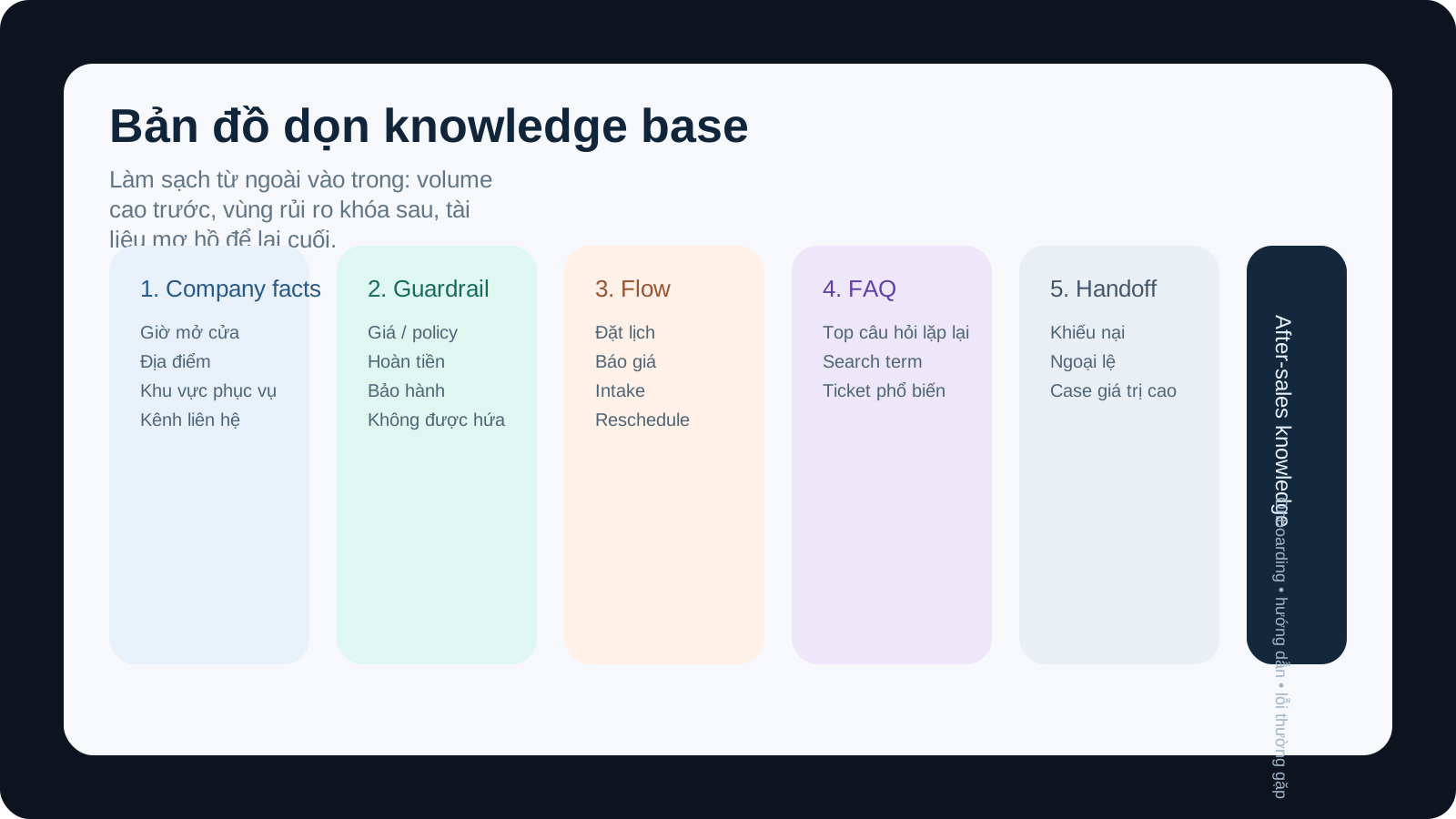
To prevent the bot from improvising, Golden Sea usually divides the minimum knowledge base into six layers.
| Layer | Typical documents | Why clean it early |
|---|---|---|
| 1. Company facts | Business hours, location, service area, contact channels, core services | These are high-volume, low-risk questions that drive self-service quickly. |
| 2. Policy and guardrails | Pricing rules, refund policy, warranty, service boundaries, no-promise zones | This layer stops the bot from overpromising. |
| 3. Use-case flows | Booking, quote requests, rescheduling, order status, account reset | It helps the bot move the customer to the next step instead of replying vaguely. |
| 4. High-volume FAQs | Repeated inbox questions, ticket themes, search-term demand | This is the fastest way to reduce agent workload. |
| 5. Handoff rules | When a human must take over and what the bot must never handle alone | This prevents the bot from staying too long in risky conversations. |
| 6. After-sales knowledge | Usage guides, onboarding, common issue handling, follow-up support | This protects support quality after the sale. |
The order matters. Salesforce describes knowledge base articles as pages that answer common questions, solve problems, or help customers use products and services. If the chatbot will surface knowledge content, the company should prioritize documents that can directly answer a specific question. Strategy decks, internal notes, and loosely structured sales collateral should not go in first.
Which documents should be cleaned first in the first 14 days?
If resources are limited, do not try to sanitize the entire document library immediately. Start with sources that combine high volume and low risk.
| Priority | Document group | Which bad answers it helps reduce |
|---|---|---|
| 1 | Opening hours, addresses, service area, contact methods | "What time are you open?" "Do you support this location?" |
| 2 | Booking, demo, quote-request, and intake flows | "How do I book?" "What do you need for a quote?" |
| 3 | Core policies: warranty, cancellation, rescheduling, refund, response windows | "Can I cancel?" "Do you refund?" |
| 4 | Service and package descriptions written in one consistent language | "What is included in this service?" |
| 5 | High-volume support FAQs | Repeated questions that do not require human intervention. |
| 6 | Human-handoff rules and blocked zones | So the bot knows when to stop instead of filling gaps with guesses. |
Zendesk explicitly recommends identifying regular questions and creating answers first for issues customers can resolve on their own. That is why these six groups are more effective than dumping every internal file into the bot.
Which document types should stay out at the beginning?
Not every file should become a knowledge source on day one. Microsoft Copilot Studio shows that knowledge sources are governed by source limits and orchestration rules. That means the more random material you add, the harder it becomes to ground the bot in the right answer.
Golden Sea usually delays at least these four categories:
- Marketing drafts and sales decks.
- Unversioned internal price sheets.
- Raw chat logs that have not been edited.
- Complex legal or policy material that even humans still debate.
Many teams assume that more data is always better. In early-stage chatbot deployment, less but cleaner knowledge is usually safer and more useful.
How should a knowledge article be rewritten so the bot can use it well?
Zendesk gives four useful rules for content consumed by generative AI: keep it focused, complete, self-contained, and clear. Applied properly, this means chatbot-ready knowledge writing looks different from internal notes.
A good chatbot-facing article usually needs:
- A clear question-answer title.
- A direct answer near the top.
- Scope or applicability conditions.
- Explicit next steps.
- Limits and exceptions.
- An owner and last-updated signal.
Salesforce also stresses that article titles should make it clear what the article is about. A poor source is a long file full of positioning language and hidden operational details. A better source says exactly what the customer needs to do, when the rule applies, and when a human must confirm the next step.
Vietnamese and English knowledge should be cleaned separately
Because Golden Sea is running a bilingual architecture, chatbot knowledge should not assume that machine translation is enough. If the English version still carries Vietnamese menu names, unclear policy wording, or context that only makes sense in Vietnamese, the English bot will fail in subtle ways.
The most practical approach is to split knowledge editing into three layers: information that stays identical, information that needs contextual rewriting, and information that must remain tightly locked such as policies and promises.
What governance keeps the knowledge base from getting dirty again?
Knowledge bases do not collapse on the first day. They decay when nobody owns them. So along with cleanup, the business needs a minimum governance loop:
| Required practice | Purpose |
|---|---|
| Named owner for each article group | Ensures responsibility when content becomes outdated or contradictory. |
| Review cycle | Checks policy, pricing, service scope, and response windows on schedule. |
| Change log | Shows when answers changed and why. |
| Blocked-topic list | Defines what the bot must never answer alone. |
| Search-term review | Reveals which questions users ask that the knowledge base still fails to cover. |
Microsoft also shows that in some configurations, responses can be blocked if the agent did not actually use a knowledge source or tool. That is a valuable operating lesson: it is better for the bot to fall back safely than to generate a polished but unsupported answer.
A 30-day playbook for knowledge cleanup
| Week | What to do | Output |
|---|---|---|
| Week 1 | Audit every current and planned knowledge source. | A list of sources marked use now, rewrite first, or block. |
| Week 2 | Rewrite 15-20 articles for high-volume, low-risk questions. | Knowledge set v1 for basic self-service. |
| Week 3 | Add handoff rules, policy guardrails, and named owners. | The bot knows when to answer and when to stop. |
| Week 4 | Review search terms, top ticket issues, and bot failures. | A second-wave backlog for knowledge expansion. |
Only after that first cycle is stable should the business expand into long technical documentation, complex legal materials, or massive internal repositories.
Five mistakes that make the chatbot worse as it learns more
- Uploading everything instead of selecting intentional sources.
- Keeping multiple versions without one authoritative source.
- Using marketing pages as policy or support sources.
- Skipping owners and update dates.
- Failing to separate bot-answerable questions from human-only issues.
Conclusion
A chatbot knowledge base does not begin with how many files you can gather. It begins with knowing which documents must be clean first, which ones need rewriting for machine use, and which topics should never be left to AI interpretation. For SMEs, cleaning the six core knowledge groups usually delivers faster and safer results than flooding the system with raw internal files.
Read next: How fragmented data makes business AI go blind · AI customer service QA checklist · Should SMEs start with calls or inbox? · 24/7 AI customer service · What data must be clean before handing customer email to AI?