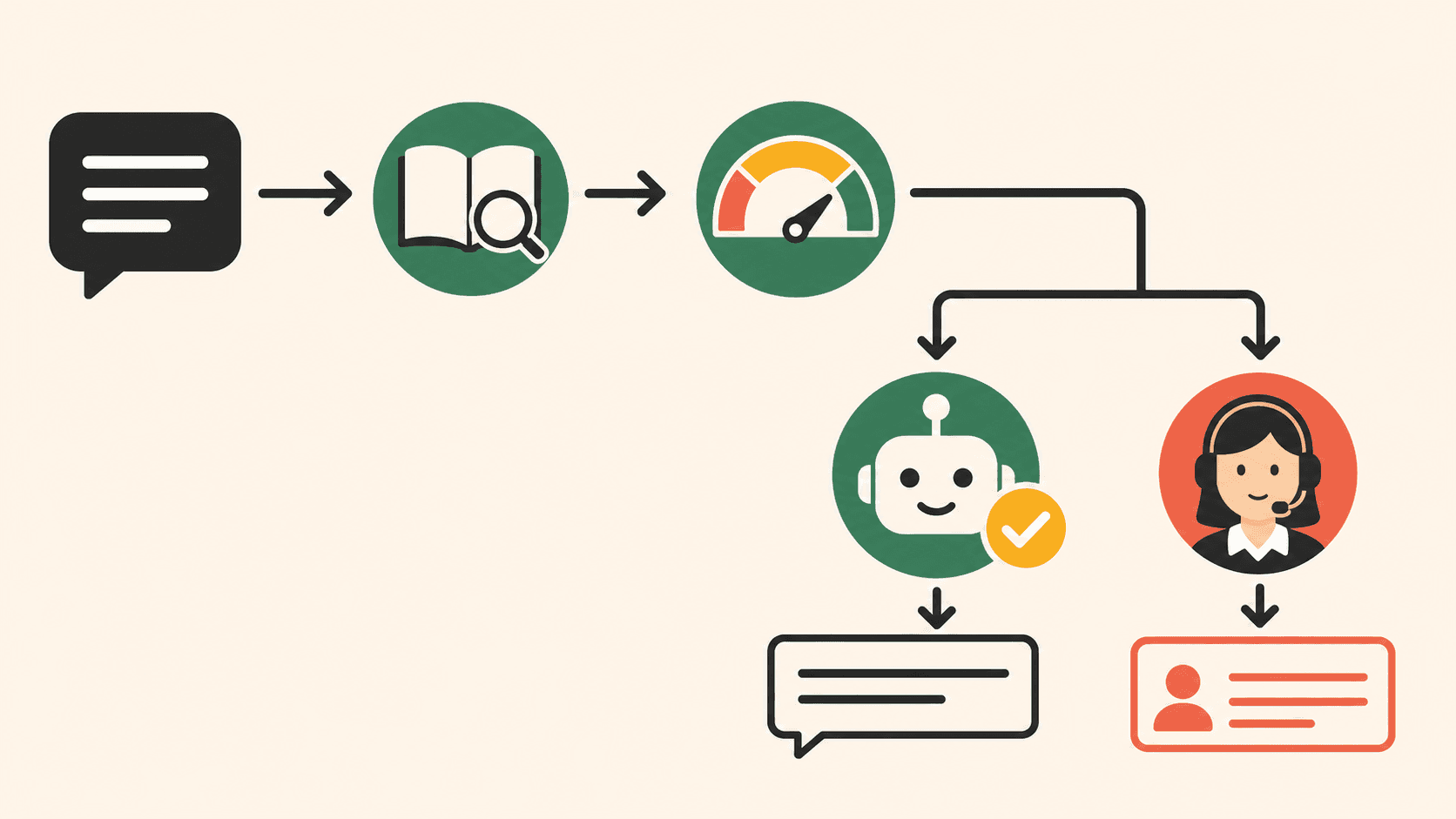

A 24/7 AI customer service system should handle repetitive questions on its own, prepare context, and hand off to a human when confidence is low or the stakes are high. The goal is not to keep customers talking to a bot at all costs. The goal is to get them to the right answer or action as fast as possible.
Speed makes the first impression, but reliability builds the relationship. Quoting the wrong price at midnight faster than a human could is not a good experience. That is why an AI customer service system needs to be designed as an operation with policies, data, permissions, and accountability — not just a chat box.
What can AI customer service do well?
AI excels at explaining standardized information, classifying requests, collecting missing details, checking statuses, booking appointments by rule, and summarizing conversations for staff. It can also work after hours to confirm requests have been received and prioritize urgent cases.
AI is weaker at policy exceptions, strong emotions, disputes, specialized advice, and decisions that carry commitments. These situations need humans, because the right answer depends on judgment, authority, or legal responsibility.
Start with a risk matrix
| Consequence if wrong | High confidence | Low confidence |
|---|---|---|
| Low | Answer automatically | Ask follow-up questions or offer options |
| Medium | Answer from approved templates | Wait for staff approval |
| High | Prepare a draft | Escalate to a human immediately |
Opening hours are low-consequence. Conditional pricing is medium. Complaints, refunds, diagnoses, or legal commitments are high. The matrix aligns the team on what the AI is allowed to do, instead of debating after every incident.
Layer 1: a trusted data source
The AI must answer from a knowledge base with clear ownership: products, pricing, policies, locations, processes, and template answers. Every document should have an effective date. Expired content must be removed from the retrieval source, not just left sitting next to the new version.
For questions that require personal data, the system must authenticate and retrieve only what is needed. Do not dump the entire CRM into the prompt when all you need is an appointment status. Data minimization reduces risk and makes answers more focused.
Layer 2: understanding intent and collecting enough information
Customers rarely phrase things the way your processes are named. “Any openings tomorrow?” may be a booking request. The AI needs to identify intent and ask for missing details concisely. It should not re-ask for data it already has, or force customers through a long script for a simple question.
Design the intent set from real conversations: pricing questions, booking, rescheduling, order status, warranty, complaints, and consultation. Evaluate it against the business's own data, not just a vendor-prepared demo.
Layer 3: confidence thresholds
When the system lacks a clear enough source, the right answer is to admit its limits and hand off to a human — not to guess. Thresholds can be based on retrieval scores, agreement across sources, intent type, and required data.
Do not let the AI hide uncertainty behind confident-sounding prose. Internal interfaces should show staff the sources used and the reason for escalation. That helps the team fix the knowledge base instead of patching individual answers.
Layer 4: human handoff that doesn't make customers start over
When escalating, the system must pass along a summary: who the customer is, what they want, what they have already provided, what the AI has answered, and why it escalated. Staff need to take over with full context. If the customer has to repeat everything from the beginning, the automation has just shifted its cost onto the customer experience.
Set an SLA for handoffs and communicate realistic expectations. After hours, the system can say the request has been logged and when someone will respond. Do not pretend a human is on duty when there isn't one.
Layer 5: audit logs and the ability to fix things
Log the timestamp, sources retrieved, instruction version, actions taken, outcomes, and any human interventions. When something goes wrong, the team needs to be able to reproduce it. Logs also reveal which questions are missing from the knowledge base and where customers tend to give up.
Access to logs must be managed, since they contain conversation data. Define retention periods, permitted uses, and deletion procedures under an appropriate policy.
Industry scenarios
Spa and fitness
AI can share general information, check available time slots, send appointment reminders, and answer pre-session preparation questions. Questions about health conditions or promised results must go to a specialist.
F&B and retail
AI handles opening hours, locations, order status, basic policies, and request intake. When products sell out, prices change, or customers report quality issues, you need real-time data connections or a human handoff.
Dental and medical clinics
AI is a good fit for administrative work: schedules, addresses, documents to bring. It should not diagnose or promise treatment outcomes. This scope must be written into policy and tested.
Operational metrics
- First response time.
- Correct resolution rate without human involvement.
- Rate of correct escalations to humans.
- Rate of customers having to repeat information.
- Policy or factual errors.
- Abandonment rate and negative feedback.
- Post-conversation outcomes: bookings, orders, or qualified leads.
Do not optimize containment rate at all costs. A bot that keeps 90% of conversations but gives evasive answers can be worse than a system that correctly routes 40% of complex cases to humans.
A safe pilot process
- Pick three to five low-risk intents.
- Clean up the sources and write standard answers.
- Build a test set from real, anonymized conversations.
- Run in shadow mode.
- Open to a small group with human oversight.
- Categorize errors daily.
- Only add new intents once the existing set is stable.
Transparency with customers
Businesses should make it clear when customers are interacting with an AI assistant if that affects expectations, and always provide a path to a human. Transparency does not weaken the AI; it makes the brand's promise more credible.
Conclusion
Good AI customer service is not judged by how human it sounds, but by whether customers get the right outcome quickly and accountably. Trusted sources, a permission matrix, handoffs, and logs are the four non-negotiable pieces.
To build the data foundation for this system, read how fragmented data is blinding your business's AI. Golden Sea implements on the principle that sensitive cases always have a path to a human.
Read next: The Minimum Log Stack for AI Customer Service: What to Record for Audits and Optimization · Inbox SLA for AI Customer Service: How to Set Response Thresholds and Human Handoffs