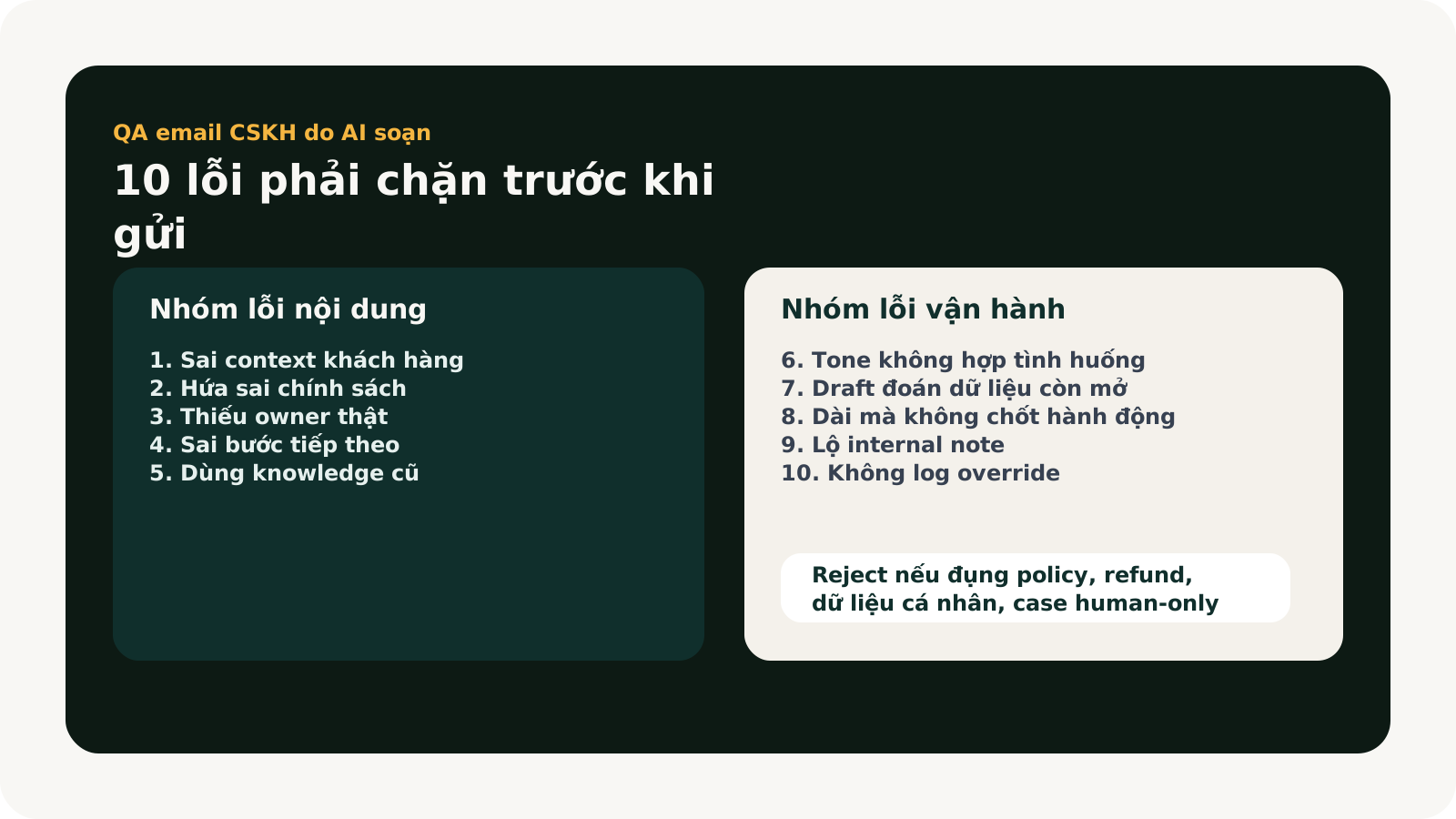

Short answer: AI-drafted customer-service email should not be reviewed like ordinary marketing copy. The dangerous failures are not robotic wording. They are wrong promises, wrong context, missing ownership, incorrect next steps, and messages that make customers think the business has resolved something when nobody actually owns the case yet.
Why AI-drafted support email needs a dedicated QA scorecard
The earlier email-readiness article already showed that weak source data creates weak drafts. But once the system is live, teams still need a concrete QA layer before sending. Zendesk's autonomous-service-agent guidance stresses QA controls, policy adherence, and knowledge feedback loops. Quality cannot be measured by “it reads fine.”
At Golden Sea, the purpose of this scorecard is operational: it helps reviewers stop smooth-sounding emails that hide business risk underneath.
The ten errors worth blocking before send
| Failure | Reviewer question | If missed |
|---|---|---|
| Wrong customer context | Is the draft referring to the correct case, order, or service? | The customer loses trust immediately |
| Wrong policy promise | Does the email imply a refund, deadline, exception, or free support that is not approved? | The team inherits a promise it cannot keep |
| No real owner | Does the email say who is handling the case and by when? | The customer gets a reply but the case still has no owner |
| Wrong next step | Does the CTA match the current case status? | The customer is pushed into the wrong action |
| Outdated source | Which policy or knowledge version informed this draft? | The wording may be correct for old documentation but wrong for current operations |
| Tone mismatch | Does this case need apology, reassurance, or a clearer escalation path? | The complaint becomes worse because the tone is wrong |
| Open-data guess | Is the draft guessing around missing information? | The message sounds complete while hiding unsafe assumptions |
| Verbose without closure | Can the customer understand the next action within ten seconds? | More back-and-forth and slower SLA recovery |
| Internal note leakage | Is any internal-only language exposed to the customer? | Internal process leaks or creates confusion |
| No override log | If a reviewer changed the draft, was the reason recorded? | The team cannot learn what the AI keeps getting wrong |
A three-layer QA rhythm
- Machine check: catch missing fields, sensitive policy keywords, blocked topics, and duplicate data.
- Ops review: verify context, next step, owner, SLA, and policy alignment.
- Exception review: reserve for refunds, complaints, legal sensitivity, personal-data issues, or high-value accounts.
This keeps the process lightweight for low-risk lanes without removing the human gate where judgment matters.
A lightweight scorecard that small teams can actually use
Small teams do not need a heavy review framework. A ten-row scorecard with three outcomes is often enough: pass, pass with edits, and reject. What matters is a shared definition. If the owner is wrong or the message makes an unapproved promise, the draft should be rejected even if the wording sounds polished. Only clear failure definitions make the scorecard useful.
An efficient rhythm is usually: AI creates the draft, a machine check catches missing fields or sensitive keywords, a reviewer clears normal lanes in two to five minutes, and only sensitive lanes go to a higher approver. If every email follows the exact same review path, the team either slows down too much or becomes too loose where judgment matters.
How the scorecard should feed back into the system
- If errors repeat in context, review CRM fields, retrieval logic, and templates.
- If errors repeat in policy promises, review blocked-topic rules and approval gates.
- If errors repeat in next-step quality, review workflow ownership, SLA lanes, and CTA templates.
When an email should move to human-only immediately
Some lanes are not worth “saving” with a quick QA pass. Refunds, public complaints, personal-data issues, billing disputes, and policy exceptions should usually move straight to human-only handling. That rule speeds up QA because the reviewer no longer wastes time debating drafts that were never safe to send.
For SMEs, this is how speed and risk control stay compatible. Not every AI-drafted message deserves delivery.
Read next: Which data must be clean before AI drafts support email? · AI customer service QA checklist · The minimum log stack for AI customer service