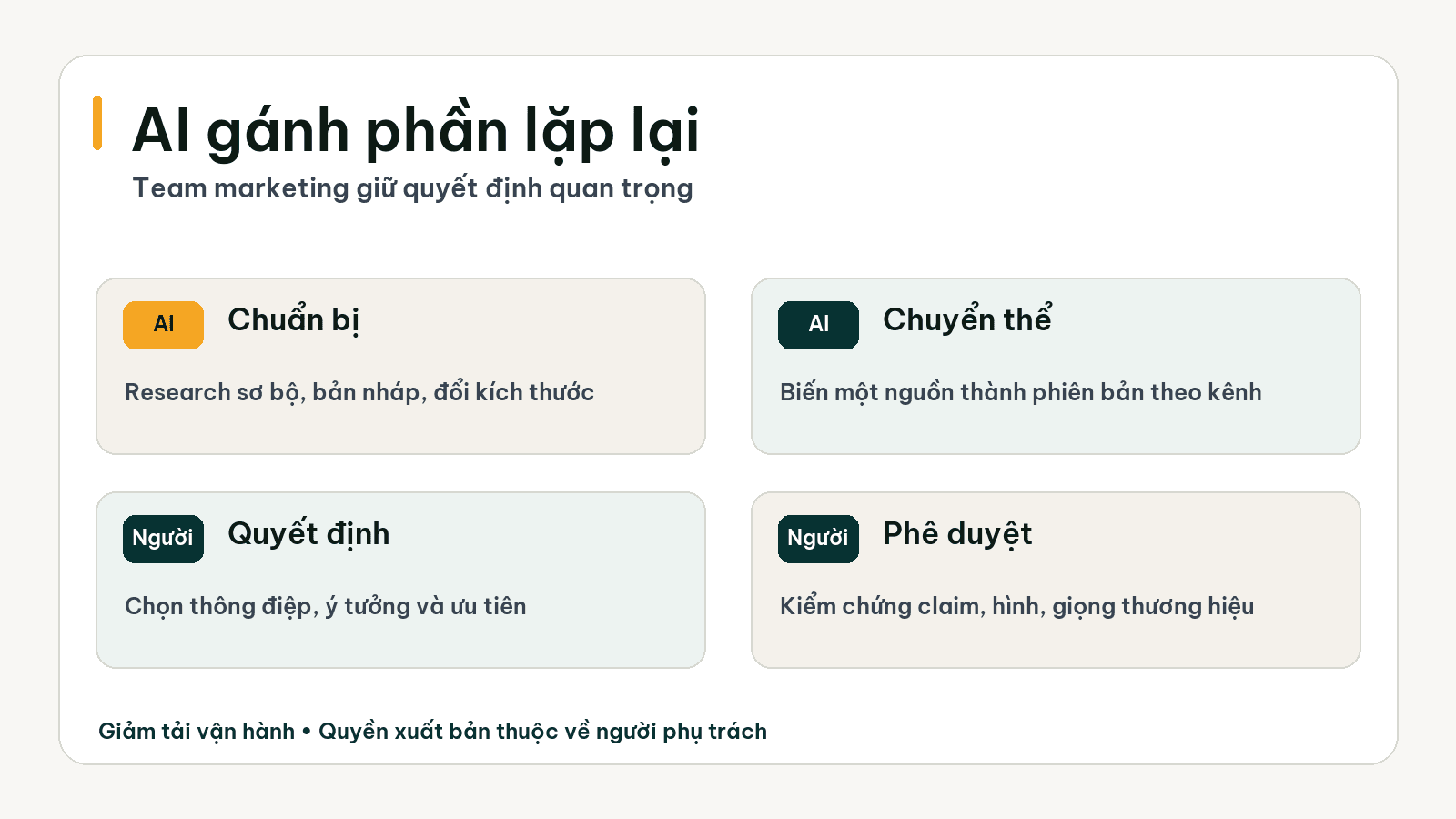

Short answer: An AI media team is a content production flow that helps marketers spend less time on recurring work: receiving assets, preparing drafts, producing image or video versions, adapting them for channels, and preparing a calendar. People still choose the message, verify claims, and approve publication. Measure time to an approved deliverable and output quality, not the number of AI-generated files.
For an existing marketing department, the useful question is which weekly tasks consume time and can be standardized. A dedicated media AI works best with a clear brief, an asset library with usage rights, and a named approver. That gives the team more room for customer insight, concepts, and campaign quality.
An AI media team is not one bot auto-posting content
A real AI media team is an operating system for content: intake, source collection, angle generation, drafting, design or video production, human approval, scheduling, and reporting. A caption writer alone is not a media team; it is only one component.
The common mistake is expecting AI to replace marketing judgment immediately. AI can speed up repetitive work, but people still need to decide the offer, review claims, choose angles, and protect brand context.
When can AI reduce a media team's workload?
AI is useful when the business already has consistent source material: real photos, real videos, offers, customer feedback, inbox questions, and campaign calendars. AI can turn those inputs into multiple content versions and keep publishing consistent.
If the business has no positioning, no customer insight, no real visuals, and no owner for approval, AI will create more posts without necessarily creating more trust.
What still needs human approval
Humans should approve claims, pricing, results, customer images, professional advice, and sensitive replies. This protects reputation. One inaccurate post can save minutes in production but damage trust for much longer.
The stronger model is not fully autonomous posting. It is AI producing drafts and operating the workflow while humans keep final approval.
Minimum structure
The minimum structure has three layers: input sources, draft production, and approval. Sources include image/video folders, offers, customer questions, and brand guidelines. The production layer creates captions, visuals, reels, headlines, and schedules. The approval layer checks tone, accuracy, and fit.
After two to four weeks, measure which content creates useful inboxes, saves, shares, or sales conversations instead of only counting views.
Quick implementation checklist
- Define the inputs: owner, source material, offer, and channel.
- Break the workflow into accountable steps instead of placing everything inside one AI box.
- Set review standards for claims, visuals, brand voice, CTA, and personal data.
- Track real actions such as phone clicks, messaging clicks, forms, downloads, and bookings.
- Review after two to four weeks using lead quality and response speed, not only publishing volume.
How Golden Sea frames this problem
Golden Sea does not treat AI as decoration. For AI media operations, the real purchase is a clearer operating flow: the website creates signal, content uses real source material, leads get classified, risky outputs are reviewed by humans, and data returns to reporting. If the business lacks a strong web foundation, start with website design and tracking. If leads exist but handling is fragmented, consider AI automation. If the business needs custom software, dashboards, or deep integrations, IT outsourcing is the right layer.
Signs a business is ready for an AI media team
A business is ready when three things exist: a clear offer, real source material, and an accountable reviewer. If every content session starts with “what should we post?”, AI only produces uncertainty faster. If the team already has project photos, customer questions, pricing notes, campaign calendars, and a few working formats, AI can multiply output while staying under control.
Another sign is that the owner no longer wants to buy single posts. They want an operating rhythm: what to say this week, where the visuals come from, which clips to cut, which captions need approval, which posts deserve ads, and where leads go after responding.
What makes an AI media team look cheap
The first mistake is overusing AI imagery when real assets exist. Audiences increasingly recognize synthetic visuals, especially for local services. The second mistake is crowding images with too much text, inconsistent fonts, tight line spacing, and unstable logo placement. The third mistake is writing in a voice that is too polished and too generic.
To avoid cheapness, use AI for structure, not to fake lived experience. Real images should be large and contextual. Text should carry one clear idea. CTA should feel like a natural invitation, not a hard sales push.
Assign work by deliverable, not tool name
Map a working week: intake, image search, caption writing, clip editing, revisions, aspect-ratio exports, scheduling, and reporting. Mark the steps with clear rules and frequent repetition. AI can prepare drafts there, but only when inputs are clean and acceptance criteria are explicit. If the brief changes constantly or the product message has not been decided, AI creates more versions to revise rather than less work.
Start a pilot with one deliverable, such as a video from an approved product photo set. Record time from brief to approval, revision rounds, and the reasons for revision. The product photo to video workflow separates source images, script, draft, and human sign-off. After a few cycles, the team can decide whether to expand.
One source can serve several channels when edited for each
An AI media team can also turn one source into a web article, social post, and video script. Each version needs its own purpose and call to action; pasting the same text everywhere rarely earns attention. Keep a verified master source with image rights and an update date, ask AI for three structures, and let an editor choose angles and verify claims. The AI content repurposing guide gives a concrete example.
If the business wants Golden Sea to operate production and request approvals on a recurring basis, see AI Media Room. If its own team wants to operate the workflow, templates, and status board, see AI Content System. Both require a business owner for the message and publishing rights.
Conclusion
Useful content does not need exaggerated selling. It helps business owners see where value is leaking, understand why the problem happens, and identify a small next step. When website, content, and automation are connected into one workflow, Golden Sea earns natural consulting opportunities without forcing the sale.