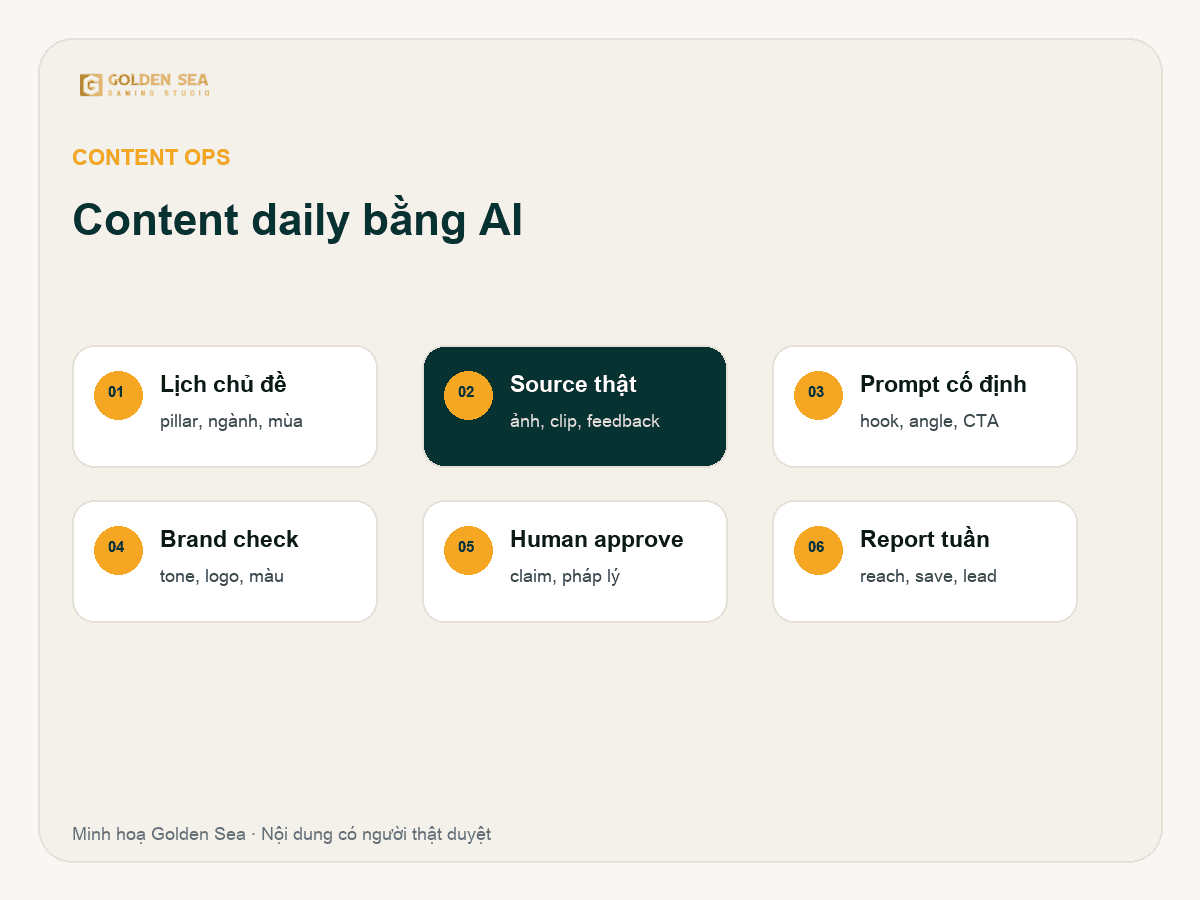

Short answer: To produce daily content with AI without losing brand voice, a business needs a process first: real sources, format-specific prompts, visual templates, an approval checklist, and reporting. Using AI only to write more will create consistency in volume, not in trust.
This article targets the primary keyword daily content with AI, supported by AI content writing, content automation, AI content approval workflow, AI media team. The search intent is informational plus implementation: the reader is trying to understand the problem before buying, so the article must be useful first and sales-driven second.
Why daily content loses brand voice
Daily content fails when the team only tries to hit volume. Each post uses a different hook, design style, claim level, and tone. Viewers cannot recognize the brand, while the owner sees consistency in output but not in substance.
AI makes this more obvious. Without guidelines, AI writes fluent but generic copy. Every post may be grammatically correct while losing the brand's voice.
Step 1: build real sources before prompts
Real sources include photos, videos, customer questions, feedback, offers, pricing, process notes, common mistakes, and founder opinions. If the source library is weak, AI fills the gaps with generic language.
Golden Sea's rule is source first, prompt second. A good prompt cannot rescue an empty data library.
Step 2: use prompts by role
A hook prompt is not a caption prompt. A carousel prompt is not a video script prompt. Each format needs its own output structure, length limits, CTA, tone, risk level, and approval criteria.
Save prompts by format: educational post, pain-point post, mini case, checklist, service explainer, and objection response.
Step 3: approve with a fixed checklist
Before publishing, ask six questions: is the claim true, is there a source, is anything exaggerated, does the visual fit the brand, is the CTA natural, and will the reader feel helped? If not, do not publish just to fill the calendar.
This lets AI produce quickly without turning the Page into soulless content automation.
Quick implementation checklist
- Define the inputs: owner, source material, offer, and channel.
- Break the workflow into accountable steps instead of placing everything inside one AI box.
- Set review standards for claims, visuals, brand voice, CTA, and personal data.
- Track real actions such as phone clicks, messaging clicks, forms, downloads, and bookings.
- Review after two to four weeks using lead quality and response speed, not only publishing volume.
How Golden Sea frames this problem
Golden Sea does not treat AI as decoration. For daily content and AI media team, the real purchase is a clearer operating flow: the website creates signal, content uses real source material, leads get classified, risky outputs are reviewed by humans, and data returns to reporting. If the business lacks a strong web foundation, start with website design and tracking. If leads exist but handling is fragmented, consider AI automation. If the business needs custom software, dashboards, or deep integrations, IT outsourcing is the right layer.
How many pillars should a daily content calendar have?
SMEs should not begin with thirty scattered topics. A practical calendar often needs four or five pillars: customer pain points, immediately useful guides, real-source cases, service explainers, and founder opinions. Each pillar has a job. Pain points create recognition. Guides create saves and shares. Cases build trust. Service explainers create demand. Founder opinions create personality.
Once the pillars exist, AI no longer starts from nothing. It turns one source into multiple formats: a short post, carousel, reel script, email, or blog opening. That is how content becomes consistent without becoming hollow.
Connecting daily content to website and SEO
Social content disappears quickly. Strong posts should be turned into blog sections, FAQs, mini cases, or supporting landing pages. A repeated Page question can become an H2 in a blog. A checklist that gets saved can become a lead magnet. A service explainer video can be embedded on a service page.
This is where SEO and GEO benefit. The website gains answers to real questions, while social posts gain a place to send readers. Golden Sea should treat daily content as a signal detector: posts that earn saves, shares, or inboxes deserve to become long-form assets.
Conclusion
Useful content does not need exaggerated selling. It helps business owners see where value is leaking, understand why the problem happens, and identify a small next step. When website, content, and automation are connected into one workflow, Golden Sea earns natural consulting opportunities without forcing the sale.