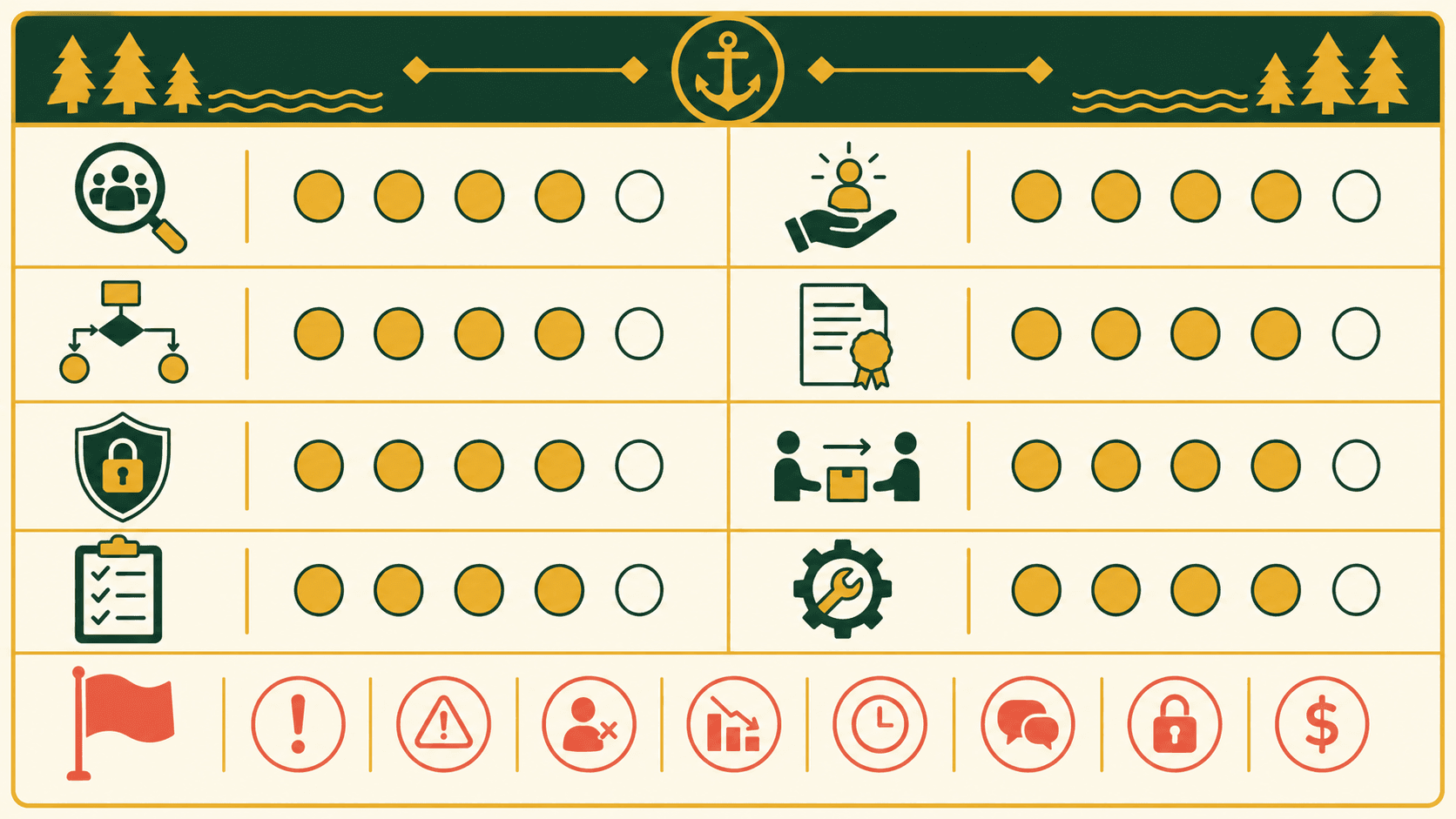

Short answer: A buyer's checklist for discovery, data, safety, ownership, handover, maintenance, pricing and vendor red flags. Recent Reddit discussions suggest operators care more about repetitive work, reliability and implementation than technology labels. Reddit is qualitative research, not a representative SME sample, so these concerns frame questions rather than market statistics.
Guiding principle: start with observable leakage, design human control and expand only when evidence shows the workflow outperforms the old process.
Do they study the workflow or sell a tool?
A strong partner asks about real cases, exceptions, owners and baselines before proposing a stack. Comparison should use the same baseline, the same risk frame and the same ownership model so the cheapest quote does not win by accident.
The risk to confront
A first-call demo does not prove operational understanding. The risk is comparing quotes or demos that do not share the same scope, then drawing the wrong conclusion about the best option.
Recommended action
Ask them to restate the workflow and unknowns. Use one scorecard for scope, support, ownership, data and risk before looking at price.
Data and access design
The proposal should name data sources, least privilege, retention and access revocation. Comparison should use the same baseline, the same risk frame and the same ownership model so the cheapest quote does not win by accident.
The risk to confront
Sharing admin accounts for speed creates lasting risk. The risk is comparing quotes or demos that do not share the same scope, then drawing the wrong conclusion about the best option.
Recommended action
Use service accounts, a permission matrix and access logs. Use one scorecard for scope, support, ownership, data and risk before looking at price.
Evaluation and safety gates
A vendor should explain tests for correct cases, failures, exceptions and sensitive actions. Comparison should use the same baseline, the same risk frame and the same ownership model so the cheapest quote does not win by accident.
The risk to confront
The model is smart is not a control plan. The risk is comparing quotes or demos that do not share the same scope, then drawing the wrong conclusion about the best option.
Recommended action
Require an evaluation set, acceptance thresholds and rollback. Use one scorecard for scope, support, ownership, data and risk before looking at price.
Ownership and handover
Contracts should clarify ownership of workflows, prompts, documents, accounts and generated data. Comparison should use the same baseline, the same risk frame and the same ownership model so the cheapest quote does not win by accident.
The risk to confront
Hidden lock-in appears when the business tries to switch providers. The risk is comparing quotes or demos that do not share the same scope, then drawing the wrong conclusion about the best option.
Recommended action
Require an architecture map, runbook and export procedure. Use one scorecard for scope, support, ownership, data and risk before looking at price.
Maintenance is mandatory
APIs, policies and data change; production needs monitoring, incident response and reviews. Comparison should use the same baseline, the same risk frame and the same ownership model so the cheapest quote does not win by accident.
The risk to confront
Build-and-disappear engagements allow workflows to decay silently. The risk is comparing quotes or demos that do not share the same scope, then drawing the wrong conclusion about the best option.
Recommended action
Agree SLAs, maintenance scope and change pricing. Use one scorecard for scope, support, ownership, data and risk before looking at price.
Pricing and claim red flags
Be cautious of guaranteed ROI, assumption-free quotes and promises to replace an entire team immediately. Comparison should use the same baseline, the same risk frame and the same ownership model so the cheapest quote does not win by accident.
The risk to confront
Absolute claims often hide weak discovery and proof. The risk is comparing quotes or demos that do not share the same scope, then drawing the wrong conclusion about the best option.
Recommended action
Compare vendors on outcome, risk, ownership and total cost. Use one scorecard for scope, support, ownership, data and risk before looking at price.
Decision checklist
- Does the problem occur frequently enough and cause visible loss?
- Are inputs, outputs, owners and exceptions documented?
- Is there a system of record and least-privilege access?
- Are human gates, logs and rollback defined?
- Will baseline and pilot results use the same measurement?
Conclusion
How to Evaluate an AI Automation Partner Before Signing becomes an advantage only when the business has discipline around data, ownership and measurement. The better starting question is not which AI to buy, but which workflow deserves redesign first. Golden Sea approaches Automation Operations as audit, standardize, pilot, measure and scale—with AI assisting and humans retaining authority over consequential decisions.
Continue with: Businesses Do Not Need an AI Agent — They Need Less Leakage · Why AI Automation Creates More Work Instead of Less · Is AI Automation Really Worth the Cost for an SME?