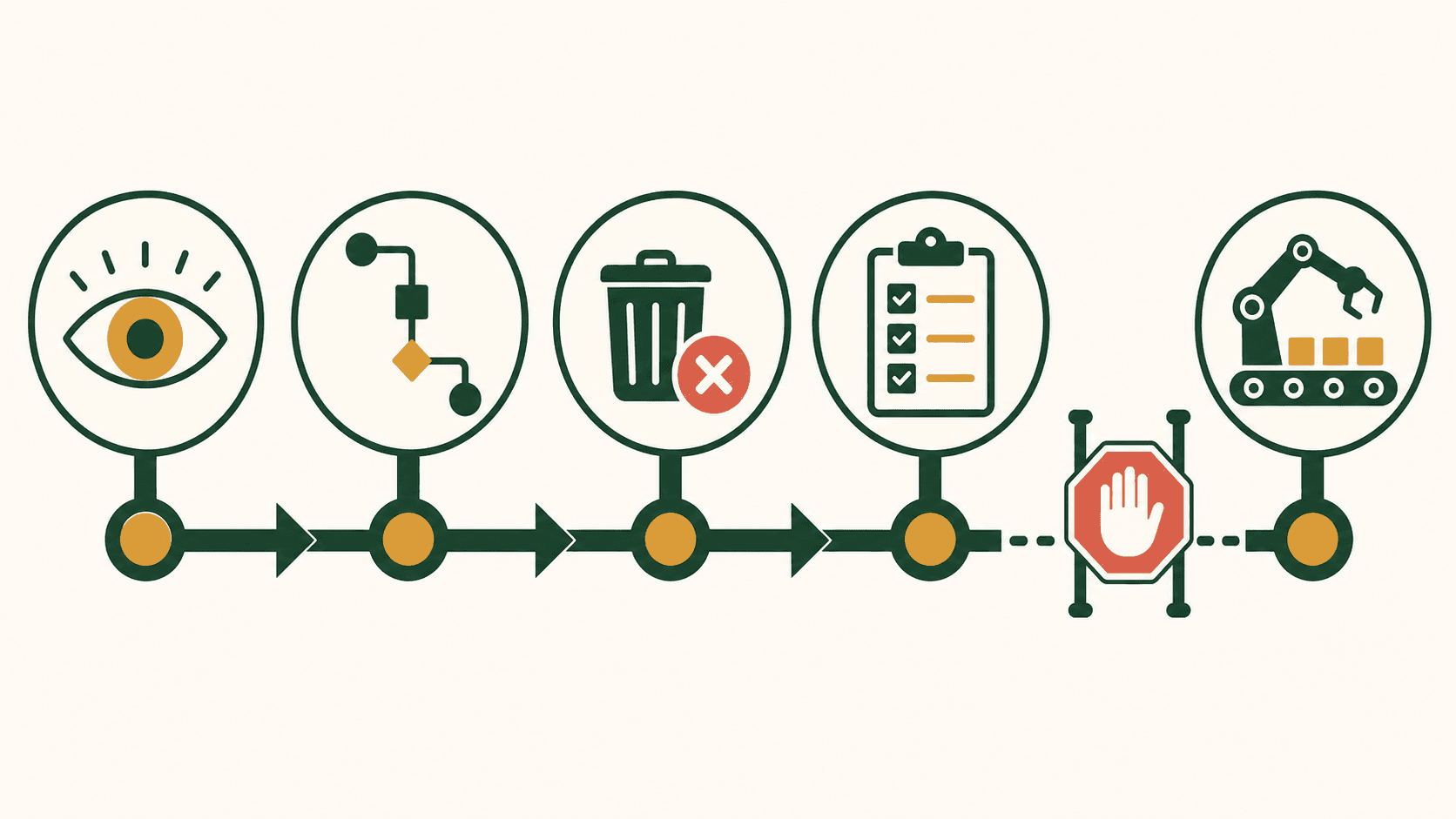

Short answer: Automation amplifies strengths and weaknesses. Use Observe–Map–Remove–Standardize–Automate before building. Recent Reddit discussions suggest operators care more about repetitive work, reliability and implementation than technology labels. Reddit is qualitative research, not a representative SME sample, so these concerns frame questions rather than market statistics.
Guiding principle: start with observable leakage, design human control and expand only when evidence shows the workflow outperforms the old process.
Automation is an amplifier
A system that executes a bad process faster still produces bad outcomes and becomes harder to stop. The right sequence is usually standardize first and automate second, because automation only scales what already exists in the process.
The risk to confront
Speed obscures causes as errors propagate across systems. The risk is automating a process with unclear ownership, unclear exceptions and unclear measurement, then scaling disorder instead of control.
Recommended action
Measure manual quality before adding automation. Map the process, remove unnecessary steps, standardize the inputs and only then add automation to the last layer.
Observe the real work
SOPs describe what should happen; observation reveals what actually happens. The right sequence is usually standardize first and automate second, because automation only scales what already exists in the process.
The risk to confront
Ignoring workarounds creates a design that fails on busy days. The risk is automating a process with unclear ownership, unclear exceptions and unclear measurement, then scaling disorder instead of control.
Recommended action
Follow 20 cases including failures and exceptions. Map the process, remove unnecessary steps, standardize the inputs and only then add automation to the last layer.
Map handoffs and decisions
A useful map records the recipient, required data, waiting time and decision criteria. The right sequence is usually standardize first and automate second, because automation only scales what already exists in the process.
The risk to confront
Task boxes alone miss the true leakage points: handoffs. The risk is automating a process with unclear ownership, unclear exceptions and unclear measurement, then scaling disorder instead of control.
Recommended action
Mark every change of owner or system. Map the process, remove unnecessary steps, standardize the inputs and only then add automation to the last layer.
Remove non-value work
Not every existing step deserves automation. The right sequence is usually standardize first and automate second, because automation only scales what already exists in the process.
The risk to confront
Automating redundant approval merely accelerates bureaucracy. The risk is automating a process with unclear ownership, unclear exceptions and unclear measurement, then scaling disorder instead of control.
Recommended action
Remove duplicate steps, unused data and unread reports. Map the process, remove unnecessary steps, standardize the inputs and only then add automation to the last layer.
Standardize the definition of done
Inputs and outputs need a minimum schema so humans and systems interpret them consistently. The right sequence is usually standardize first and automate second, because automation only scales what already exists in the process.
The risk to confront
If done depends on who is on duty, automation will require constant manual correction. The risk is automating a process with unclear ownership, unclear exceptions and unclear measurement, then scaling disorder instead of control.
Recommended action
Use checklists and good/bad examples instead of vague prose. Map the process, remove unnecessary steps, standardize the inputs and only then add automation to the last layer.
Automate the deterministic part first
Start with repeatable, low-risk work that can be rolled back. The right sequence is usually standardize first and automate second, because automation only scales what already exists in the process.
The risk to confront
Putting sensitive decisions in the first pilot expands testing scope too quickly. The risk is automating a process with unclear ownership, unclear exceptions and unclear measurement, then scaling disorder instead of control.
Recommended action
Run in parallel, log everything and expand autonomy based on evidence. Map the process, remove unnecessary steps, standardize the inputs and only then add automation to the last layer.
Decision checklist
- Does the problem occur frequently enough and cause visible loss?
- Are inputs, outputs, owners and exceptions documented?
- Is there a system of record and least-privilege access?
- Are human gates, logs and rollback defined?
- Will baseline and pilot results use the same measurement?
Conclusion
Do Not Automate a Process That Is Already Chaotic becomes an advantage only when the business has discipline around data, ownership and measurement. The better starting question is not which AI to buy, but which workflow deserves redesign first. Golden Sea approaches Automation Operations as audit, standardize, pilot, measure and scale—with AI assisting and humans retaining authority over consequential decisions.
Continue with: Businesses Do Not Need an AI Agent — They Need Less Leakage · Why AI Automation Creates More Work Instead of Less · Is AI Automation Really Worth the Cost for an SME?