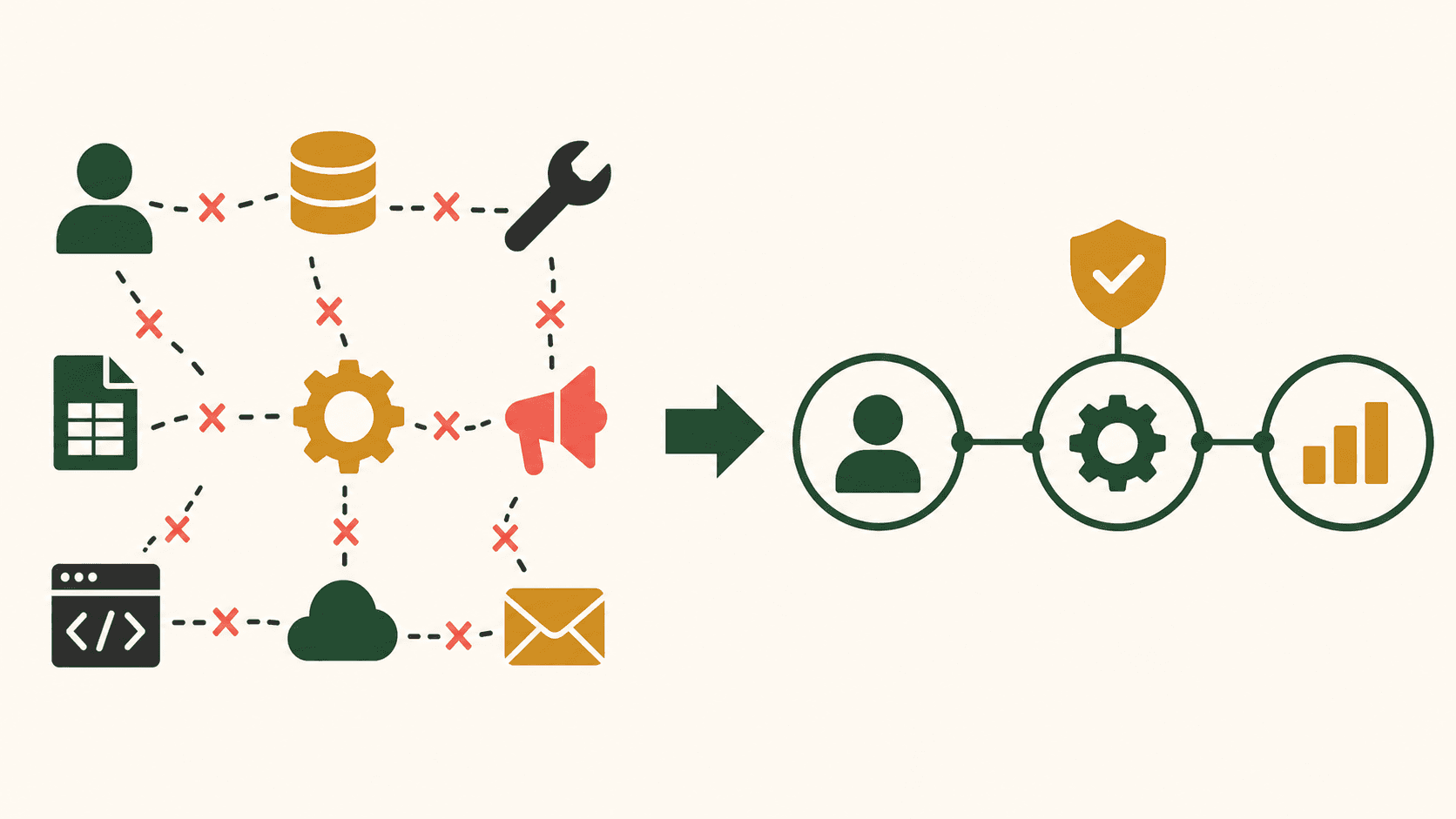

Short answer: Tool sprawl creates integration tax, failures and weak ownership. Start with one operating workflow instead of ten AI apps. Recent Reddit discussions suggest operators care more about repetitive work, reliability and implementation than technology labels. Reddit is qualitative research, not a representative SME sample, so these concerns frame questions rather than market statistics.
Guiding principle: start with observable leakage, design human control and expand only when evidence shows the workflow outperforms the old process.
A tool is not a system
Ten capable apps do not automatically form a continuous operation. The baseline should separate volume, waiting time, error rate and handoff friction so the team can see what automation actually changes.
The risk to confront
The gaps between tools become copy-paste work and unclear responsibility. The risk is comparing quotes or demos that do not share the same scope, then drawing the wrong conclusion about the best option.
Recommended action
Map the end-to-end outcome before selecting components. Use one scorecard for scope, support, ownership, data and risk before looking at price.
Integration tax grows with connections
Each connection adds authentication, mapping, retry logic, versions and monitoring. The baseline should separate volume, waiting time, error rate and handoff friction so the team can see what automation actually changes.
The risk to confront
Maintenance cost grows faster than visible subscription fees. The risk is comparing quotes or demos that do not share the same scope, then drawing the wrong conclusion about the best option.
Recommended action
Count handoffs and failure points, not just licenses. Use one scorecard for scope, support, ownership, data and risk before looking at price.
Ownership becomes fragmented
Marketing owns one app, sales another and engineering owns webhooks while nobody owns the outcome. The baseline should separate volume, waiting time, error rate and handoff friction so the team can see what automation actually changes.
The risk to confront
Failures are reassigned rather than resolved at the root. The risk is comparing quotes or demos that do not share the same scope, then drawing the wrong conclusion about the best option.
Recommended action
Assign one process owner for the whole workflow. Use one scorecard for scope, support, ownership, data and risk before looking at price.
Observability before sophistication
A simple workflow with logs and metrics beats a sophisticated agent chain nobody can observe. The baseline should separate volume, waiting time, error rate and handoff friction so the team can see what automation actually changes.
The risk to confront
Without intermediate state, debugging becomes guesswork. The risk is comparing quotes or demos that do not share the same scope, then drawing the wrong conclusion about the best option.
Recommended action
Log input, decision, action, result and exception. Use one scorecard for scope, support, ownership, data and risk before looking at price.
Choose the first workflow deliberately
Score pain, frequency, clarity, risk and measurability. The baseline should separate volume, waiting time, error rate and handoff friction so the team can see what automation actually changes.
The risk to confront
Choosing novelty often produces infrequent use cases. The risk is comparing quotes or demos that do not share the same scope, then drawing the wrong conclusion about the best option.
Recommended action
Prioritize high pain, high frequency, clear rules and manageable risk. Use one scorecard for scope, support, ownership, data and risk before looking at price.
A 30-day plan
Week one observes, week two standardizes, week three builds and tests, week four runs in parallel and measures. The baseline should separate volume, waiting time, error rate and handoff friction so the team can see what automation actually changes.
The risk to confront
Buying tools before discovery reverses the decision process. The risk is comparing quotes or demos that do not share the same scope, then drawing the wrong conclusion about the best option.
Recommended action
Add a tool only when the workflow proves that capability is needed. Use one scorecard for scope, support, ownership, data and risk before looking at price.
Decision checklist
- Does the problem occur frequently enough and cause visible loss?
- Are inputs, outputs, owners and exceptions documented?
- Is there a system of record and least-privilege access?
- Are human gates, logs and rollback defined?
- Will baseline and pilot results use the same measurement?
Conclusion
One Good Workflow Is Better Than Ten AI Tools becomes an advantage only when the business has discipline around data, ownership and measurement. The better starting question is not which AI to buy, but which workflow deserves redesign first. Golden Sea approaches Automation Operations as audit, standardize, pilot, measure and scale—with AI assisting and humans retaining authority over consequential decisions.
Continue with: Businesses Do Not Need an AI Agent — They Need Less Leakage · Why AI Automation Creates More Work Instead of Less · Is AI Automation Really Worth the Cost for an SME?