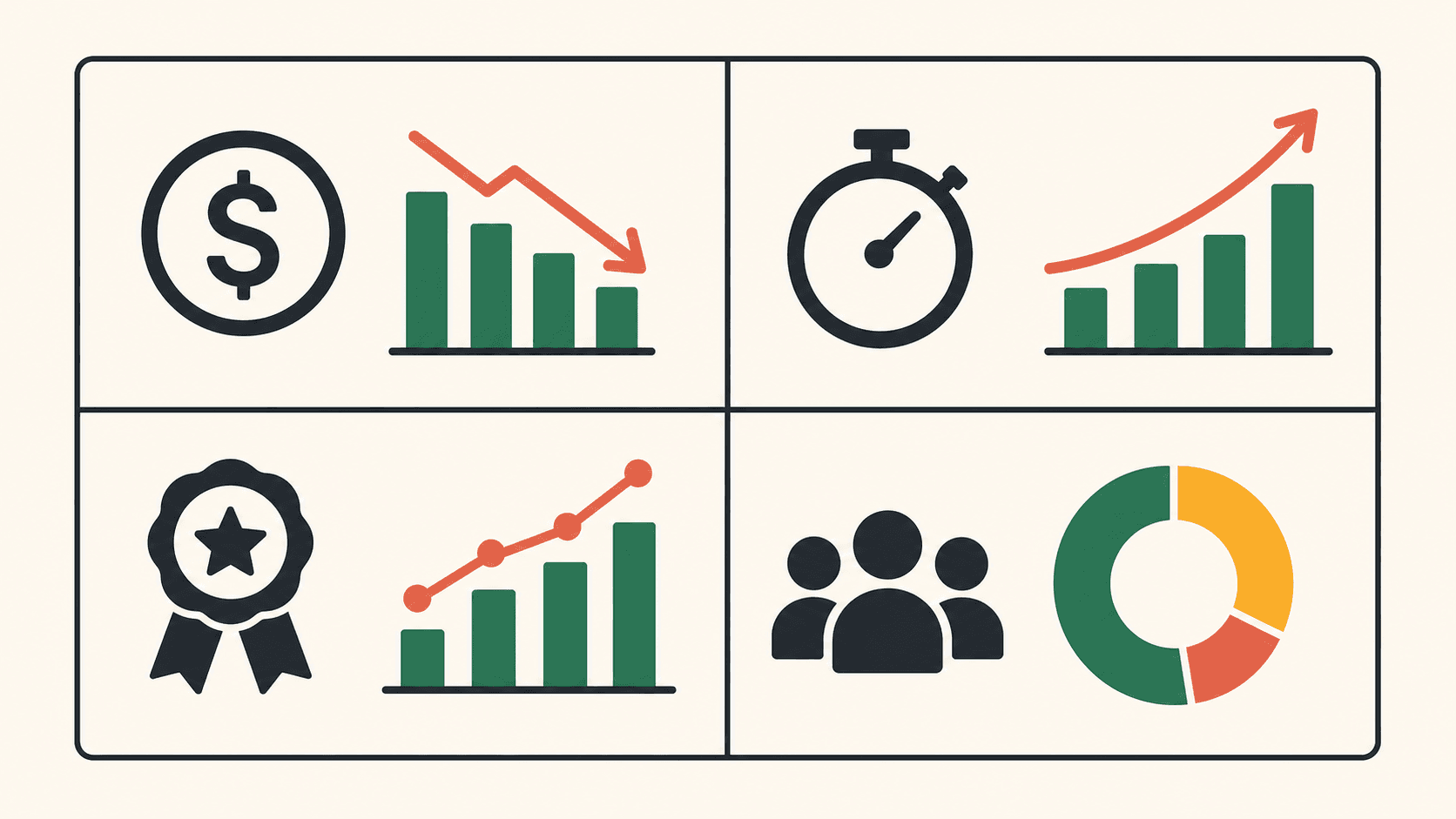
AI automation ROI is not just hours saved multiplied by an hourly wage. A workflow can run faster while producing more errors, frustrating customers, or forcing managers to double-check more work. To know whether AI is creating value, SMEs need to measure cost, speed, quality, customer outcomes, and risk at the same time.
The framework below includes 12 practical metrics. You don't need all of them for every project. Pick one primary outcome metric, three to five leading indicators, and a set of guardrails to protect quality.
The basic ROI formula
ROI = (financial value created or losses avoided − total AI cost) / total AI cost. Total cost includes setup, integration, software, models, data, oversight time, error fixing, training, and maintenance. Value can come from cost reduction, increased capacity, retained leads, higher revenue, or reduced risk.
Not every kind of value converts precisely into money right away. In that case, report on two levels: directly measured operational impact, and financial assumptions with the methodology spelled out. Transparency beats a big ROI number nobody can recalculate.
Group 1: economic metrics
1. Cost per output that meets the standard
Divide the total process cost by the number of outputs that pass the approval bar. For content, that means approved articles, not generated drafts. For customer service, it means correctly resolved conversations. This is a powerful metric because it combines volume and quality.
2. Incremental cost per unit of volume
Measure the cost of adding 100 more conversations, 10 more articles, or 1,000 more records. AI usually has a scaling advantage, but model fees, API costs, and review overhead can rise quickly. This metric helps the business budget for peak periods.
3. Recovered opportunity cost
Time the business owner no longer spends stitching reports together or chasing deadlines can shift to sales, product, or partnerships. Record the hours freed up and describe the higher-value work done instead — don't assume every saved hour automatically turns into money.
Group 2: speed and capacity
4. Cycle time
Cycle time is the time from trigger to finished output. For example, from receiving a brief to an approved piece of content, or from a customer's message to its resolution. Measure the median along with high percentiles so the very slow cases don't stay hidden.
5. Quality-adjusted throughput
This is the number of outputs that meet the standard within a given period. If throughput rises but the major-revision rate rises too, the system is just pushing work onto reviewers. Always look at throughput together with quality.
6. SLA compliance rate
SLAs are useful for inboxes, follow-ups, and reports. Track the percentage of cases completed within the committed deadline, not just the average time. A pretty average can still hide many customers waiting far too long.
Group 3: quality and control
7. First-pass acceptance rate
The rate of outputs approved on the first attempt reflects how well the Agent understands the standards. If it's low, fast generation time is meaningless. Categorize rejection reasons to know whether to fix the data, the instructions, or the logic.
8. Rework rate
Measure the percentage of outputs needing major revision and the time spent fixing them. A policy-violating answer should carry more weight than a punctuation error. Classify errors as minor, moderate, or severe to avoid treating all errors as equal.
9. Human escalation rate
A lower escalation rate is not always better. Correctly escalating sensitive situations is a sign of good control. Also measure escalation precision: of the cases escalated, how many truly needed a human; and of the cases not escalated, did any dangerous ones slip through?
Group 4: customers and revenue
10. Lead leakage rate
The percentage of qualified leads that never get a response or an on-time follow-up. If the workflow reduces this number, the value is usually closer to revenue than hours saved. Agree on what counts as a qualified lead before measuring.
11. Stage-by-stage conversion rate
Compare inbox to booking, quote to reply, or past customer to repeat purchase. Don't attribute the entire change to AI if you're simultaneously running ads or changing prices. Use a control group or a staged rollout where possible.
12. Customer experience signals
Measure negative feedback, the rate of customers asking for a human, resolution time, and short post-interaction surveys. An AI that replies fast but goes in circles can make the experience worse. Qualitative review of real conversations helps explain the numbers.
Guardrail metrics you can't skip
- Number of severe errors or policy violations.
- Data and access-control incidents.
- Content with no source or with expired sources.
- Workflow failure rate due to integrations.
- System downtime.
- Number of complaints related to automated interactions.
A guardrail crossing its threshold can justify pausing even when short-term ROI is positive. Losses of trust and data usually outweigh the costs just saved.
Designing the right baseline
Measure the old way of working for at least one representative cycle. Record seasonality, shifts, and case difficulty. If a control group isn't possible, roll out to one channel or a small group first. Compare like cases with like — don't let the AI handle the easy cases while humans get all the hard ones.
Keep metric definitions fixed. If at the start of the project “resolved conversation” means the customer got an answer, don't redefine it as “the chatbot sent a message” in the end-of-period report.
A one-page scorecard template
| Layer | Primary metric | Target | Guardrail |
|---|---|---|---|
| Economics | Cost per output meeting the standard | Decrease over the pilot | No hidden oversight costs |
| Operations | Cycle time, SLA | Faster and more consistent | No backlog pushed onto humans |
| Quality | First-pass acceptance | Steadily increasing | No severe errors |
| Customers | Lead leakage, feedback | Improving | No increase in complaints |
Numbers that easily mislead
“Ten times faster content creation” doesn't say whether the content gets used. “Handles 80% of questions” doesn't say how many answers were correct. “Saves 100 hours” doesn't say what staff did with those 100 hours. Every claim should come with a denominator, timeframe, scope, and methodology.
When you don't have a real case study yet, label the number as a hypothesis or scenario. Golden Sea currently does not use the 50-million-down-to-10-million calculation as universal proof; it's a benchmark that must be validated separately for each business.
Reporting cadence
During the pilot, check errors and guardrails daily, report on operations weekly, and evaluate ROI after a sufficiently long cycle. Once stable, reduce manual reporting frequency but keep real-time alerts for severe errors.
Conclusion
Trustworthy AI ROI is a measurement system, not a multiplication. It connects total cost to quality-adjusted output, speed, customers, and risk. Choose few metrics, but define them clearly and make them traceable.
Before measuring, the business needs a pilot with a baseline. See the 90-day AI Automation roadmap to design the experiment and the scale-up decision points.
Read next: How to Evaluate an AI Automation Partner Before Signing · Is AI Automation Really Worth the Cost for an SME?