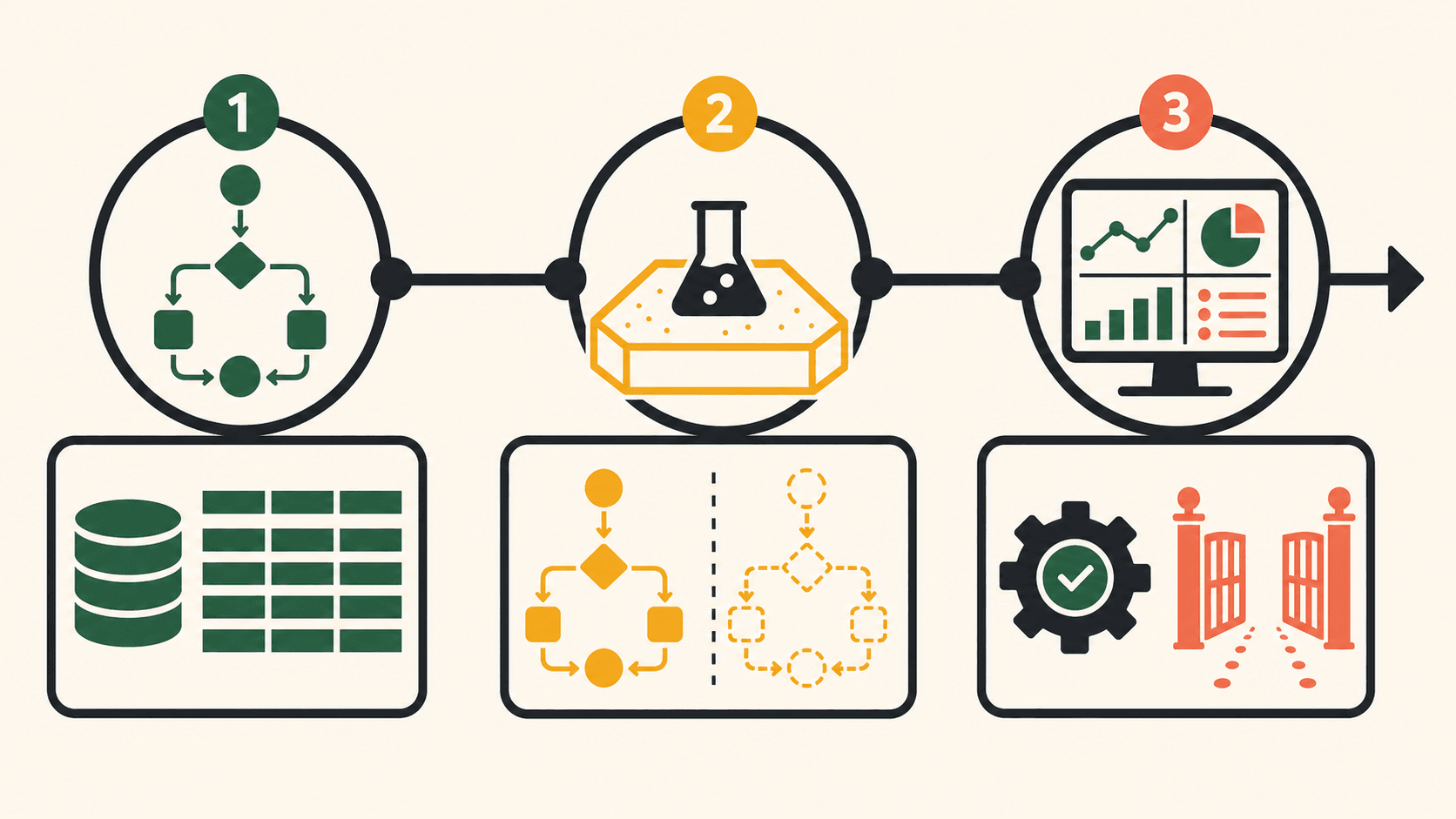

A 90-day AI Automation roadmap should deliver one workflow that runs reliably, with before-and-after metrics and control mechanisms in place. The goal is not to automate the entire business. If, after 90 days, the organization knows which use case works, which errors keep recurring and what conditions must be met to scale, the pilot has already created value.
The plan below splits into three phases: the first 30 days for standardizing and choosing the problem; the next 30 for building and testing; the final 30 for supervised operation, evaluation and the scaling decision. This approach suits SMEs because it keeps scope small, minimizes disruption and forces the project to stay tied to real outcomes.
Before day 1: pick who is accountable
Every pilot needs a business owner who understands the process and has decision-making authority. This person doesn't have to be technical. They are responsible for defining the output, approving exceptions and confirming that the workflow actually makes the work better.
You also need an implementer, the direct users, and someone who signs off on data and risk. In an SME, one person may wear several hats, but responsibilities must be written down. A vague "AI team" usually means everyone has opinions and no one makes decisions.
Days 1–30: understand and standardize
Week 1: build the opportunity list
Interview the people doing the work and observe the process. Record triggers, data, tools, steps, waiting points, errors and exceptions. Lead with "where does time go every week?" rather than "what do you want AI to do?"
Score opportunities by frequency, cost, clarity, risk and measurability. Choose one narrowly scoped workflow: inbox triage, content drafting, lead syncing or the weekly report. Avoid use cases that require changing multiple systems at once.
Week 2: measure the baseline
Measure at least five current-state metrics: processing time, output volume, error rate, revision cycles and management time. If the workflow touches customers, add SLA, response rate and downstream outcomes. The baseline doesn't need to be perfect, but it must be good enough to compare against.
Sample a wide range of cases, including normal ones and exceptions. If you only measure the easy cases, the pilot will look good on paper and fail in real operation.
Week 3: standardize data and quality bars
Establish sources of truth: which price list is official, which brand documents are in use, which CRM fields are mandatory. Remove duplicates and expired documents. Assign an owner and a last-updated date to every critical source.
Create an output checklist. A qualifying answer must follow policy, be clear, match the brand voice and leak no data. A qualifying content piece must have sources, an argument, structure and a review step. AI can only be evaluated once humans agree on what "good" means.
Week 4: design the workflow and its controls
Map the future flow: triggers, automation steps, Agent steps, approvals, fallbacks and logs. Classify actions into three groups: allowed autonomously, requires approval, forbidden. Set thresholds for handing off to a human when data is missing or confidence is low.
Days 31–60: build, test and pilot
Weeks 5–6: build the smallest version
Integrate only the systems you need. If the goal is inbox triage, you don't yet need automated follow-ups and advanced reporting. A small version makes it clear whether errors come from the model, the data or the process design.
Build a test suite covering common, edge and dangerous cases, with expected results for each. Every change to prompts, data or logic must rerun the suite, so fixing one error doesn't create another.
Week 7: run in shadow mode
In shadow mode, the AI generates recommendations but takes no real action. Employees keep working the old way and compare. This is how you collect data without putting customers at risk.
Classify errors: misread intent, wrong source, missing data, wrong action or poor phrasing. Don't lump everything into "the AI isn't good yet." Each error type needs a different fix.
Week 8: a limited pilot
Let the workflow handle a small percentage of cases or a low-risk segment. Keep the kill switch, alerts and someone on call. Monitor daily during the first week instead of waiting for the end-of-month report.
Tell the users the goal, the scope and how to give feedback. If employees only see a new tool imposed on them, they tend to work around it or stop reporting errors. They should be treated as the people training the system with real-world experience.
Days 61–90: stabilize and decide on scaling
Weeks 9–10: optimize from real data
Prioritize errors that are frequent or high-consequence. Update the knowledge base, adjust human-handoff thresholds and simplify redundant steps. Don't optimize to shave a few seconds while quality is still unstable.
Compare against the baseline: total time, human intervention time, outputs meeting the bar, cost, errors and customer outcomes. Include supervision and error-fixing time to avoid phantom ROI.
Week 11: standardize operations
Write a runbook covering how to start, check, handle errors, stop the workflow, recover and who to contact. Set a data-update schedule and a review cadence. An Agent is not an install-and-forget project; data and external tools keep changing.
Weeks 12–13: decide
Three outcomes are all legitimate: scale, extend the pilot or stop. Scale when quality clears the threshold, the impact is large enough and the team can govern it. Extend if the potential is clear but the sample is too small. Stop if the cost of control exceeds the benefit or the process simply isn't a fit.
The 90-day scorecard
| Area | Question |
|---|---|
| Value | Which outputs or outcomes improved? |
| Quality | What is the pass rate, and how many serious errors? |
| People | Did the team save time or gain a burden? |
| Control | Is there traceability, handoff and a safe stop? |
| Economics | How did total cost per output change? |
| Scaling | Is the next bottleneck in data, process or technology? |
How to avoid operational disruption
- Run in parallel before replacing the old way.
- Cap the share of cases AI handles.
- Keep employees' right to take over.
- Alert when integrations or data fail.
- Never change several variables at once.
- Schedule rollouts outside peak periods.
What should the budget include?
A pilot budget covers process analysis, data cleanup, integration work, tool and model fees, users' time, testing, training and support. Don't count only the API bill. Most failures don't come from the price per token — they come from data and processes that weren't ready.
Conclusion
In 90 days, a business should produce operational proof, not a demo. That proof consists of a working workflow, a scorecard, an error log, a runbook and a decision on the next investment.
If you haven't chosen a use case yet, start with the 5 processes SMEs should automate first. Golden Sea delivers on the principles of small scope, before-and-after measurement, and keeping humans at the critical decision points.
Read next: What Is an AI Operations Audit and Why Do It Before Automation? · Measuring AI Automation ROI: 12 Metrics Beyond Hours Saved