
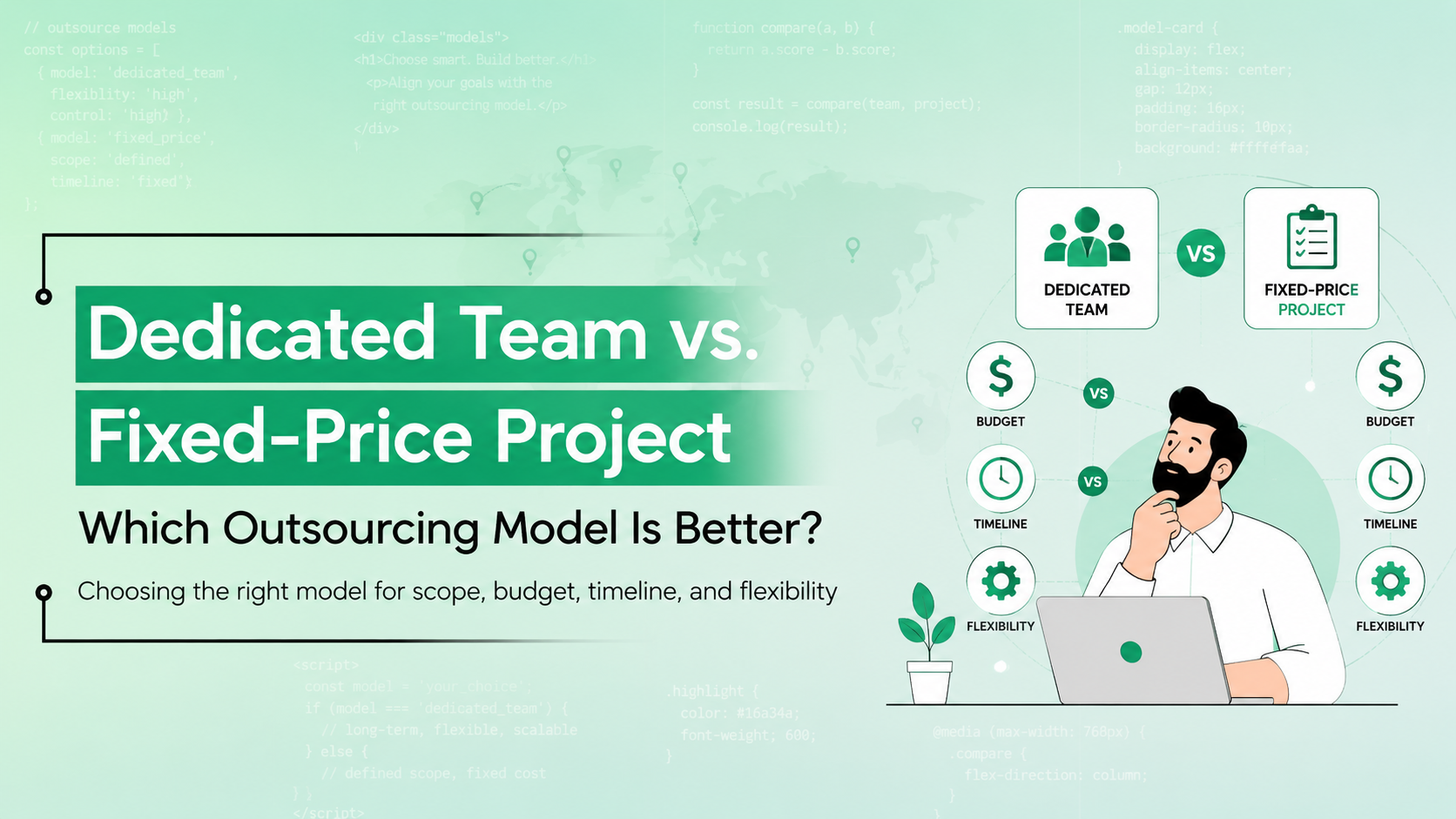
Dedicated Team vs Fixed Price: Which Outsourcing Model Is Better?
Dedicated team vs fixed price is a common question when companies choose an outsourcing model. The right choice depends on your scope, timeline, budget, and how often the product may change.
A fixed-price project works well when the scope is clear, the timeline is predictable, and the expected deliverables are already defined. A dedicated team works better when the product changes often, needs long-term development, or requires ongoing support.
In simple terms, fixed price is better for clear projects. A dedicated team is better for evolving products.
This guide explains the difference between both models, their pros and cons, when to choose each one, and how to decide which outsourcing model fits your project.
What Is a Fixed-Price Project?
A fixed-price project is an outsourcing model where the client and development team agree on a defined scope, timeline, and price before the work begins.
This model works best when the project requirements are clear.
For example, a company may need a landing page, a simple MVP, a mobile app prototype, a dashboard, or a specific set of game assets. If the deliverables are easy to define, the outsourcing team can estimate the cost and timeline more accurately.
In this model, both sides usually agree on the project scope, feature list, timeline, deliverables, review process, payment milestones, and change request process.
Because of this, fixed-price projects can feel easier to control. The client knows what will be delivered, when it should be delivered, and how much it should cost.
However, the fixed-price model depends heavily on clear requirements. If the scope changes often, the project may need extra change requests, timeline updates, or additional budget.
What Is a Dedicated Team?
A dedicated team is an outsourcing model where the client works with assigned developers, designers, project managers, QA testers, or specialists over a longer period.
Instead of agreeing on one fixed project scope, the client gets an ongoing team that can support product development over time.
This model works well when the product is still evolving.
For example, a startup may need to build an MVP first, then improve it based on user feedback. A game studio may need ongoing UI, art, and Unity support. An agency may need a white-label team for multiple client projects. A business may need continuous AI automation and internal tool development.
In a dedicated team model, the client usually pays based on team size and time.
For example, the team may include one full-stack developer, one UI/UX designer, one project manager, one QA tester, or one AI automation specialist.
The exact structure depends on the project.
This model gives more flexibility because the team can adjust priorities as the product changes.
Dedicated Team vs Fixed Price: The Main Difference
The main difference is how the work is planned and managed.
Fixed-price projects are based on a defined scope. Dedicated teams are based on ongoing capacity.
A dedicated team vs fixed price comparison is useful because both models solve different project needs.
| Category | Fixed Price | Dedicated Team |
|---|---|---|
| Best for | Clear, defined projects | Ongoing or evolving products |
| Scope | Fixed before development | Flexible and adjustable |
| Budget | Agreed upfront | Based on team size and time |
| Timeline | Usually fixed | Can continue long-term |
| Flexibility | Lower | Higher |
| Change requests | May require extra cost | Easier to adjust priorities |
| Client involvement | Lower to medium | Medium to high |
| Risk | Scope misunderstanding | Poor management if priorities are unclear |
| Good example | MVP with clear features | Product that changes after user feedback |
Both models can work well. However, they solve different problems.
Pros of a Fixed-Price Project
A fixed-price project can be a good choice when the project is clear from the beginning.
One major benefit is budget predictability. The client knows the estimated cost before development starts.
Another benefit is scope control. Since the deliverables are defined, both sides know what the project should include.
In addition, this model can be easier for non-technical founders who want a clear project plan and delivery timeline.
Fixed-price projects are useful when the scope is clear, the feature list is stable, the timeline is fixed, and the project has a clear end point.
For example, if you need a simple MVP with a defined user flow, a fixed-price model may work well.
Cons of a Fixed-Price Project
The fixed-price model can become difficult when the project changes often.
If the client wants to add new features during development, the team may need to adjust the timeline and budget. As a result, the project can become slower or more expensive than expected.
Another problem is that fixed-price projects require detailed planning upfront. If the initial requirements are unclear, the estimate may not match the real work.
In addition, this model can create pressure to protect the original scope. That is not always ideal for startups, because product ideas often change after user feedback.
A fixed-price model may not be the best fit when the product is still unclear, the founder expects many changes, the project needs continuous iteration, or the scope depends on user feedback.
In these cases, a dedicated team may be more practical.
Pros of a Dedicated Team
A dedicated team gives more flexibility.
This is useful when the product is still changing, when the client needs ongoing support, or when priorities may shift from week to week.
For example, after launching an MVP, a startup may learn that users want different features than expected. With a dedicated team, the founder can adjust the roadmap more easily.
Another benefit is continuity. The same team learns the product, understands the codebase, and becomes more familiar with the business context over time.
Dedicated teams are useful for long-term product development, MVP iteration after launch, ongoing app maintenance, AI automation workflows, game development support, SaaS product growth, agency white-label delivery, and continuous UI/UX improvement.
This model is especially helpful when the client needs a remote team that works like an extension of the internal team.
Cons of a Dedicated Team
A dedicated team also has risks.
The first risk is unclear direction. If the client does not define priorities, the team may spend time on less important work.
Another risk is budget control. Since the cost depends on time and team size, the client needs to manage the roadmap carefully.
In addition, dedicated teams require more active communication. The client should review progress, set priorities, and provide feedback regularly.
A dedicated team may not be ideal when the project is very small, the scope is already fixed, the client wants a single one-time delivery, or the budget cannot support ongoing work.
Because of this, dedicated teams work best when the client has a product roadmap or an ongoing need.
When Should You Choose Fixed Price?
Choose fixed price when the project is clear, limited, and easy to define.
This model is a good fit when you can explain the exact deliverables before development begins.
For example, fixed price may work well for a landing page, clickable prototype, simple MVP, defined admin dashboard, small mobile app, fixed game asset package, specific automation workflow, website redesign, or proof-of-concept build.
In these cases, the outsourcing team can estimate the work more accurately.
Fixed price is also useful when the founder needs budget certainty. If the project has a clear beginning and end, this model can reduce uncertainty.
However, the client should still prepare a clear brief, feature list, user flow, and acceptance criteria before asking for an estimate.
When Should You Choose a Dedicated Team?
Choose a dedicated team when the product is expected to change or grow over time.
This model works well when you need long-term development capacity, flexible priorities, or continuous support.
For example, a dedicated team may be better for a SaaS product roadmap, marketplace that will grow after launch, mobile app with ongoing updates, AI automation systems, game project with LiveOps content, startup product development, agency white-label support, or internal business tools.
A dedicated team is also useful when the scope is not fully known yet.
Instead of trying to define everything upfront, the team can work in stages, review progress, and adjust based on feedback.
Dedicated Team vs Fixed Price for MVP Development
For MVP development, both models can work.
A dedicated team vs fixed price decision should start with how clear your MVP scope is.
A fixed-price project is better when the MVP scope is clear. For example, if the founder already knows the core user flow, must-have features, platform, and launch goal, fixed price can be a good choice.
However, if the MVP is still being shaped, a dedicated team may be more flexible.
Many startups use a hybrid approach.
First, they start with a fixed-scope discovery or MVP build. After launch, they move into a dedicated team model for iteration, maintenance, and new features.
This approach gives founders both structure and flexibility.
Dedicated Team vs Fixed Price for AI Automation
AI automation projects can be harder to estimate upfront because workflows often change after testing.
For example, an AI workflow may start with document summaries. Later, the team may need scoring rules, CRM integration, human review steps, reporting, or internal dashboards.
If the workflow is simple and clear, fixed price may work.
However, if the automation needs testing, prompt refinement, data cleanup, tool integration, and ongoing improvement, a dedicated team may be better.
This is especially true for AI agents, internal tools, and complex business workflows.
Dedicated Team vs Fixed Price for Game Development
Game development can also use either model.
A fixed-price model may work for a clear asset package, UI screen set, prototype, or defined feature.
For example, if a client needs 20 game icons in one style, the scope is clear enough for fixed price.
However, a dedicated team may work better for ongoing game production, LiveOps content, feature updates, Unity support, or long-term art pipeline work.
Game projects often evolve based on player feedback, events, monetization needs, and production schedules. Because of this, a dedicated team can provide more flexibility.
How to Choose Between Dedicated Team vs Fixed Price
The best outsourcing model depends on your scope, timeline, budget, and level of uncertainty.
Use this simple decision table.
| Situation | Better Model |
|---|---|
| Scope is clear | Fixed price |
| Budget must be predictable | Fixed price |
| Timeline is short and defined | Fixed price |
| Project has a clear end point | Fixed price |
| Product will change often | Dedicated team |
| You need long-term support | Dedicated team |
| You need ongoing development | Dedicated team |
| Scope is still being discovered | Dedicated team |
| You need both structure and flexibility | Hybrid model |
This table is not a strict rule. However, it can help you choose the right direction.
For short and clear projects, the dedicated team vs fixed price choice often points toward fixed price. For long-term product development, the dedicated team vs fixed price choice often points toward a dedicated team.
Questions to Ask Before Choosing a Model
Before choosing between fixed price and dedicated team, ask these questions:
Do we know the exact scope?
Are the features likely to change?
Do we need only one delivery or ongoing support?
Is the budget fixed or flexible?
How quickly do we need to launch?
Who will manage priorities?
How often can we review progress?
Do we need design, development, QA, or AI automation support?
Will the product continue after launch?
Do we need a long-term partner?
These questions help clarify whether you need a project delivery model or an ongoing team model.
Red Flags to Watch For
Be careful if an outsourcing team recommends one model for every situation.
A reliable partner should explain the trade-offs.
For example, fixed price is not always cheaper if the scope changes often. At the same time, a dedicated team is not always better if the project is small and clearly defined.
Other red flags include no clear scope discussion, no explanation of change requests, no timeline breakdown, no communication process, no ownership clarity, no testing plan, no discussion of risks, and no advice on reducing scope.
A good outsourcing partner should help you choose the model that fits your project, not the model that benefits them most.
How Golden Sea Helps Choose the Right Model
Golden Sea helps clients choose between fixed-price projects, dedicated teams, and hybrid models based on project scope and timeline.
The process usually starts by understanding the product goal, current stage, must-have features, expected changes, launch timeline, and budget range.
After that, Golden Sea can suggest whether the project should be fixed scope, dedicated team, or a combination of both.
For example, if your MVP scope is clear, Golden Sea may suggest a fixed-price build. If your product will change after launch, a dedicated team may be a better fit. If you need to validate the idea first, a short discovery phase can help define the right model.
The goal is not to force one structure. Instead, the goal is to choose the model that reduces risk and supports your project.
Golden Sea can help you evaluate the dedicated team vs fixed price model based on your project scope and timeline.
FAQ
What is the difference between a dedicated team and a fixed-price project?
A fixed-price project has a defined scope, timeline, and budget. A dedicated team gives you ongoing development capacity with more flexibility as the product changes.
Which model is better for MVP development?
If the MVP scope is clear, fixed price can work well. If the product may change after user feedback, a dedicated team or hybrid model may be better.
Is fixed price cheaper than a dedicated team?
Not always. Fixed price can be cost-effective for clear projects, but frequent changes can increase cost. A dedicated team may be more efficient for long-term or evolving products.
When should I choose a dedicated team?
Choose a dedicated team when you need ongoing development, flexible priorities, long-term support, or a product roadmap that may change over time.
Can I start with fixed price and switch to a dedicated team later?
Yes. Many startups begin with a fixed-scope MVP, then move into a dedicated team model for iteration, maintenance, and new features.
How do I know which outsourcing model fits my project?
Start by looking at scope clarity, timeline, budget, expected changes, and long-term needs. If you are not sure, a short discovery phase can help define the right model.
Final Thoughts
Dedicated team and fixed price are both useful outsourcing models.
Fixed price is better when the scope is clear, the budget needs to be predictable, and the project has a clear end point. A dedicated team is better when the product changes often, needs ongoing development, or requires long-term support.
For many startups and businesses, the best choice depends on the stage of the product.
If you need a defined MVP, fixed price may work well. If you need continuous product development, a dedicated team may be the better model. In some cases, a hybrid approach gives you both structure and flexibility.
Not sure which model fits your project? Golden Sea can help you choose based on scope and timeline.
Contact Golden Sea Studios:
Website: goldenseastudios.com
Email: info@goldenseastudios.com
Social Media: @goldenseastudios (Twitter, Instagram, Facebook)
Telegram: @goldenseastudio
We are available online to assist you with any inquiries or collaborations. Reach out to us through these channels and let’s connect!
