
AI & Automation Development Guide – How Businesses Can Improve Efficiency with AI
What Is AI & Automation Development?
AI & Automation development is the process of using artificial intelligence and automated workflows to help businesses reduce manual work, improve productivity, and operate more efficiently.
Instead of relying only on people to handle repetitive tasks, companies can use AI systems to process data, support customers, generate reports, qualify leads, manage internal workflows, and assist teams in daily operations.
In recent years, AI has moved beyond simple chatbots. Businesses are now exploring AI assistants, AI agents, and workflow automation systems that can perform multi-step tasks with human supervision. This makes AI a practical solution for companies that want to scale faster while keeping operations lean.
Market Overview & Business Demand
The demand for AI & Automation solutions is growing quickly as companies look for ways to improve efficiency without increasing operational costs too much.
For many businesses, the goal of AI is not to replace people completely. The real value is in removing repetitive and time-consuming work so teams can focus on strategy, creativity, customer relationships, and business growth.
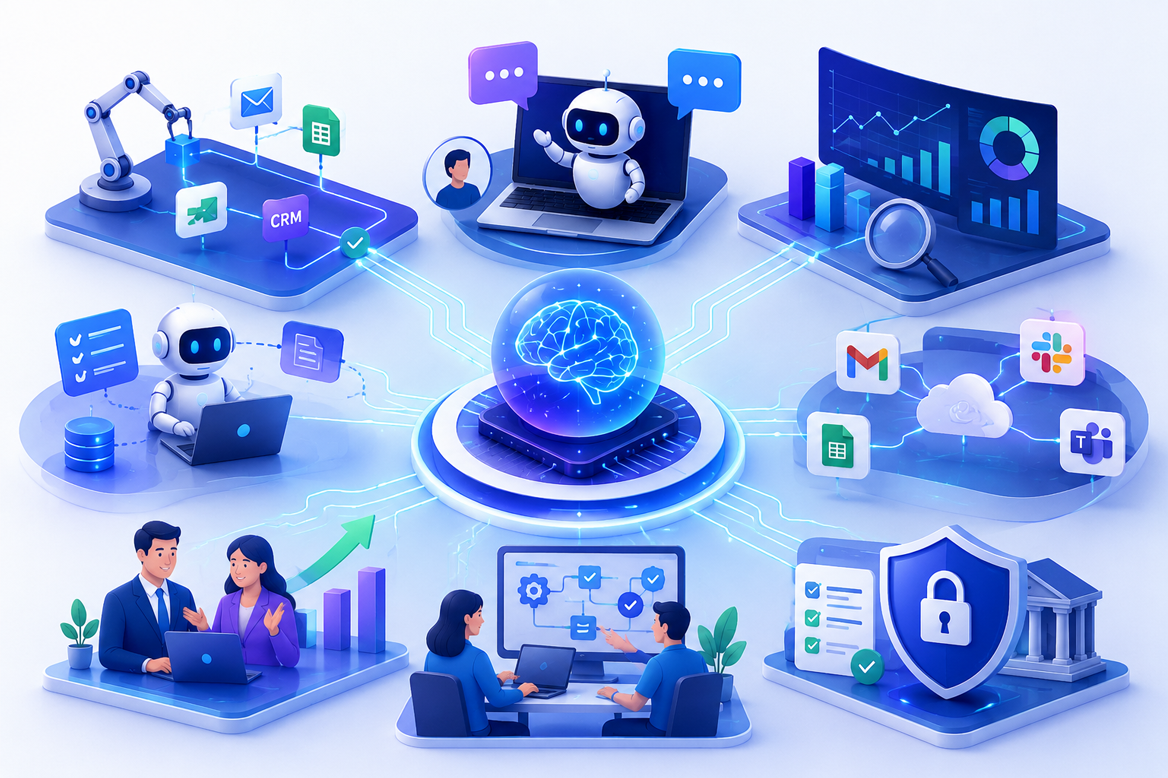
Common use cases include customer support chatbots, internal knowledge assistants, CRM automation, invoice processing, data analysis, content generation, lead scoring, and workflow management.
One of the biggest trends today is the rise of AI agents. Unlike traditional automation, AI agents can understand goals, process information, and assist with multi-step tasks across different tools. This creates new opportunities for businesses to build smarter and more flexible operations.
Key Types of AI & Automation Solutions
AI & Automation can be applied in many different ways depending on the business need.
Workflow automation is one of the most common solutions. It connects repetitive tasks across tools such as email, CRM systems, spreadsheets, project management platforms, and internal databases. This helps businesses save time, reduce manual errors, and keep operations consistent.
AI-powered customer support is another popular use case. AI assistants can answer common questions, summarize tickets, suggest responses, and help support teams reply faster.
AI data analysis is also becoming more valuable. Businesses can use AI to summarize reports, detect patterns, forecast trends, and support better decision-making.
More advanced companies are now exploring AI agents. These systems can help research information, prepare reports, update databases, draft emails, and coordinate tasks across multiple platforms with human approval.
Benefits of AI & Automation for Businesses
The biggest benefit of AI & Automation is improved efficiency. Businesses can reduce the time spent on repetitive work and speed up daily processes.
AI can also improve consistency. Automated systems follow the same process every time, which helps reduce mistakes in data entry, reporting, customer communication, and internal workflows.
Another important benefit is scalability. A company can handle more customers, more data, and more tasks without needing to expand the team at the same speed.
AI & Automation can also improve decision-making. By processing large amounts of information faster, AI systems can help teams identify trends, understand customer behavior, and make more informed business decisions.
For growing companies, this creates a strong competitive advantage. Businesses that adopt AI early can move faster, respond to market changes more quickly, and create better digital experiences for customers.
Factors That Affect AI & Automation Development Cost
The cost of AI & Automation development depends on several factors.
A simple automation workflow is usually more affordable than a custom AI system built from scratch. For example, automating email notifications or CRM updates is less complex than building a custom AI assistant connected to internal company data.
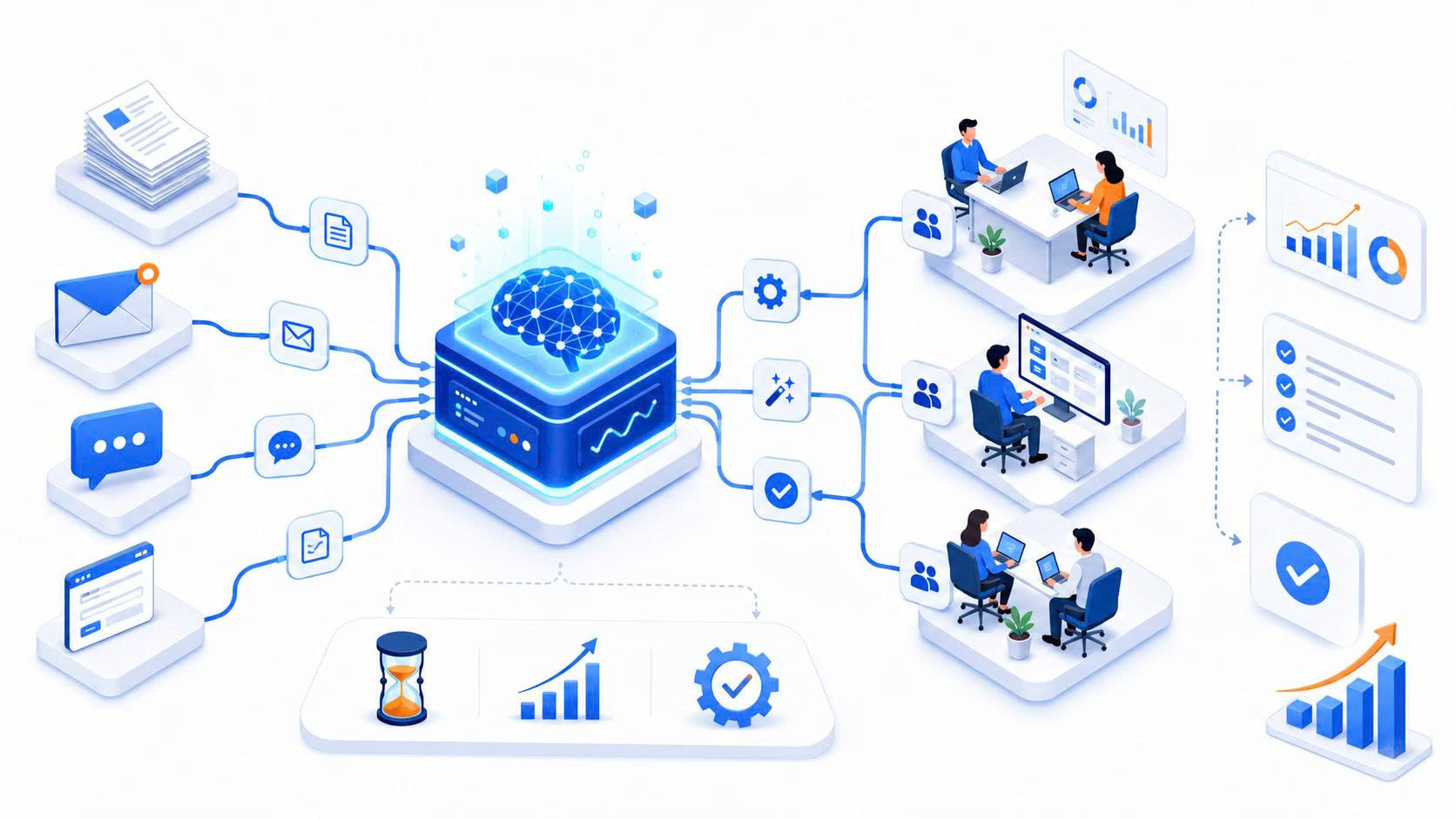
Project complexity is one of the most important cost drivers. Basic automation may only require rule-based logic, while advanced AI systems may need custom workflows, third-party integrations, database connections, model configuration, testing, and security controls.
Data quality also affects development cost. If business data is clean, organized, and easy to access, AI implementation becomes faster. If the data is scattered across different systems, more time is needed for preparation and integration.
Security and compliance can also increase development effort, especially for industries such as finance, healthcare, legal services, enterprise software, and e-commerce.
Common AI & Automation Use Cases
AI & Automation can support many business functions.
For sales teams, AI can help with lead research, lead scoring, outreach personalization, CRM updates, and follow-up reminders.
For customer support teams, AI can summarize tickets, answer frequently asked questions, suggest replies, and route issues to the right team member.
For operations teams, automation can handle reporting, document processing, task assignment, approval workflows, and internal notifications.
For marketing teams, AI can support content drafts, keyword research, campaign analysis, social media planning, and customer segmentation.
For software companies, AI can assist with QA testing, documentation, user behavior analysis, product support, and internal knowledge management.
Challenges in AI & Automation Projects
Although AI & Automation can bring strong benefits, implementation is not always simple.
One common challenge is unclear business goals. Many companies want to use AI because it is trending, but they do not clearly define the problem they want to solve. Without a clear goal, the project may become a technology experiment instead of a business solution.
Another challenge is poor data quality. AI systems depend on reliable information. If the data is outdated, incomplete, or inconsistent, the results may also be unreliable.
Integration can also be difficult. Many businesses use different tools for sales, operations, finance, customer support, and project management. Connecting these systems properly requires careful technical planning.
Human oversight is also important. AI-generated outputs should be reviewed, especially when they are used for customer communication, financial decisions, legal content, or sensitive business operations.
Why Businesses Should Work with an AI & Automation Development Partner
Building AI & Automation systems requires both technical knowledge and business understanding.
A good development partner does not simply add AI features because they are popular. They help businesses identify which workflows are worth automating, which tools should be connected, and which processes still need human control.
An experienced team can support the full process, from workflow analysis and system design to development, integration, testing, deployment, and long-term improvement.
For small and mid-sized businesses, outsourcing AI & Automation development can be a cost-effective way to access technical expertise without hiring a full internal AI team from the beginning.
Conclusion
AI & Automation is becoming a practical business advantage, not just a technology trend. From workflow automation to AI assistants and AI agents, companies can use AI to reduce manual work, improve speed, and scale operations more efficiently.
The key to success is starting with clear business problems, clean data, and realistic implementation goals. Businesses should not adopt AI only because it is trending. They should use AI where it creates measurable value.
For companies looking to modernize operations, improve productivity, and prepare for the future of digital work, AI & Automation offers a powerful and scalable solution.
Contact Golden Sea Studios:
Website: goldenseastudios.com
Email: info@goldenseastudios.com
Social Media: @goldenseastudios (Twitter, Instagram, Facebook)
Telegram: @goldenseastudio
We are available online to assist you with any inquiries or collaborations. Reach out to us through these channels and let’s connect!
