AI maturity is not measured by how many AI accounts a business has purchased, but by how deeply AI is embedded into processes, data, and accountability for outcomes. A team using five tools to write faster may still be at the first level. A business using just two Agents — but with clear processes, approvals, and KPIs — may already be further ahead.
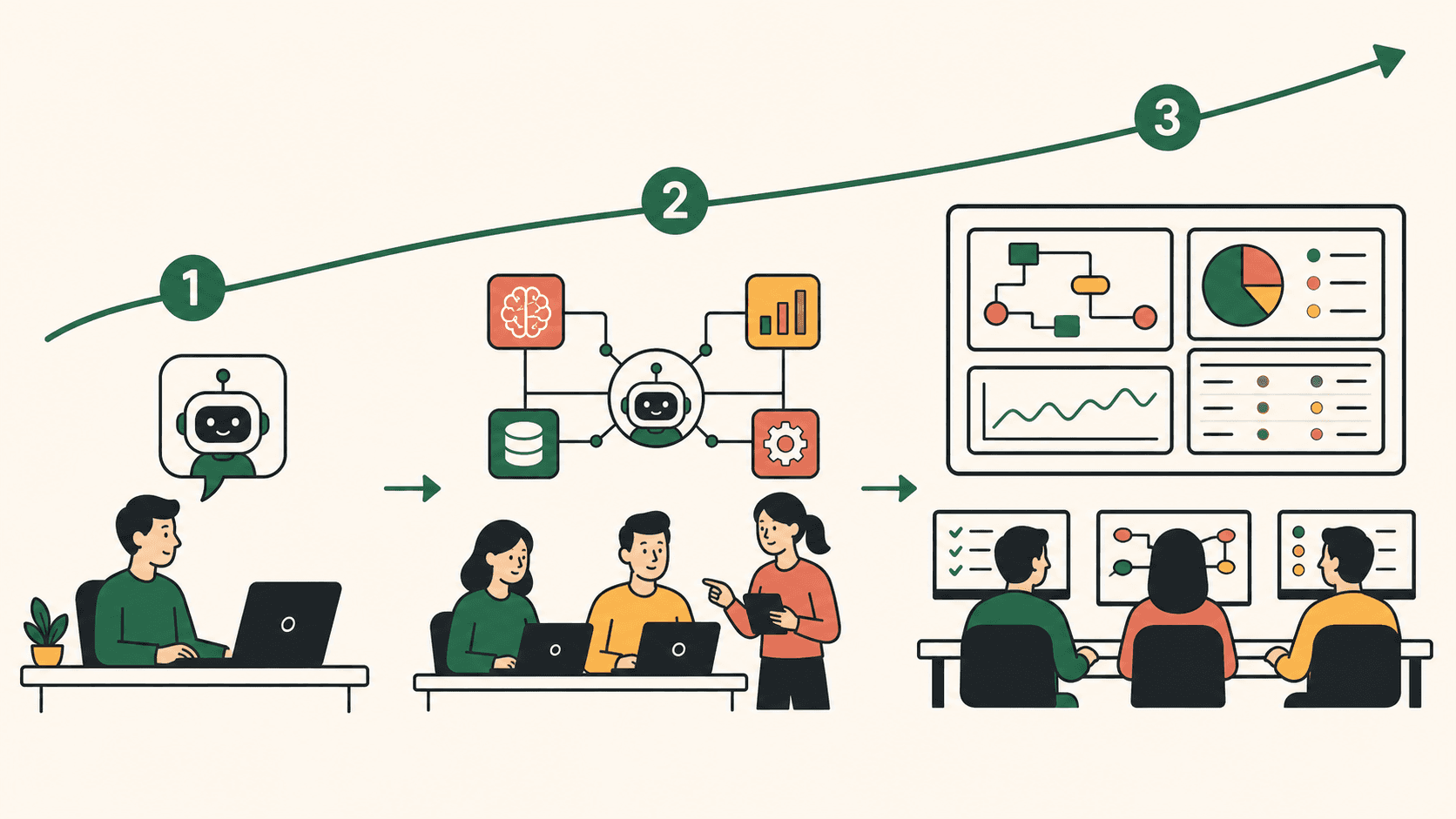
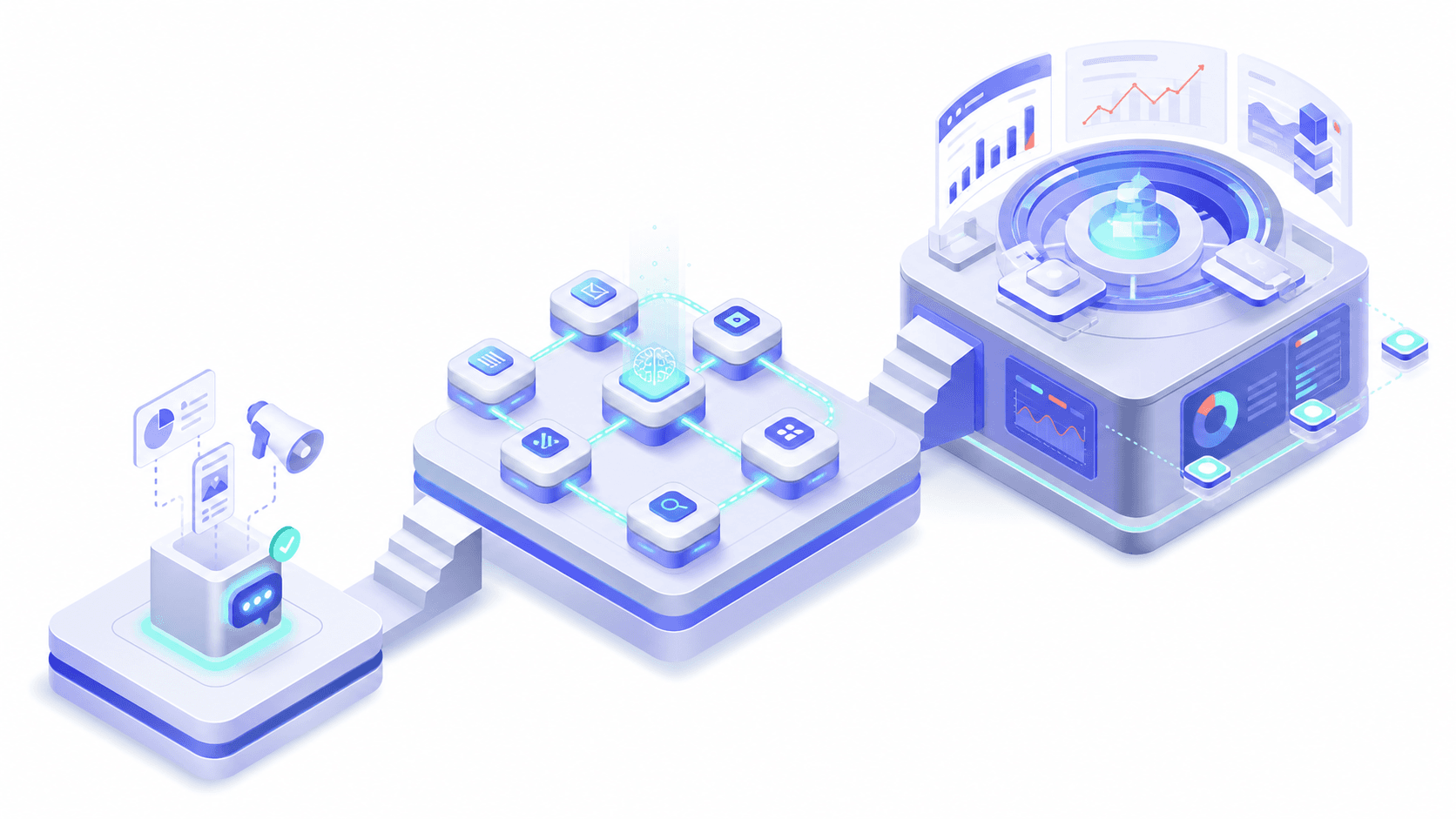
The three-level model below helps SME owners identify where they stand: AI Assistants supporting individuals; human–Agent teams working together; and human-led operating systems where Agents execute. This is not a race to reach the highest level as fast as possible. The goal is to choose the level that fits your current risk profile, data, and management capacity.
Why do you need an AI maturity model?
Without a roadmap, AI adoption usually starts with buying tools. Employees experiment on their own, everyone stores prompts in different places, data gets uploaded at will, and no one knows which outputs have been reviewed. The organization has plenty of AI activity but little repeatable AI capability.
A maturity model shifts the question from "which AI should we buy" to "which processes are creating value, who is accountable, and what evidence shows the new way is better." It also stops businesses from automating a process that is already broken: running faster down the wrong road still takes the organization further from its goals.
Level 1: AI Assistants supporting individuals
At the first level, employees use AI to write, summarize, brainstorm, translate, research, or prepare documents. The user actively issues requests and evaluates the output. The AI does not track work on its own and rarely connects deeply with internal systems.
Telltale signs
- Effectiveness depends on each person's prompting skills.
- There is no shared prompt library or common review standard.
- Outputs are mostly drafts that do not flow automatically into the next step.
- It is hard to accurately quantify how much time AI has saved.
This level is still very useful. It helps teams get comfortable, discover use cases, and reduce time spent on knowledge work. The mistake is assuming Level 1 equals operational transformation. If an employee leaves and their entire way of using AI disappears with them, the business does not yet own that capability.
What it takes to progress
Pick three to five recurring use cases, standardize the briefs, and save the prompts and good output examples. Set rules for which data is allowed into which tools. Most importantly, measure before-and-after time and revision rates. This is the data you need to decide which use cases deserve to move up to Level 2.
Level 2: Human–Agent teams working together
At Level 2, AI no longer just waits for prompts. Agents take on part of a role within a process and collaborate with staff through clear handoff points. For example, an Agent triages the inbox and prepares replies; staff handle exceptions. An Agent creates briefs and drafts; the content lead reviews arguments and brand voice.
Telltale signs
- Shared workflows exist instead of everyone doing their own thing.
- Agent permissions are scoped by role.
- There is a human handoff step when confidence is low or risk is high.
- Output is tracked with process KPIs.
- Logs show what the Agent read and what actions it took.
The biggest value of Level 2 is expanding team capacity without forcing people to do every extra task manually. However, this is also when governance issues emerge: who maintains the knowledge base, who is accountable when the Agent gets it wrong, and whether workflow changes require approval.
Common risks
Businesses may attach Agents to too many steps before validating them. When one data source is wrong, the error cascades across multiple systems. The safe approach is to limit scope, set confidence thresholds, run in parallel with the old method for a period, and have a rollback plan when anomalies are detected.
Level 3: Humans lead, Agents operate
At Level 3, leaders and specialists set goals, standards, and boundaries; multiple Agents execute most of the work chain. Humans focus on strategy, exception decisions, system improvement, and final accountability.
A content operation at this level can automatically ingest performance data, spot topics that need updating, create briefs, prepare articles, run checklists, and place items in the review queue. Once approved, the workflow publishes, distributes, and records results. Humans do not disappear; they move from execution to orchestration and quality control.
Prerequisites
- Data has clear owners, standards, and access permissions.
- Processes are stable enough to describe, with mechanisms for handling exceptions.
- An Agent evaluation system exists for before and after changes.
- Dashboards cover quality, cost, and business outcomes.
- Staff understand how to supervise, not just how to use the tools.
Not every process should reach Level 3. Sensitive customer relationships, legal, medical, and financial decisions, or high-value commitments need humans in a direct role. AI maturity includes knowing where not to automate.
Quick self-assessment table
| Question | Level 1 | Level 2 | Level 3 |
|---|---|---|---|
| How is AI triggered? | Human enters a prompt | Events within a workflow | Goals and operating schedules |
| Who does most of the work? | Humans | Humans and Agents | Agents within boundaries |
| Measurement | Individual time saved | Process KPIs | Business and system KPIs |
| Governance | Usage rules | Permissions and approvals | Evaluation, audits, lifecycle governance |
A roadmap that doesn't skip stages
- Standardize: document current processes and what a passing output looks like.
- Measure the baseline: time, cost, errors, and bottlenecks.
- Test one use case: pick a repetitive, low-risk piece of work.
- Design controls: permissions, approvals, handoffs, and logs.
- Run a pilot: compare against the baseline across a sufficient number of cases.
- Scale: only connect additional systems once quality is stable.
Microsoft found that teams using Agents effectively tend to discuss processes, share lessons, and document quality standards more regularly. What stands out is not that they have stronger models; they organize learning and accountability better.
The business owner's new role
In an AI-powered organization, leaders need to shift from checking every task to designing the system: which outputs matter, what the quality thresholds are, who has the authority to make changes, and which signals require intervention. This is a governance skill, not a prompting skill.
SME owners have an advantage because the distance between decision and execution is short. A pilot can be designed quickly, frontline feedback arrives directly, and processes are easier to change than in large enterprises. But that advantage only holds when experimentation is disciplined.
Conclusion
The three levels are not badges to show off how modern you are. They are a map that helps businesses invest in the right order. Do Level 1 well, standardize what works, move one process to Level 2, and only advance to Agent-run operations once your data and controls are ready.
To turn this model into an action plan, see the 90-day AI Automation implementation roadmap. The goal is not to automate as much as possible, but to build a system the business can trust and improve.
Read next: What Is an AI Operations Audit and Why Do It Before Automation? · Automate 80%, Route the Remaining 20% to a Human