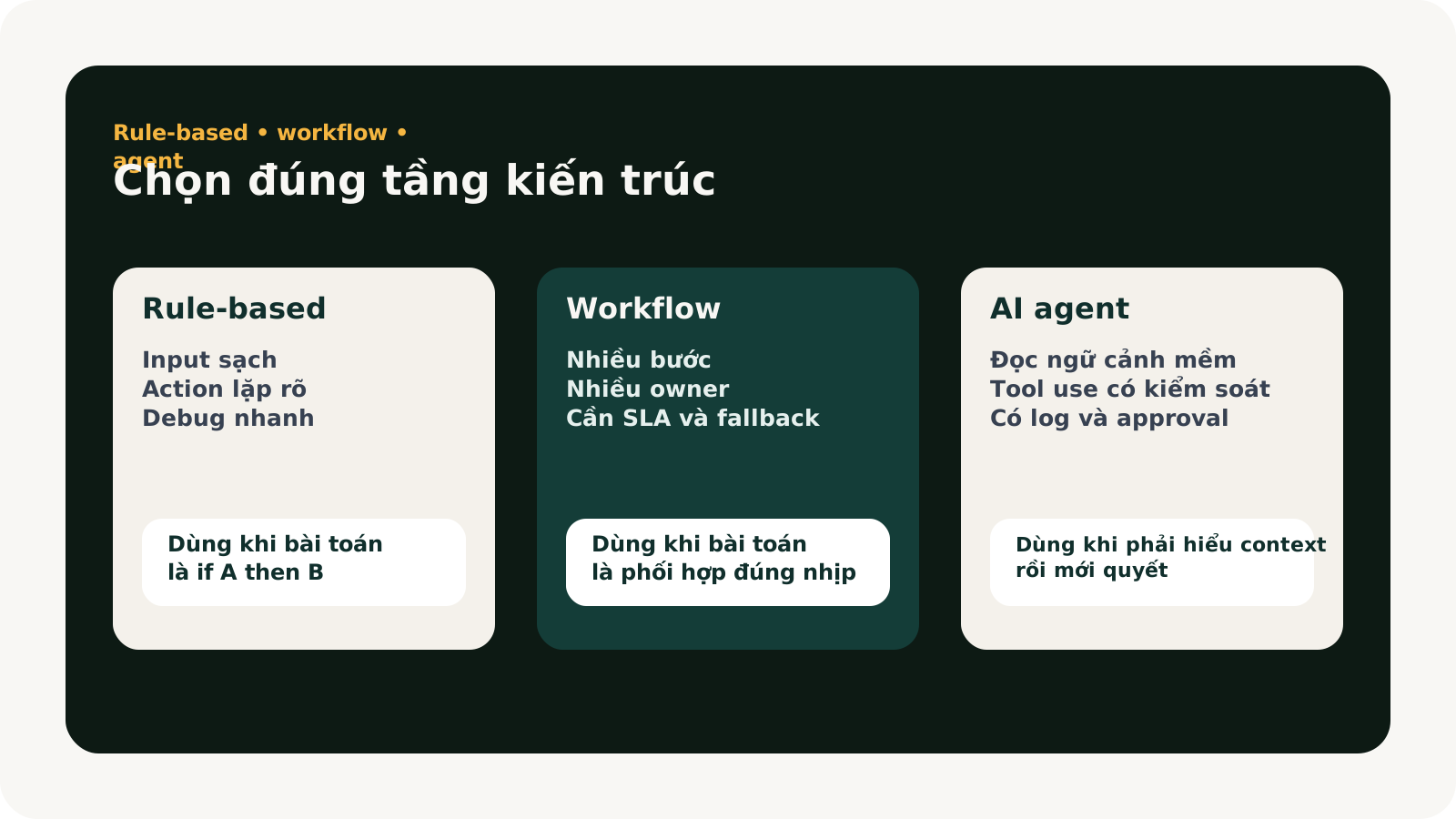

Short answer: If a repetitive task has stable conditions, clean inputs, and low-cost failure modes, rule-based automation is often enough. When the process has multiple steps, owners, and intermediate states, workflow orchestration is a better fit. AI agents make sense only when the system must interpret soft context while still keeping audit trails, approvals, and fallbacks intact.
Why architecture choice matters more than tool choice
Many teams start with the tool name and only then search for a use case. That is how businesses buy the wrong level of automation. Salesforce's July 2026 CRM-native agent guide makes the hidden requirement obvious: agents work best when they live inside event-driven workflows, have scoped read/write access, and inherit audit trails. In other words, “agent” is not a label for every automation that includes a model.
Zendesk describes autonomous service agents through capabilities such as goal orientation, dynamic knowledge access, context-aware decisioning, QA controls, and governance. If a workflow does not need those capabilities, jumping straight to an agent often increases ambiguity and debugging cost.
Three layers of operating architecture
| Architecture | Short definition | Best fit | Primary risk |
|---|---|---|---|
| Rule-based automation | Hard condition: if A, do B | Tagging, alerts, reminders, moving form data into CRM | Breaks when data is messy or conditions drift |
| Workflow orchestration | Multi-step flow with state, queue, owner, and fallback | Lead routing, approvals, follow-up, SLA handling | Creates confusion if source of truth and ownership are weak |
| AI agent | Context-reading system that uses tools and chooses the next step inside guardrails | Soft triage, response drafting, knowledge synthesis, next-step suggestions | Wrong context, overreach, hard-to-explain behavior without logs |
When rule-based automation is enough
- The input is structured and predictable.
- The task does not require nuanced context.
- Failure can be corrected quickly at low cost.
Classic examples include pushing a web lead into CRM, assigning a source campaign, or notifying the owner. Adding a model here often makes the system harder to predict without making it more useful.
When workflow orchestration is the better upgrade
Workflows matter when the core problem is not language understanding but reliable multi-step execution: multiple statuses, owners, fallback queues, and breach visibility. Missed-call recovery, lead routing, inbox SLA, and content approval all fit this pattern well.
Golden Sea typically treats workflow as the floor, not the ceiling. If the workflow layer is still weak, an agent has no stable operating surface.
When an AI agent is actually worth it
Agents are worth it when the system must interpret soft context that rules cannot cover well, yet the business still has strong guardrails and auditability. Examples include distinguishing a pricing question from a hidden complaint in the same chat, summarizing a case across multiple prior interactions, or selecting a next step by customer tier, urgency, and policy.
Recent operator discussions on Indie Hackers made the buying test simple: the workflow should be reversible, inspectable, and boring enough to run weekly. That implies previews, approvals, logs, rollbacks, or at least a fallback queue for high-impact actions.
What happens when the architecture choice is wrong
A service business that wants to “stop losing after-hours leads” may jump straight to the word agent. But if the form is still missing context, inbox lanes are still mixed together, and there is no clear owner the next morning, an agent only adds interpretation to a blind workflow. In that case, workflow design is the real answer: separate lanes, define SLA, create a callback queue, and only then add AI for triage or drafting.
The opposite case also exists. If the workflow is already stable but the team still reads long conversation threads to decide whether the customer wants pricing, is frustrated, or is asking for an exception, then AI can create real leverage. The problem is no longer routing logic. It is soft-context interpretation.
Four questions to ask before calling something an agent
- Can the system choose the next step, or does it only execute prewritten rules?
- Does it combine multiple context sources and weigh them meaningfully?
- Can it be blocked, approved, or handed back to a human at risky moments?
- Does the team have enough logging to explain why it chose that path?
Signals that the company should reduce the “AI level”
- Humans manually correct nearly every “smart” decision.
- No one on the team can explain why the flow chose that path.
- Every policy change breaks prompts, rules, templates, and ownership at once.
- End users still copy and paste as much as before.
When those signals appear, reducing autonomy and returning to a clearer workflow is often smarter than stacking on another model.
Read next: AI agents, chatbots, and automation: what is different? · Businesses do not need more agents, they need less leakage · The minimum log stack for AI customer service