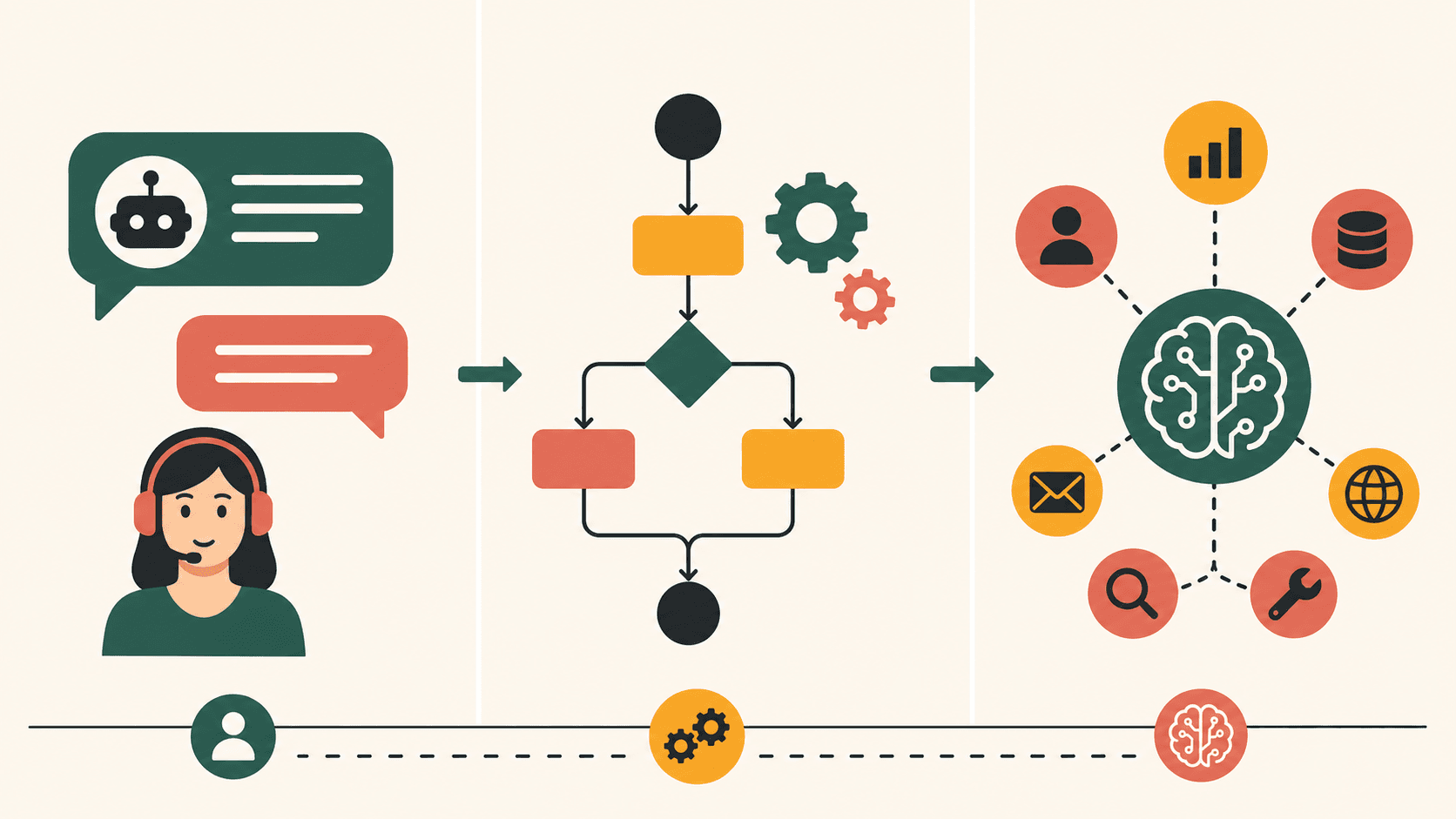
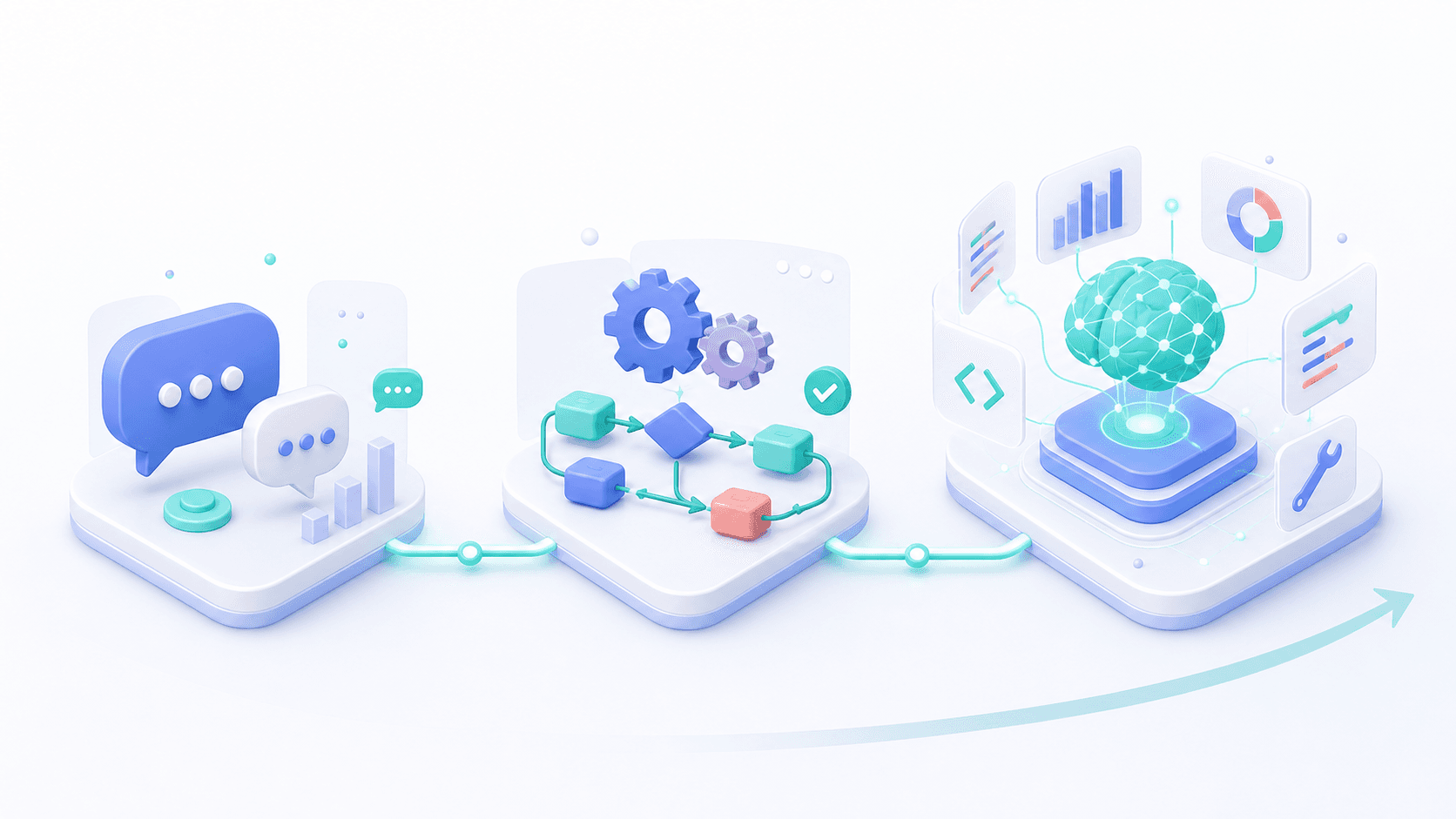
Chatbots handle communication, workflow automation executes rule-based steps, and AI Agents tackle goals with many variables, choosing actions within a controlled scope. Businesses don't need to pick one and discard the other two. A well-built operating system usually combines all three, each in its rightful place.
The confusion exists because almost every product on the market now carries an AI label. A chat box replying from a script gets called an Agent; a drag-and-drop workflow gets described as AI automation. Without distinguishing by actual capability, SMEs easily buy a tool with inflated expectations and then conclude that AI doesn't work.
Quick comparison
| Criteria | Chatbot | Automation | AI Agent |
|---|---|---|---|
| Primary goal | Answer and collect information | Run a fixed sequence of steps | Complete goals with variables |
| How it decides | Scripts or a language model | If–then conditions | Reasoning within boundaries |
| Flexibility | Medium | Low to medium | Higher |
| Ease of testing | Fairly easy | Very easy | Harder |
| Best-fit use cases | FAQs, customer intake | Data sync, notifications | Triage, research, orchestration |
Chatbot: the communication front door
A chatbot is the conversational interface between customers or employees and your systems. The simplest version matches keywords and answers from a script. Versions built on language models understand natural questions better, can look up a knowledge base, and phrase answers more flexibly.
Chatbots fit when a business wants to answer common questions, collect names and needs, guide processes, look up statuses, or route conversations to the right department. Chatbot success should be measured by correct resolution rate, response time, abandonment rate, and a healthy human handoff rate.
The chatbot's weakness is that it usually stops at conversation. If a customer says they want to book an appointment but the chatbot only sends a phone number, the business still needs staff to enter the booking, log it in the CRM, and remind the customer. The experience looks automated, but the operations behind it remain manual.
Workflow automation: the reliable rails
Workflow automation connects steps through explicit logic. When a form is submitted, the system creates a record, sends an email, notifies the person in charge, and schedules a reminder. It doesn't need deep understanding; it needs correctly formatted data and sufficiently clear rules.
It's a great choice for repetitive work with few exceptions: moving data, changing statuses, creating folders, sending notifications, aggregating figures, or running schedules. Traditional automation's big advantage is that it's predictable and easy to test. The same input always produces the same result.
The weakness shows up when the input is natural language or the situation varies a lot. A rigid workflow struggles to understand that two customers can express the same need in different words. If you try to handle every exception with conditional branches, the diagram quickly becomes unmanageable.
AI Agent: the orchestrator within boundaries
An AI Agent adds the ability to understand context, assess situations, and choose tools. Instead of always following one set of rails, the Agent can decide which document to look up, what to ask for, or which person to hand off to. That makes Agents useful for knowledge work — but also harder to control than traditional automation.
For example, a content Agent receives a topic, determines search intent, reads approved sources, builds an outline, and picks the right template. Publishing, however, can still be locked behind a review step. The Agent provides flexibility in preparation; the workflow keeps certainty in publishing.
When is a chatbot enough?
Use only a chatbot when the main goal is helping customers find information or reach the right person. If the data rarely changes, questions are well-scoped, and no actions across multiple systems are needed, a chatbot is the leaner solution. Don't deploy an Agent just to answer opening hours.
When should you use automation?
Choose automation when the steps can be described with clear conditions: new record created, do A; no response after two days, do B; order completed, send C. This is often the foundation layer worth building first, because it forces the business to standardize data and statuses.
When do you need an AI Agent?
Agents fit when inputs are inconsistent, content needs to be read and understood, or a choice must be made among multiple actions. Problems like scoring leads from conversations, summarizing customer feedback, researching topics, checking content against brand guidelines, or spotting anomalies in reports are good examples.
Still, weigh the consequences if the Agent chooses wrong. If a mistake only produces a mediocre draft, high autonomy is fine. If a mistake sends the wrong price to thousands of customers, add approvals or use hard rules.
A combined architecture for SMEs
- Chatbot at intake: understands questions and collects missing data.
- Agent for analysis: determines intent, priority, and recommended actions.
- Automation for execution: logs to the CRM, creates tasks, and sends rule-based notifications.
- Humans in control: handle exceptions, review content, and make sensitive decisions.
- Dashboard for measurement: tracks speed, quality, and outcomes.
This structure avoids two extremes: forcing a rigid workflow to handle every situation, or handing all authority to an AI model. Each layer does what it's best at.
Five questions before buying any tool
- Does the tool only generate answers, or does it actually take actions?
- Can it connect to the data and software the business already uses?
- Can you configure permissions, approvals, and activity logs?
- When uncertain, does the system hand off to a real person?
- Is pricing per user, per run, or per model usage?
Ask the vendor to demo a real process end to end. Don't just watch the chat screen. Ask where the data goes, who approves, how errors are caught, and where results get recorded.
Conclusion
Chatbots aren't obsolete, automation isn't less intelligent, and AI Agents aren't the answer to everything. The chatbot is the interface, automation is the rails, and the Agent is the judgment layer. Value emerges when all three layers are designed around a specific business process.
If you're not sure where to start, read the 5 processes SMEs should automate first. It's how you shift the conversation from technology names to the outputs that need improving.
Read next: Agent, workflow, or rule-based automation: which architecture fits repetitive work? · Why Businesses Buy Outcomes, Not AI Agents