
Short answer: Zalo is the channel closest to Vietnamese customers, but handing it to AI too early, while the data is still messy, makes the experience mechanical and costs you trust.
This article is for business owners, operations teams, and marketing teams that want websites, outsourcing, or AI automation to reduce manual work without losing control. The core idea: do not buy the name of a technology; buy an output that can be accepted, measured, and improved.
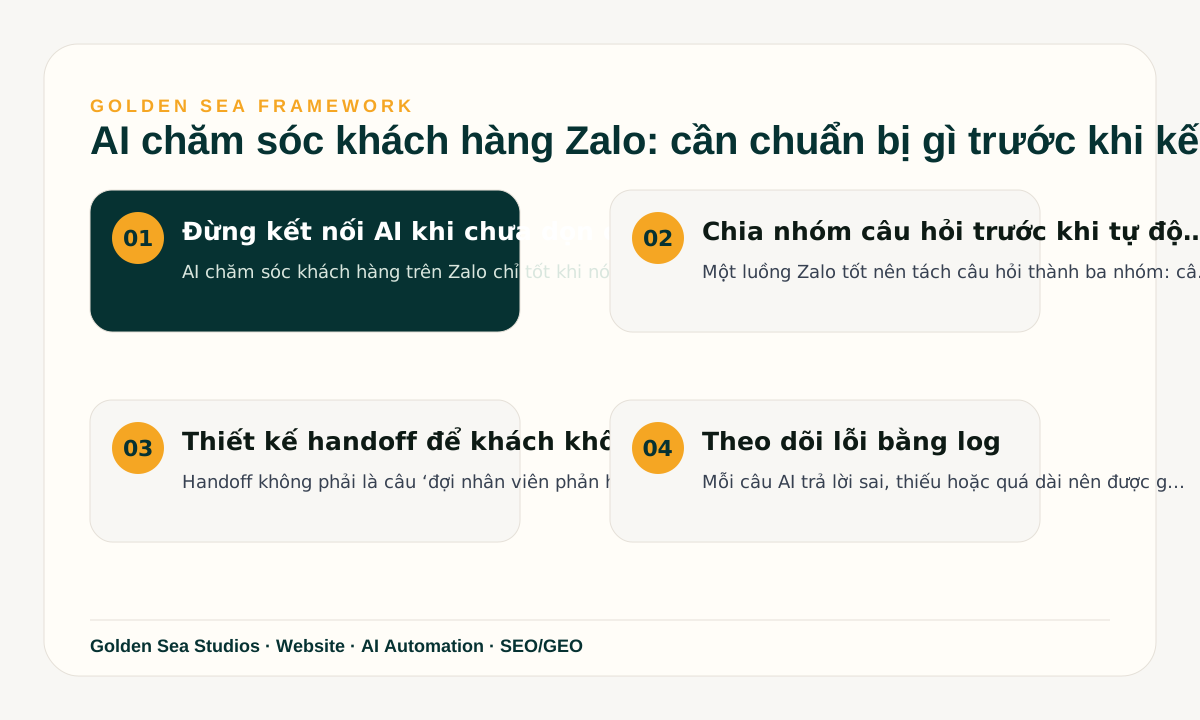
Do not connect AI before you have cleaned up your standard answers
AI customer support on Zalo is only as good as the answers behind it. If your own team still replies to the same question in three different ways, AI will amplify that inconsistency. The first task is not picking a model. It is collecting the frequently asked questions, the pricing policy, working hours, return conditions, booking steps, and the questions that must always go to a human operator.
Group your questions before you automate anything
A good Zalo flow separates questions into three groups: informational, sales, and sensitive. Informational questions can be answered automatically. Sales questions should probe the customer's need and tag the lead as hot or cold. Sensitive questions such as complaints, refunds, service failures, or professional advice should reach a human operator as early as possible.
Quick checklist
- Define the input, output, and accountable owner.
- Mark cases that must be escalated to a human.
- Set acceptance criteria before choosing tools.
- Measure one operating metric before and after the pilot.
Design the handoff so the customer never feels abandoned
A handoff is not the sentence "please wait for a staff member". A good handoff states what the issue has been recorded as, who will handle it, roughly how long the reply will take, and whether the customer needs to supply anything else. When customers can see that the system understood their situation, they accept the wait far more easily.
Track failures with logs
Every answer the AI gets wrong, leaves incomplete, or drags out should be logged. Logs let the team repair the knowledge base instead of guessing why a customer became frustrated. For a service business, review them at least weekly during the first month to lock down the phrasings that cause misunderstandings.
Start with a small pilot
You do not need to hand the entire Zalo channel to AI on day one. Start with 20 to 30 frequently asked questions, one form that captures the customer's need, and one route to a human operator. After two to four weeks, measure response time, how many leads arrive with complete information, how many cases needed correction, and what your staff say about it.
When to use it, and when not to
Use it when
Use it when the workflow repeats often, someone owns approval, input data can be centralized, and the business knows which metric should improve: response time, qualified leads, handoff errors, manual admin hours, or missed follow-ups.
Do not use it when
Do not use it when the process changes every day, nobody owns quality control, internal policies are still unclear, or the business expects AI to take responsibility away from humans. In that stage, the first job is to document the workflow and quality bar.
How Golden Sea approaches this
Golden Sea does not recommend buying a large system immediately. A safer path is a focused pilot: one data flow, one user group, one monitoring dashboard, and one acceptance checklist. Once the pilot proves useful, the system can expand to more channels or deeper automation.
If your Page or Zalo channel is answering far too much by hand, Golden Sea can help build a small pilot before you automate everything.
FAQ
Should AI quote prices on Zalo by itself?
Only a price range, or a guided way to collect requirements, when the price depends on the customer's needs. A firm quotation should be checked by a human operator.
Will Zalo AI replace customer service staff?
Not entirely. AI should handle repetitive questions, gather information, and prompt follow-ups. A human operator still owns sensitive cases and the final decision.
What documents does a business need to prepare?
FAQs, a price list and policies, the booking workflow, the list of cases that must go to a human operator, and an error-reporting template.
Sources and limitations
The SEO/GEO recommendations in this article are based on Google's official guidance on helpful content and site clarity, plus NIST's AI risk management framework. Any internal performance numbers in future articles should come directly from GA4, Search Console, or CRM data, not estimates.
Read also: AI automation services, website and software services, software outsourcing Vietnam in the AI era.