
To compare a media team, an agency, and AI Operations, a business must calculate the total cost of producing a defined level of output. Comparing salaries against software fees is comparing the wrong units. A cheaper option that requires the business owner to rewrite posts, chase deadlines, and process data by hand can end up costing more than the option with the higher quote.
This article lays out a transparent costing framework. Figures like 50 million VND for a team and roughly 10 million VND for an AI system are illustrative scenarios based on product positioning, not proven savings for every business. Real costs must be calculated from specific scope, quality standards, and volume.
Step one: define the output you're buying
Don't start with the question of how many people you need. Define how many posts, videos, designs, campaigns, handled conversations, followed-up leads, and management reports the business needs each month. Add quality standards, response times, and the number of review rounds.
For example, a goal of “doing marketing” is too vague. A measurable goal is 20 pieces of multi-channel content, 100% of inbox messages triaged within 15 minutes, promising leads followed up within 24 hours, and a weekly report with traceable numbers. Only when the output is clear can the three options be put on the same table.
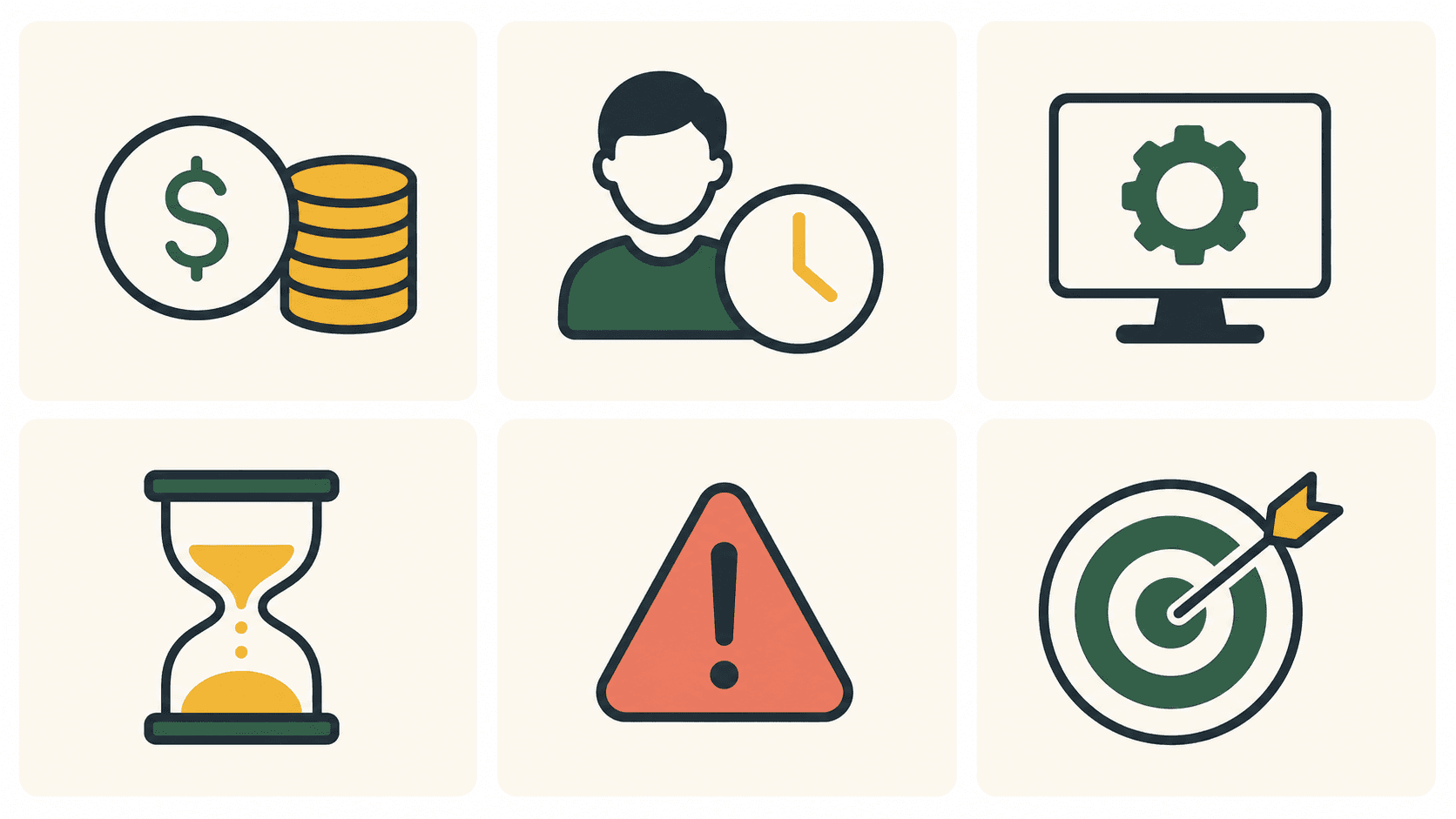
Five cost categories to include
1. Direct costs
For an in-house team, this means salaries, insurance, recruiting, equipment, and benefits. For an agency, it's the retainer, out-of-scope fees, production budget, and revision rounds. For AI Operations, it's setup fees, operating costs, AI models, integration software, and optimization support.
2. Management costs
The time of the business owner and managers has value. Track the hours spent assigning work, re-explaining, reviewing, chasing deadlines, resolving conflicts, and compiling reports. Multiply those hours by an appropriate opportunity cost. This is usually the biggest overlooked expense.
3. Tools and coordination costs
A team needs design software, publishing calendars, storage, a CRM, internal chat, and dashboards. An agency may cover part of this, but the business still needs handover systems. AI Operations also requires integrations and monitoring. Don't double-count, but don't assume any single quote covers everything.
4. The cost of delays and dropped work
Late inbox replies, leads that never get followed up, content that misses its schedule, and reports that arrive after decisions are made all carry costs. They're hard to convert precisely, but you can count occurrences, average lead value, and current conversion rates to build an estimated range.
5. Risk and change costs
Staff resigning, the agency swapping your account manager, tool accounts getting locked, or AI workflow failures are all risks. Each option carries a different risk profile. Assess recovery time, dependence on individuals, data export capability, and backup operating plans.
The total cost of ownership formula
Monthly TCO = direct costs + management + tools + expected delay costs + expected risk costs. Then divide by a unit of useful output, such as one approved piece of content, one resolved conversation, or one qualified lead followed up.
Don't simply divide by the number of posts. Ten posts produced but eight requiring rewrites is not equivalent to ten approved posts. Use output that meets the standard as your denominator.
The illustrative 50 million vs. 10 million scenario
Suppose an SME spends about 50 million VND per month on a mix of content, design, page management, tools, and management time. An AI Operations system is quoted at around 10 million VND to operate, plus internal staff time for review and exception handling. You cannot immediately conclude the business saves 40 million.
You need to add the cost of reviewers, model fees, amortized setup, special production, and the portion of work AI doesn't yet handle. If the new total is 20 million with the same output, the 30 million gap becomes a hypothesis worth testing. If quality issues lose leads or damage the brand, that loss must be subtracted from the math.
Comparing the three models
| Model | Strengths | Weaknesses | Best fit when |
|---|---|---|---|
| In-house | Deep brand knowledge, fast reactions | Fixed costs, requires management | Deep, continuous needs |
| Agency | Diverse expertise, production capacity | Information gaps, limited scope | Campaigns and external capabilities are needed |
| AI Operations | Consistent, fast, scales well for repetitive work | Needs data, oversight, and optimization | Processes with repetitive volume |
The best option is usually hybrid. AI handles the repetitive volume; internal staff keep strategy and relationships; specialized partners join for campaigns or complex creative work. The goal is not to eliminate any model, but to assign work where each has the advantage.
Metrics to measure during a pilot
- Cost per approved output.
- Time from request to ready-to-use deliverable.
- Rate of major revisions and average revision rounds.
- Rate of inbox responses within SLA.
- Rate of dropped leads or late follow-ups.
- Management hours required per week.
- Rate of cases the AI must escalate to humans.
Measure for at least one full cycle that includes normal days and peak periods. One good week doesn't represent a whole month. Also keep a baseline of the old approach so you don't judge by gut feeling.
Questions to ask the vendor
Which integrations does the setup fee cover? How do costs scale with volume? Who owns the workflow and the data? When the AI model or API changes, who is responsible for updates? Are there activity logs, approvals, and data exports? What is the support turnaround when the system goes down?
A good quote must be tied to a defined output scope and assumptions. If it merely promises to “replace the whole team” without specifying volume, standards, and exceptions, the business doesn't have enough information to calculate ROI.
When shouldn't you switch to AI Operations yet?
If strategy changes weekly, data lacks an accurate source of truth, the brand isn't consistent, or most of the work is one-of-a-kind creative campaigns, full automation isn't the right fit yet. Start with data synchronization, reporting, or draft preparation instead.
Don't deploy just to cut headcount, either. That approach tends to trigger team resistance and ignore quality. Aim to increase capacity, reduce repetitive work, and make cost per output predictable.
Conclusion
The right decision isn't “team or AI” — it's which operating configuration produces enough output at an acceptable total cost and risk. Define the output, calculate TCO, run a pilot, and measure with data before making a big change.
For a more complete set of metrics, see AI Automation ROI: what to measure beyond hours saved. Golden Sea's policy is to commit only to measurable scope, with humans reviewing every touchpoint that affects the brand and its customers.
Read next: Media Team Cost vs AI Media Operations: How Should SMEs Calculate It? · Building an AI content engine: from idea to every channel