
Short answer: Many outsourcing quotations look cheap because they leave out management, acceptance, and maintenance. This article helps an SME see the real total cost before signing.
This article is for business owners, operations teams, and marketing teams that want websites, outsourcing, or AI automation to reduce manual work without losing control. The core idea: do not buy the name of a technology; buy an output that can be accepted, measured, and improved.
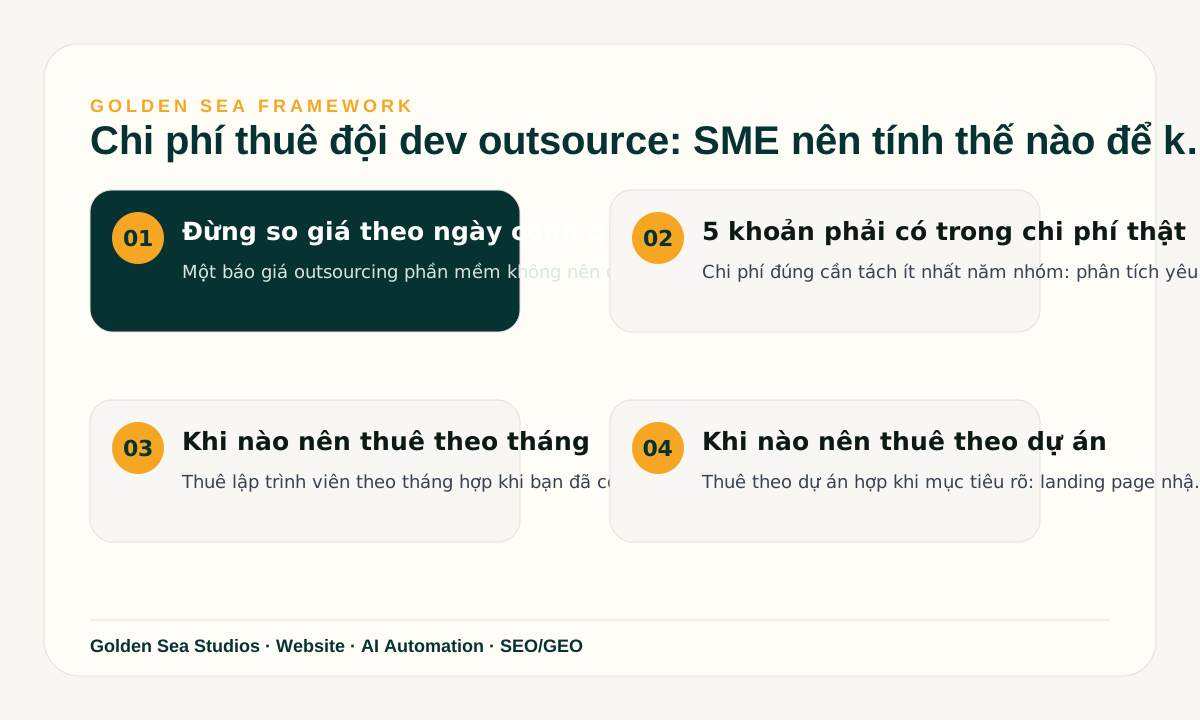
Do not compare day rates too early
A software outsourcing quotation should not be read like a payroll sheet. Day rates are only the visible part. Underneath sit the questions of who breaks the requirements down, who checks quality, who responds when the product drifts off target, and who keeps the documentation so later changes do not depend on one individual. Comparing developer rates alone leads businesses to the option that looks cheaper and is then paid for in rework, repeated meetings, and waiting for handover.
Five items a real cost must include
A correct cost breakdown separates at least five groups: requirements analysis, flow design, development, testing and acceptance, and maintenance after handover. Projects that touch customer data, payment integration, a CRM, Zalo, email, or internal systems also need security, access control, and operational logging. These items are not there to inflate the quotation; they tell the buyer they are purchasing something operable rather than an interface that merely looks finished.
Quick checklist
- Define the input, output, and accountable owner.
- Mark cases that must be escalated to a human.
- Set acceptance criteria before choosing tools.
- Measure one operating metric before and after the pilot.
When monthly hiring makes sense
Hiring developers monthly works when you already have a product owner, a clear backlog, someone internal who can prioritize features, and the ability to check the output. Without a product management workflow, monthly hiring usually becomes "there are people writing code, but nobody is moving the project forward". In that case, a scoped package or a full team with technical management is the safer choice.
When per-project hiring makes sense
Hiring per project works when the goal is clear: a lead-capture landing page, an internal dashboard, an MVP, a booking app, or a request triage system. What must be locked down is the definition of done. It is not enough to say "there is a contact form" — say where the form sends data, whether leads are stored, whether spam is blocked, who is notified, and whether traffic sources are tracked.
A quick way to read a quotation
One simple approach is to ask: does this quotation include project management, is there an acceptance checklist, is handover documentation included, how long is maintenance covered, how are out-of-scope changes priced, and who is responsible if a third-party integration changes its API. If the vendor answers clearly, a slightly higher price can still be cheaper in total cost.
When to use it, and when not to
Use it when
Use it when the workflow repeats often, someone owns approval, input data can be centralized, and the business knows which metric should improve: response time, qualified leads, handoff errors, manual admin hours, or missed follow-ups.
Do not use it when
Do not use it when the process changes every day, nobody owns quality control, internal policies are still unclear, or the business expects AI to take responsibility away from humans. In that stage, the first job is to document the workflow and quality bar.
How Golden Sea approaches this
Golden Sea does not recommend buying a large system immediately. A safer path is a focused pilot: one data flow, one user group, one monitoring dashboard, and one acceptance checklist. Once the pilot proves useful, the system can expand to more channels or deeper automation.
If you have a web or app project and cannot tell whether to hire per person or per project, Golden Sea can help break down the scope before quoting.
FAQ
Is outsourcing a dev team cheaper than hiring in-house?
It can be, when the need is project-based, no long-term full-time team is required, and the scope is clearly managed. If the product is core to the business and needs continuous development, consider an in-house team or a hybrid model.
What should a software outsourcing quotation contain?
Scope, timeline, key people, acceptance items, maintenance, change limits, and responsibility for integrations.
Where should an SME start?
Start from a written problem statement, the user flow, the data you need to store, and the business outcome you want to measure.
Sources and limitations
The SEO/GEO recommendations in this article are based on Google's official guidance on helpful content and site clarity, plus NIST's AI risk management framework. Any internal performance numbers in future articles should come directly from GA4, Search Console, or CRM data, not estimates.
Read also: AI automation services, website and software services, software outsourcing Vietnam in the AI era.