
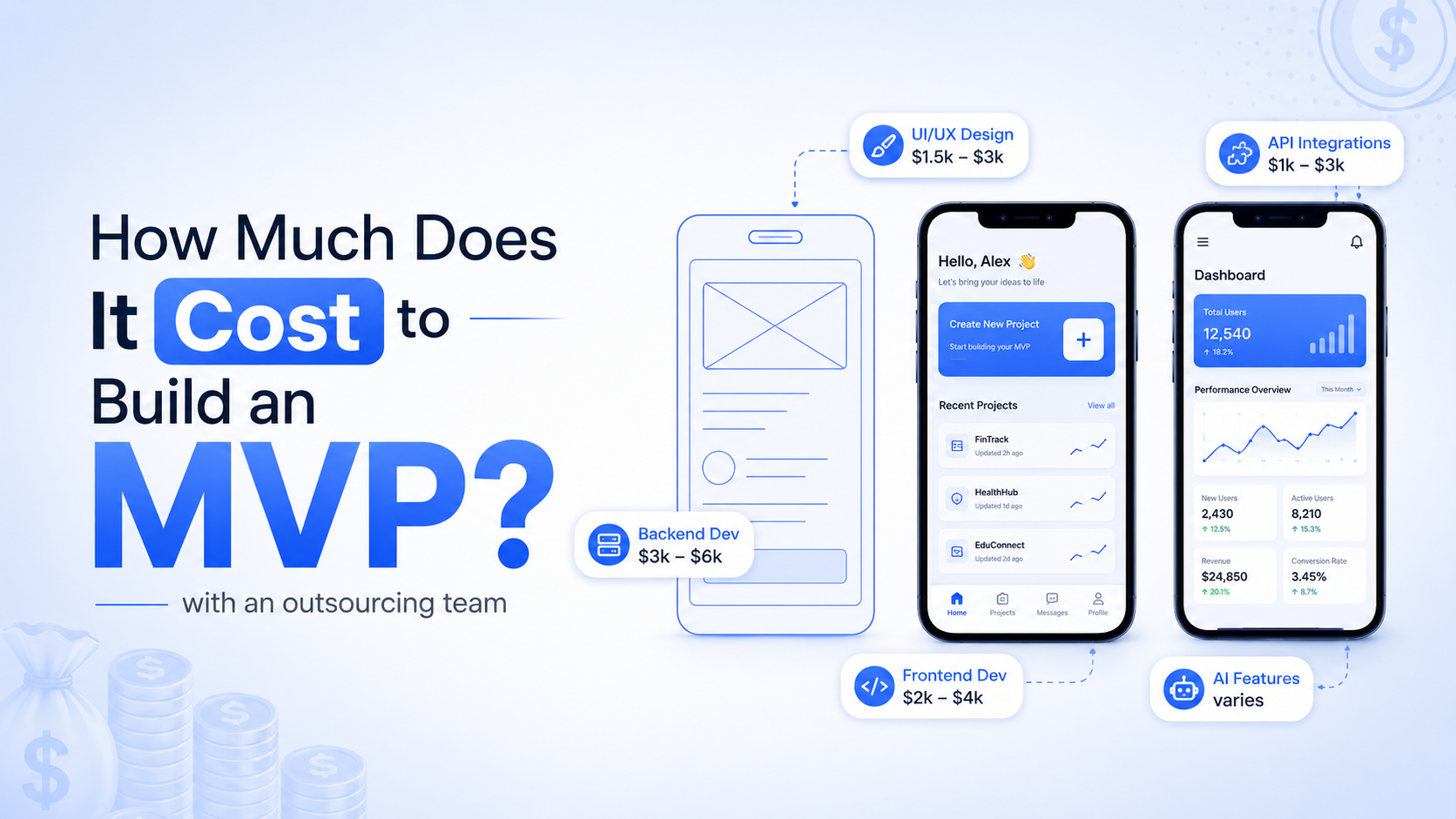
How Much Does It Cost to Build an MVP With an Outsourcing Team?
The cost to build an MVP with an outsourcing team depends on scope, platform, design complexity, backend requirements, integrations, AI features, timeline, and team size.
In most cases, a simple MVP costs less than a complex product with custom workflows, dashboards, payments, user roles, AI automation, or third-party integrations. Because of this, the best way to estimate MVP development cost is not to ask for one fixed number too early. Instead, you should break the product into scope, timeline, and team structure.
For startups, outsourcing can be a practical way to build an MVP faster without hiring a full in-house product team from day one.
What Is an MVP?
An MVP, or minimum viable product, is the first usable version of a product that helps you test the core idea with real users.
It is not the final product. It is also not a rough prototype with no real function. A good MVP should be simple, focused, and useful enough to validate the main business assumption.
For example, if you are building a marketplace, the MVP may only need user registration, listing creation, search, booking requests, and basic admin control. It does not need every advanced feature at the beginning.
If you are building a SaaS dashboard, the MVP may only need login, data input, a few core reports, and a simple user interface. Advanced analytics, complex permissions, and automation can come later.
The goal of an MVP is to answer one question:
Can this product solve a real problem for real users?
Why MVP Cost Is Hard to Estimate Without Scope
MVP cost can vary a lot because every product is different.
A simple app with a few screens will not cost the same as a product that needs custom backend logic, payment integration, admin dashboards, AI features, and multiple user roles.
For example, two founders may both say they want to build a “simple platform.” However, one platform may only need a landing page, sign-up flow, and basic dashboard. Another may need user permissions, payments, chat, API integrations, notifications, AI recommendations, and analytics.
Those are very different projects.
That is why a reliable estimate usually needs a clear brief. The outsourcing team needs to understand what the product does, who uses it, what features are required, and what can wait until later.
Main Factors That Affect MVP Development Cost
Several factors can affect the cost to build an MVP with an outsourcing team.
| Cost Factor | Why It Matters |
|---|---|
| Scope | More features require more design, development, and testing |
| Platform | Web, mobile, and cross-platform apps have different complexity |
| Design | Custom UI/UX costs more than basic interface design |
| Backend | Complex logic, databases, and admin systems increase effort |
| Integrations | Payment, CRM, AI, email, analytics, and APIs add development time |
| AI Features | AI workflows need data handling, prompts, review logic, and testing |
| Timeline | Faster delivery may require a larger team |
| Team Size | More roles increase cost but may improve speed |
| Maintenance | Post-launch support adds ongoing cost |
In practice, MVP cost is not only about the number of screens. It is about how much logic, data, workflow, and product behavior sits behind those screens.
Simple MVP Cost Range
A simple MVP usually focuses on one clear user flow.
This type of project may include basic UI, user registration, a small number of screens, simple backend logic, and limited integrations.
For example, a simple MVP may include a landing page, user sign-up, login, a basic dashboard, form submission, email notification, a simple database, and basic analytics.
Because the scope is focused, this type of MVP is usually the most cost-effective option.
For a simple MVP, the outsourcing cost may range from a lower five-figure budget to a moderate five-figure budget, depending on the region, team structure, and timeline.
This type of MVP is a good fit when the founder wants to test one core idea quickly.
For example, a startup may want to validate whether users will submit requests, browse listings, book a service, or use a basic dashboard. In that case, the MVP should avoid unnecessary features and focus on the main user action.
Medium MVP Cost Range
A medium MVP usually has more user flows, stronger backend logic, and more integrations.
For example, the product may include user roles, admin management, payment integration, CRM connection, analytics, notifications, and more polished UI/UX.
This kind of MVP is common for SaaS products, marketplaces, internal business tools, booking platforms, AI-assisted workflows, and customer portals.
Because the product has more moving parts, the outsourcing cost is usually higher than a simple MVP.
In addition, the team needs more time for planning, design, development, testing, and feedback.
If your MVP needs both a customer-facing app and an admin dashboard, the cost will increase because the team is building two connected experiences.
Complex MVP Cost Range
A complex MVP requires more advanced architecture, integrations, automation, data workflows, or product logic.
This type of MVP may include AI features, custom permissions, multi-sided marketplace logic, real-time chat, advanced dashboards, third-party APIs, payment flows, data processing, or complex admin systems.
A complex MVP may include:
AI automation workflows
Multi-role permission system
Custom backend architecture
Advanced admin dashboard
Payment and subscription system
Real-time messaging
Complex search
API integrations
Document processing
Reporting and analytics
Mobile and web versions
Security and compliance requirements
For a complex MVP, the budget can move into a higher five-figure or even six-figure range, depending on the scope and delivery speed.
However, not every complex idea needs a complex first version. A good outsourcing partner should help reduce the first version to the smallest useful product.
That way, the startup can test the core business idea before spending too much on advanced features.
Dedicated Team vs Fixed Scope
When working with an outsourcing team, there are usually two common models: fixed scope and dedicated team.
Each model works better in different situations.
| Model | Best For | How It Works |
|---|---|---|
| Fixed scope | Clear MVP with defined features | The team estimates cost and timeline based on agreed deliverables |
| Dedicated team | Ongoing product development | The client works with assigned developers, designers, or specialists over time |
Fixed Scope MVP
A fixed scope model works well when you know exactly what you want to build.
For example, if the MVP has a clear feature list, user flow, design direction, and timeline, the outsourcing team can estimate the work more accurately.
This model is useful for founders who want a clear delivery plan and budget range.
However, fixed scope can become difficult if the product changes too often during development. Every new feature or change request may affect timeline and cost.
Dedicated Team MVP
A dedicated team model works better when the product is expected to evolve.
For example, a founder may not know every feature yet. The team may need to test ideas, adjust the product, and improve based on user feedback.
In this model, the client may work with a small team that includes a developer, designer, project manager, QA tester, or AI automation specialist.
The cost is usually based on team size and time. This gives more flexibility but requires stronger project management.
Which Model Should You Choose?
If your MVP scope is clear, fixed scope may be better.
If your idea is still changing, a dedicated team may be more practical.
For many startups, a hybrid approach works well. The first stage can be fixed scope for discovery, prototype, or MVP build. After launch, the client can move into a dedicated team model for iteration and maintenance.
How AI Features Affect MVP Cost
AI features can increase MVP cost because they require more than a simple prompt.
A real AI workflow may need input processing, prompt design, data structure, integrations, output formatting, human review, testing, and safety rules.
For example, an AI-powered lead research tool may need to collect company data, summarize information, score leads, generate outreach angles, and prepare email drafts.
That is more complex than adding a chatbot box to a page.
AI features may include:
AI chatbot
AI document extraction
AI report generation
AI lead scoring
AI content drafting
AI workflow automation
AI recommendation system
AI-powered internal assistant
The cost depends on how deeply AI connects with the product.
A simple AI draft generator may be affordable. A multi-step AI agent connected to CRM, email, and internal data will cost more.
How Design Affects MVP Cost
Design also affects MVP cost.
A basic MVP can use a clean and simple interface. This is often enough when the goal is validation.
However, some products need a stronger design from the beginning. For example, consumer apps, marketplaces, game platforms, and customer-facing SaaS products may need a more polished user experience.
Design work may include:
User flow mapping
Wireframes
UI design
Clickable prototype
Responsive design
Design system
Brand styling
Dashboard design
Mobile app screens
Admin panel design
If the design is custom and detailed, the cost will be higher. However, good design can also reduce development confusion and improve user adoption.
How Integrations Affect MVP Cost
Integrations can add significant effort to an MVP.
A simple product may only need email notifications. A more advanced product may need payment gateways, CRM systems, analytics tools, chat tools, AI APIs, calendar tools, file storage, or marketing automation platforms.
Common integrations include:
Stripe or PayPal
HubSpot or Salesforce
Google Sheets
Slack
Notion
Airtable
OpenAI API
Google Calendar
Email platforms
Analytics tools
Cloud storage
Every integration adds setup, testing, error handling, and maintenance considerations.
Because of this, startups should only include integrations that are truly needed for the first version.
How to Reduce MVP Development Cost
The best way to reduce MVP cost is to reduce scope.
Many founders try to build too much in version one. As a result, the MVP becomes expensive, slow, and harder to launch.
To reduce cost, start with the core user problem.
Ask:
What is the main action users need to complete?
Which features are required for validation?
Which features can wait until version two?
Can we use existing tools instead of building everything custom?
Can we start with web before mobile?
Can admin tasks be manual at first?
Can AI be added as a simple workflow before becoming a full feature?
For example, instead of building a full messaging system, the MVP may start with email notifications. Instead of building a complex analytics dashboard, the first version may use a simple report export.
This helps reduce cost without removing the core value.
What to Include in an MVP Brief
A clear brief helps the outsourcing team estimate cost more accurately.
Your MVP brief should explain the product idea, target users, main problem, core user flow, required features, and nice-to-have features.
It should also include the platform choice, design references, admin requirements, integrations, AI features, timeline expectation, budget range, similar product examples, and launch goal.
The brief does not need to be perfect. However, it should explain what you want to build and why.
From there, a good outsourcing team can refine the scope and suggest a practical MVP plan.
MVP Cost Estimate Checklist
Before asking for an estimate, prepare a short brief that answers the most important product questions.
Start with the problem your MVP should solve and the type of users it will serve.
After that, describe whether the first version should be web, mobile, or both.
Next, separate must-have features from features that can wait until later.
In addition, explain whether the product needs user accounts, payments, an admin dashboard, AI features, or third-party integrations.
You should also share any design references, target launch timeline, and budget range.
Finally, decide who will review the work and approve each milestone during development.
These details help the outsourcing team estimate scope, timeline, and team structure more accurately.
Example MVP Scenarios
Here are a few examples of how scope affects cost.
| MVP Type | Example Features | Cost Level |
|---|---|---|
| Simple MVP | Landing page, login, basic dashboard, simple form | Lower |
| Medium MVP | User roles, admin panel, payments, integrations | Medium |
| Complex MVP | AI workflows, real-time features, custom backend, multi-platform | Higher |
This is why two MVPs can have very different budgets.
The name “MVP” does not define the cost. The scope does.
Common MVP Cost Mistakes
One common mistake is asking for an estimate without a clear scope. Without a feature list or user flow, the estimate will be too broad.
Another mistake is treating every idea as a must-have feature. This makes the MVP larger, slower, and more expensive than it needs to be.
In addition, some founders build both web and mobile too early. Depending on the product, a web app may be enough for the first version.
Backend and admin requirements can also be easy to underestimate. Even when the front-end looks simple, the backend may require complex logic.
Finally, many teams forget about post-launch support. After users test the MVP, the product will need fixes, improvements, and new decisions.
How Golden Sea Can Help
Golden Sea can help founders and businesses turn an MVP idea into a clear scope, timeline, and team structure.
The process usually starts with reviewing the product idea, target users, must-have features, platform choice, integrations, and launch goal.
After that, Golden Sea can help break the product into a practical MVP plan.
This may include app and web development, AI automation features, admin dashboards, backend systems, game-related products, or dedicated remote team support.
The goal is not to build the largest possible version. Instead, the goal is to build the right first version.
Send Golden Sea your MVP idea and we’ll help break it into scope, timeline, and team structure.
FAQ
How long does it take to build an MVP?
What budget should a startup expect for MVP development?
Should a founder build a web app or mobile app first?
Can the project start with only a rough idea?
Before contacting a development team, what should I prepare?
Is outsourcing a good option for MVP development?
Final Thoughts
MVP development cost depends on scope, platform, design, backend, integrations, AI features, timeline, and team size.
A simple MVP should focus on the core user problem. Meanwhile, a medium MVP may include stronger workflows, user roles, payments, and integrations.
For more advanced products, a complex MVP may require custom backend systems, AI features, advanced permissions, or multi-platform support.
Because of this, the best way to control cost is to define what the first version truly needs.
For founders, the goal is not to build everything at once. Instead, the goal is to build enough to test, learn, and move forward.
Send Golden Sea your MVP idea and we’ll help break it into scope, timeline, and team structure.
Contact Golden Sea Studios:
Website: goldenseastudios.com
Email: info@goldenseastudios.com
Social Media: @goldenseastudios (Twitter, Instagram, Facebook)
Telegram: @goldenseastudio
We are available online to assist you with any inquiries or collaborations. Reach out to us through these channels and let’s connect!
