
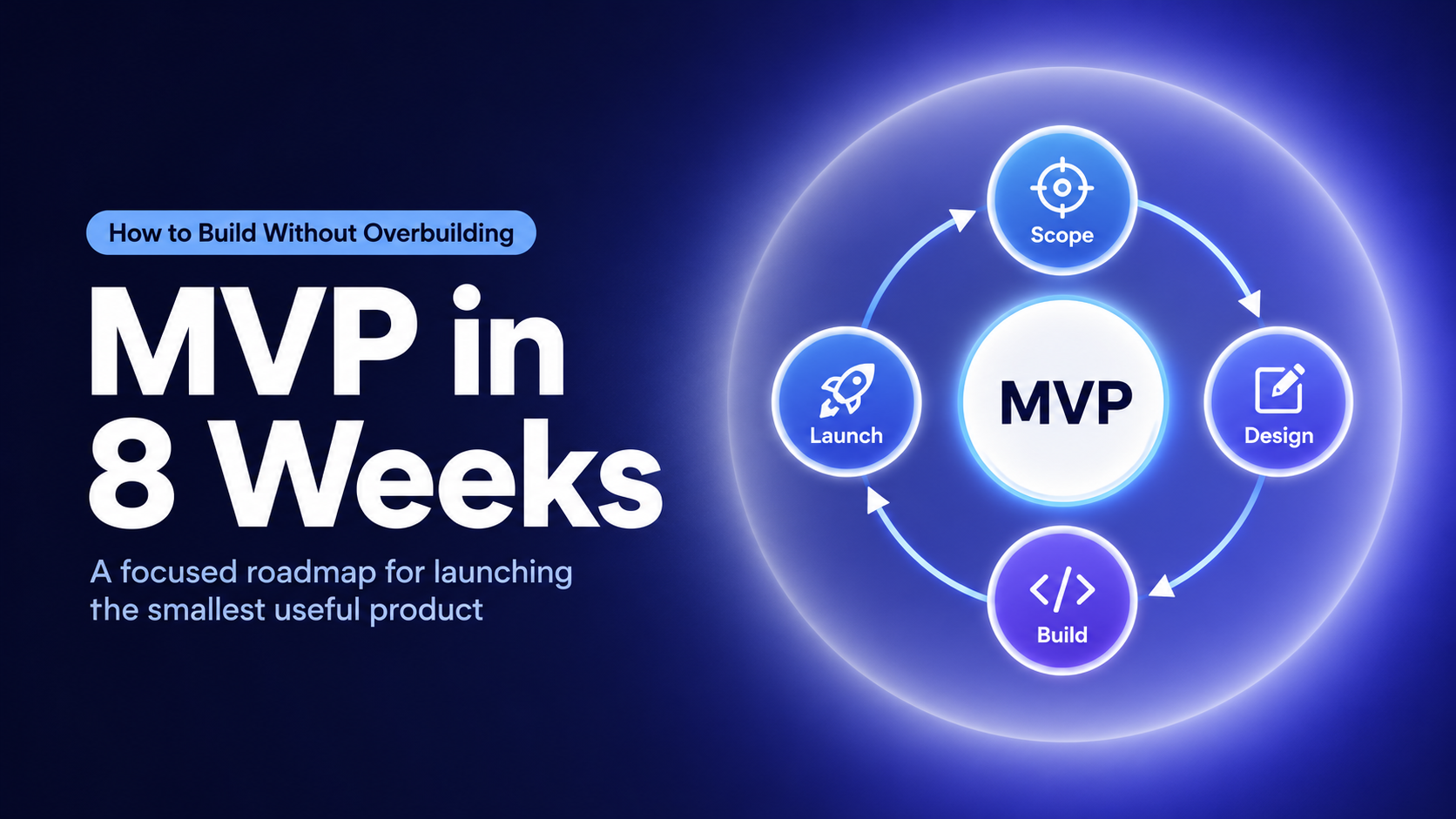
MVP in 8 Weeks: How to Build Without Overbuilding
Building an MVP in 8 weeks is possible, but only if the scope stays focused.
An MVP in 8 weeks is not a perfect product. It is a testable first version that helps founders validate the market, learn from users, and decide what to build next.
Because of this, the goal is not to include every feature. The goal is to launch the smallest useful version that proves whether the product idea has demand.
To build fast, founders need to lock the scope, prioritize the core user flow, use an existing design system where possible, release a narrow version, and improve after real feedback.
Why MVPs Often Get Overbuilt
Many MVPs fail because they become too large before launch.
At first, the idea sounds simple. Then the team adds more features. A dashboard becomes more advanced. A basic account system becomes a full permission system. A simple payment flow becomes multiple subscription plans.
As a result, the MVP becomes slower, more expensive, and harder to test.
This usually happens because founders want the first version to feel complete. However, an MVP does not need to feel complete. It needs to answer one clear question:
Do users care enough to use this?
If the answer is yes, you can improve the product. If the answer is no, the extra features will not save it.
What an MVP in 8 Weeks Needs Before You Start
An MVP in 8 weeks needs clear decisions before development begins.
If the team starts with unclear scope, the timeline will become difficult very quickly. Therefore, the first step is to define what the product must prove.
Before building, you should know who the product is for, what problem it solves, what the core user flow is, which features are truly required, which features can wait, what platform you will launch first, who will review the work, and how success will be measured.
For example, if you are building a booking marketplace, the core flow might be simple: a user searches for a service, views a listing, sends a booking request, and the admin manages that request.
That may be enough for the first version. Advanced chat, loyalty points, complex payments, reviews, and AI recommendations can come later.
The Main Rule: Lock the Scope Early
The fastest way to build an MVP is to lock the scope early.
This does not mean the product can never change. It means the team needs a clear agreement on what belongs in version one.
A strong MVP scope should include the main user role, core user flow, minimum required screens, backend logic, admin needs, launch goal, and success metric.
Everything else should move into a later phase.
For example, a founder may want user accounts, onboarding, payments, notifications, dashboards, analytics, referrals, reviews, and AI chat.
Some of these may matter later. However, the first version may only need user accounts, onboarding, a core action, and a simple admin view.
The question should always be:
Does this feature help validate the core idea?
If not, it should probably wait.
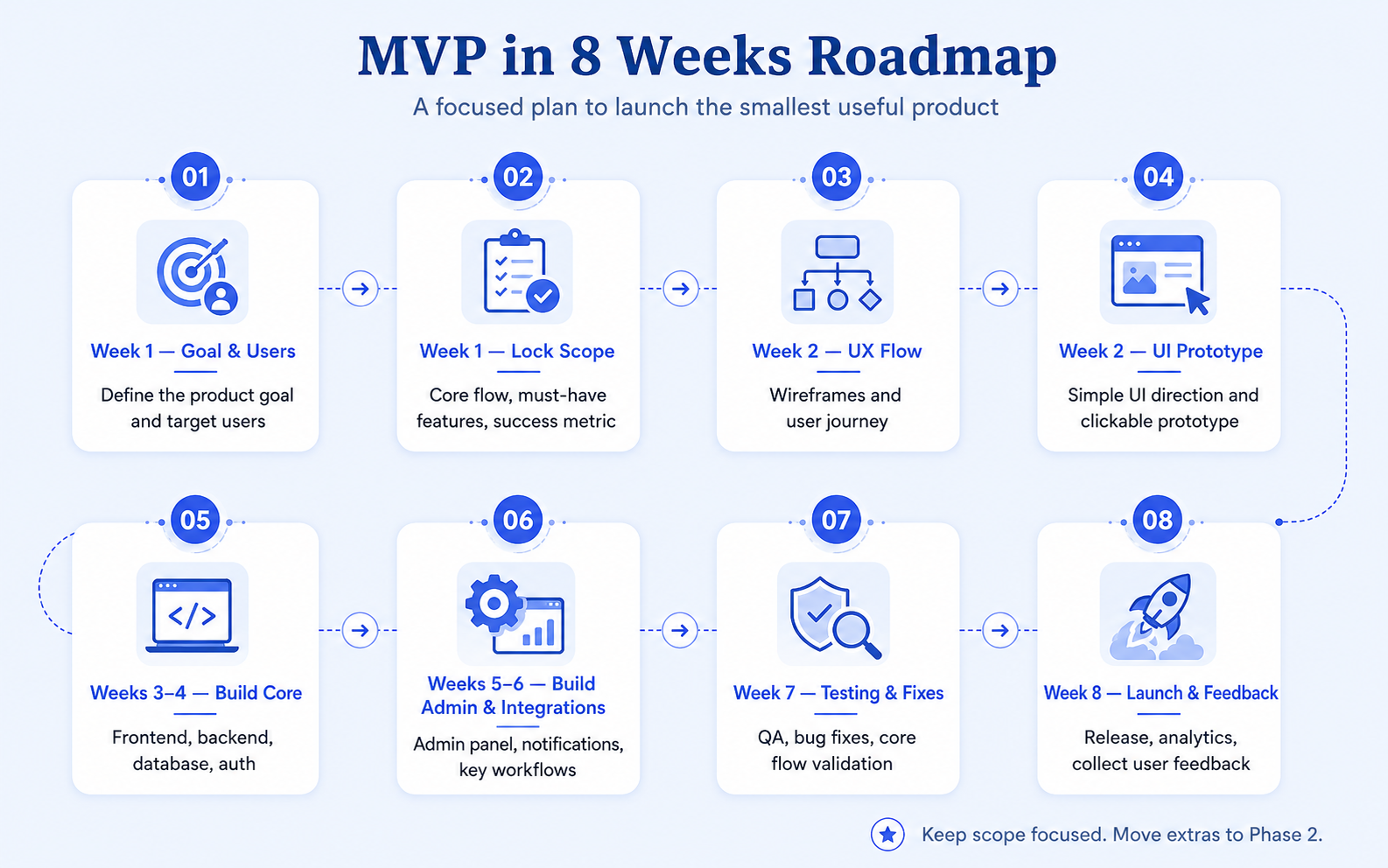
Week 1: Scope and Product Definition
The first week should focus on product clarity.
This is where founders and the development team define the MVP scope, core flow, user roles, and must-have features.
The goal is to avoid confusion before design and development begin.
During week 1, the team should define the product goal, target users, core problem, main user journey, must-have features, nice-to-have features, admin requirements, platform choice, technical risks, timeline, and milestones.
At this stage, it is important to separate “must-have” from “nice-to-have.”
A must-have feature is required for the product to work. A nice-to-have feature improves the experience but does not block the first test.
For example, login may be required. A custom profile avatar may not be.
Week 2: UX and UI
Week 2 should focus on user experience and interface design.
The team does not need a massive design system or perfect branding for an MVP. Instead, the goal is to create clean, usable screens that support the core flow.
A good MVP design phase may include wireframes, core screen layout, user flow review, simple UI direction, clickable prototype, a basic design system, and responsive behavior.
This step matters because unclear design creates development delays.
If the development team does not know how the screens should behave, they will need to ask more questions during the build. That slows everything down.
To move faster, founders can use existing UI patterns, standard components, and simple layouts. In many cases, clarity is more important than visual originality.
Weeks 3–6: Development
Weeks 3 to 6 are the main development phase.
This is where the team builds the frontend, backend, database, admin panel, integrations, and core product logic.
The development phase should stay focused on the agreed scope. If new ideas appear, they should go into a phase 2 list unless they are truly required for launch.
During this stage, the team may work on frontend screens, backend logic, database setup, user authentication, admin panels, core features, API integrations, email notifications, basic analytics, security basics, and deployment setup.
For example, if the MVP is a SaaS dashboard, development may include login, data input, report display, basic admin control, and one or two key workflows.
It should not include every advanced dashboard, export format, AI feature, and enterprise permission system unless those are required to validate the product.
Week 7: Testing and Fixes
Week 7 should focus on testing.
The goal is to find bugs, check the core flow, and make sure users can complete the main action without confusion.
Testing does not need to be overcomplicated. However, it should be serious enough to protect the launch.
The team should test user registration, login, logout, core user actions, form submissions, dashboard behavior, admin actions, payment flow if included, email notifications, mobile responsiveness, basic security, broken links, and empty states.
At this stage, the team should avoid adding new features unless they are critical. New features during testing often create delays and new bugs.
Instead, the focus should be stability.
A simple, stable MVP is better than a larger product that breaks during user testing.
Week 8: Release
Week 8 should focus on launch preparation and release.
This does not always mean a public launch to everyone. In many cases, an MVP should launch to a small group of early users, pilot customers, internal testers, or selected prospects.
A controlled release helps the team learn faster without exposing the product to too much risk.
During week 8, the team should prepare production deployment, basic analytics, error tracking, feedback methods, support process, admin access, launch checklist, onboarding notes, known issue list, and a phase 2 backlog.
After release, the goal is to collect feedback.
Founders should watch what users actually do, not only what they say. Do they complete the main action? Do they understand the product? Do they ask for the same missing feature? Do they return after the first use?
These signals are more valuable than guessing before launch.
What Features Should Move to Phase 2?
Many features feel important, but not all of them belong in the MVP.
Phase 2 is where you place useful features that are not required for the first market test.
Common phase 2 features include advanced analytics, complex role permissions, referral systems, loyalty programs, in-app chat, multiple payment plans, AI recommendations, advanced search filters, custom notifications, mobile app versions, multi-language support, complex onboarding, export tools, and third-party integrations.
For example, a marketplace MVP may not need in-app chat immediately. The first version can use email notifications or manual coordination. If users validate the marketplace flow, chat can become a phase 2 feature.
This approach helps reduce cost, shorten the timeline, and keep the first release focused.
What Should Stay in the MVP?
Some features usually need to stay because they support the core product test.
These may include the core user flow, basic account system, main action or transaction, simple admin panel, essential notifications, basic data storage, important security settings, basic analytics, and feedback collection.
For example, if the product is a booking platform, the user must be able to request a booking. If the product is a reporting dashboard, the user must be able to see the core report. If the product is a lead research tool, the user must be able to generate or review lead output.
The MVP should keep the features that prove the main value.
Everything else should be questioned.
How to Avoid Overbuilding
The best way to avoid overbuilding is to make trade-offs early.
Founders should create two lists: version 1 and phase 2.
Version 1 should include only the features required to test the product. Meanwhile, phase 2 should include everything that can wait until after user feedback.
In addition, the team should review scope every week.
If a feature does not support the core user flow, it should be delayed.
A useful question is:
Can we still test the idea without this feature?
If the answer is yes, the feature probably belongs in phase 2.
Example: Turning a Big Idea Into an 8-Week MVP
Imagine a founder wants to build a platform that connects businesses with freelance designers.
The full product idea may include profiles, portfolios, search, chat, reviews, payments, subscriptions, dispute handling, AI matching, notifications, and analytics.
That is too much for an MVP in 8 weeks.
A focused version could include business user sign-up, designer profile submission, basic listing view, project request form, admin review panel, email notification, manual matching process, and a basic feedback form.
This version does not include everything. However, it can test whether businesses want to submit projects and whether designers want to join.
If the test works, phase 2 can add chat, payments, reviews, and AI matching.
8-Week MVP Timeline Summary
| Week | Focus | Main Output |
|---|---|---|
| Week 1 | Scope | Product brief, core flow, must-have features |
| Week 2 | UX/UI | Wireframes, design direction, clickable prototype |
| Weeks 3–6 | Development | Frontend, backend, admin, integrations |
| Week 7 | Testing | Bug fixes, core flow testing, launch checklist |
| Week 8 | Release | MVP launch, feedback collection, phase 2 backlog |
This timeline works best when the scope is focused and decisions are made quickly.
If the team keeps adding features, the 8-week plan will become unrealistic.
Common Mistakes Founders Make
One common mistake is trying to impress users with too many features.
However, users do not need every feature in the first version. They need one clear problem solved well enough to test.
Another mistake is delaying launch until the product feels perfect. In reality, the MVP should help the team learn earlier.
In addition, some founders skip user flow planning. This creates confusion during design and development.
A fourth mistake is building a mobile app too early when a web app could validate the idea faster.
Finally, many teams forget to plan phase 2. Without a phase 2 list, every new idea feels urgent and the MVP becomes bloated.
How Golden Sea Can Help
Golden Sea helps founders turn ideas into focused MVP scopes before development starts.
The process usually begins by reviewing the product idea, user flow, must-have features, platform choice, timeline, and launch goal.
After that, Golden Sea can help separate version 1 from phase 2, choose the right team structure, and build a practical MVP plan.
This may include UX/UI design, app and web development, backend systems, AI automation features, admin dashboards, or dedicated remote team support.
The goal is not to build too many features. Instead, the goal is to build the right first version quickly.
Golden Sea helps founders turn ideas into focused MVP scopes before development starts.
FAQ
How long does it take to build an MVP?
How much does MVP development cost?
Should I build a web app or mobile app first?
Can I start with only a rough idea?
What should I prepare before contacting a development team?
What features should wait until phase 2?
Final Thoughts
Building an MVP in 8 weeks is possible when the scope is focused.
The goal is not to create a perfect product. Instead, the goal is to test the market with the smallest useful version.
To move fast, founders should lock the scope, prioritize the core user flow, use simple design systems, build only what is required, release to real users, and improve after feedback.
Features that do not help validate the core idea should move to phase 2.
Golden Sea helps founders turn ideas into focused MVP scopes before development starts.
Contact Golden Sea Studios:
Website: goldenseastudios.com
Email: info@goldenseastudios.com
Social Media: @goldenseastudios (Twitter, Instagram, Facebook)
Telegram: @goldenseastudio
We are available online to assist you with any inquiries or collaborations. Reach out to us through these channels and let’s connect!
