
Short answer: A website template is enough when the business wants to test an offer quickly, has one clear service, and needs leads soon. It is not enough when the problem requires deeper positioning, multiple content paths, or operations integration behind the site.
This article targets the primary keyword website template for SME, supported by low-cost website design, SEO-ready website for SMEs, landing page package. The search intent is commercial investigation plus implementation: the reader is trying to understand the problem before buying, so the article must be useful first and sales-driven second.
Templates are not bad. Using them for every problem is bad
A website template works when the business needs to get online quickly, the service is not too complex, and content can fit into a few clear pages. A good template saves time on layout, responsiveness, and basic structure.
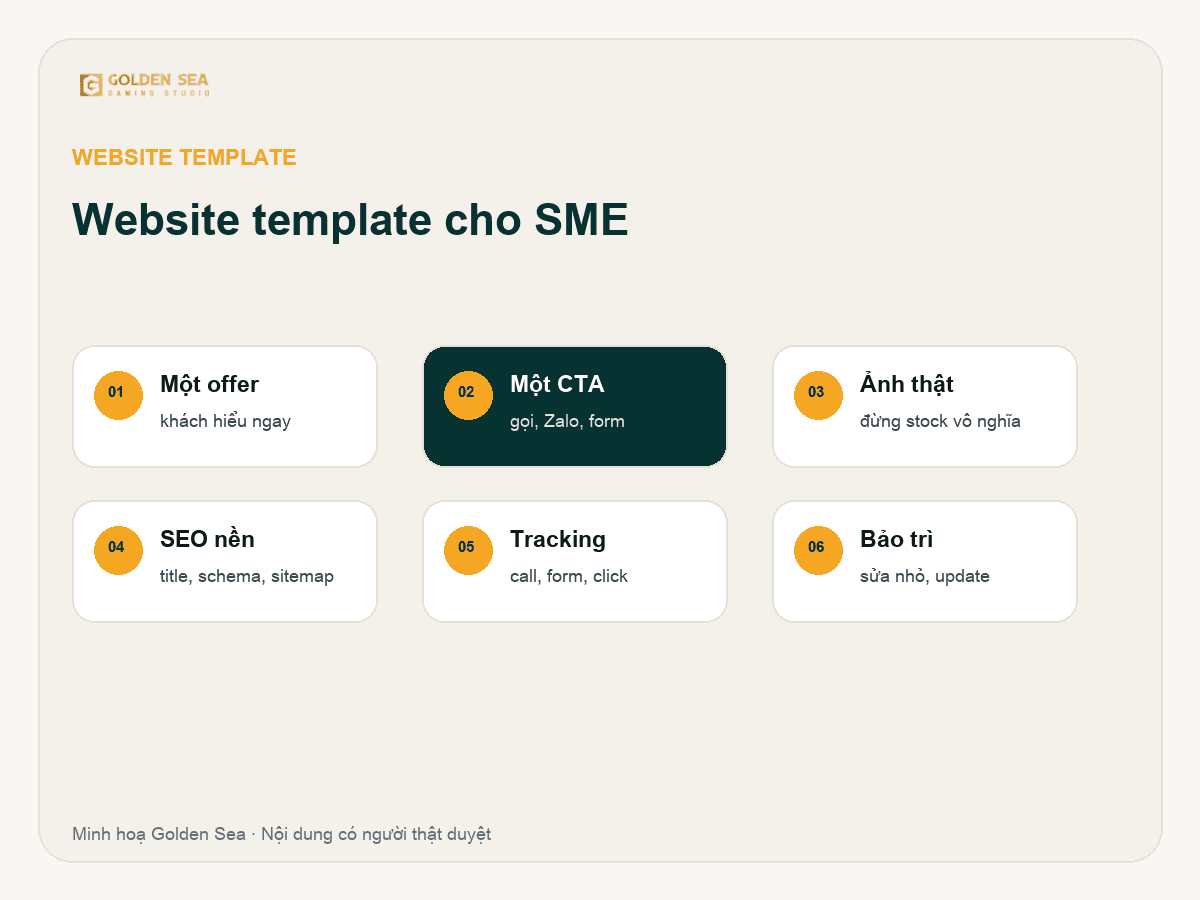
But a template does not create positioning. If the hero fails to explain the offer, the CTA is vague, and no one owns the form response, the website will not generate leads even if it looks clean.
When a template package is enough
A template package is enough when the business needs a landing page or small website to introduce a service, receive inquiries, and start technical SEO basics. Examples include a small spa, homestay, local service, small clinic, class, consulting offer, or a new service branch to test quickly.
The condition is focused scope: one primary offer, one buyer group, one main CTA, and enough real visuals.
When to move to custom concept
If the business needs multiple content routes, many services, case studies, bilingual pages, booking, dashboards, or integrations, a template can become too tight. The higher fee is not for more decoration; it is for content architecture and operating flow design.
Custom work makes sense when the website is a long-term sales asset, not only an online presence.
A template still needs SEO foundations
Even a simple template needs titles, meta descriptions, headings, canonicals, sitemap, robots, basic schema, image alt text, speed, and form tracking. Missing these foundations can turn cheap setup into expensive repair.
Golden Sea treats templates as an entry point, not a lower-standard shortcut.
Quick implementation checklist
- Define the inputs: owner, source material, offer, and channel.
- Break the workflow into accountable steps instead of placing everything inside one AI box.
- Set review standards for claims, visuals, brand voice, CTA, and personal data.
- Track real actions such as phone clicks, messaging clicks, forms, downloads, and bookings.
- Review after two to four weeks using lead quality and response speed, not only publishing volume.
How Golden Sea frames this problem
Golden Sea does not treat AI as decoration. For website templates and automation upgrades, the real purchase is a clearer operating flow: the website creates signal, content uses real source material, leads get classified, risky outputs are reviewed by humans, and data returns to reporting. If the business lacks a strong web foundation, start with website design and tracking. If leads exist but handling is fragmented, consider AI automation. If the business needs custom software, dashboards, or deep integrations, IT outsourcing is the right layer.
How is a two-hour template different from a two-week website?
A fast website template works because many decisions are pre-locked: layout, sections, responsiveness, forms, and basic SEO structure. It is useful for launching an offer, testing demand, or replacing an outdated page. But the speed has limits. A two-hour template should not promise deep positioning, custom concept work, advanced copywriting, proprietary imagery, or complex integrations.
A two-week website usually includes discovery, concept refinement, industry-specific writing, feedback cycles, and more complete handover. The two packages should not be compared by page count. They should be compared by how settled the business problem is.
Using templates as a smart consulting entry point
A template can be an excellent entry point when scope is clear. A customer who needs to get online quickly buys the template. Once the site runs, real data appears: which pages get viewed, which CTAs get clicked, what customers ask, and where forms drop off. That creates a natural path toward SEO, content, or automation.
This is more natural than hard upselling. Instead of telling customers they need AI, let the website reveal the bottleneck: visitors without forms, forms without callbacks, inboxes without classification, or content without measurable leads.
Conclusion
Useful content does not need exaggerated selling. It helps business owners see where value is leaking, understand why the problem happens, and identify a small next step. When website, content, and automation are connected into one workflow, Golden Sea earns natural consulting opportunities without forcing the sale.