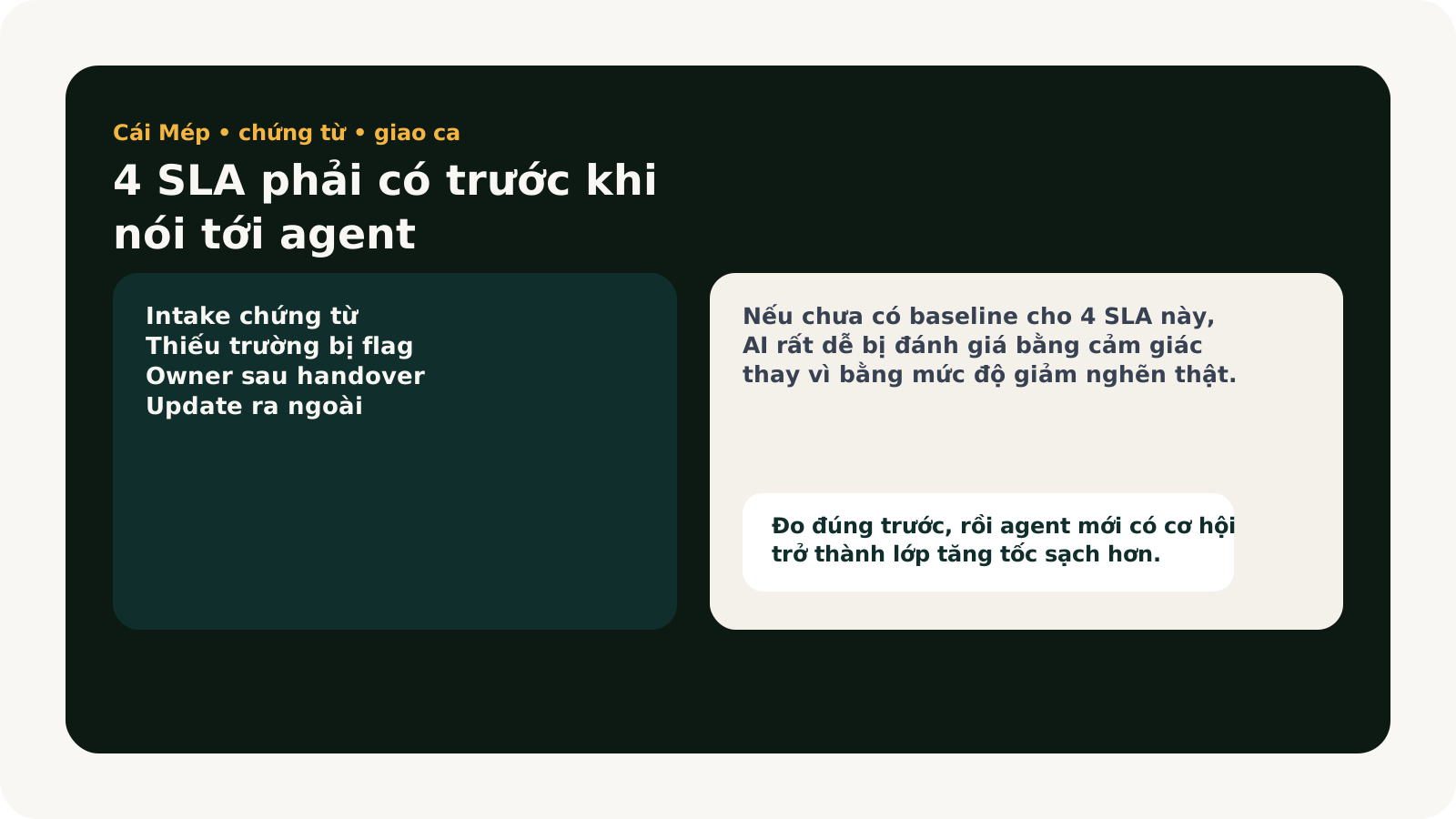
Short answer: Before talking about AI agents for logistics in Cai Mep, a business should measure four minimum SLAs: document intake time, missing-field detection time, owner assignment after handover, and customer or partner update time. Without those four layers, AI gets judged by feeling instead of by whether it actually reduces operational friction.
Why Cai Mep should start from SLA instead of agents
Vietnam's logistics conversation is moving toward digitization, cleaner data, and measurable operations. In Ba Ria - Vung Tau, recent BVU discussions on digital logistics and the formal recognition of Vietnam Logistics Day both reinforce the same direction: logistics needs metrics and identified bottlenecks, not only manual hustle.
That is why Golden Sea would start with SLA definition before agent selection. The useful question is not which agent looks smartest. It is which delay is most expensive in documents and shift handover, and how it will be measured before and after automation.
The four SLAs to measure first
| SLA | Practical definition | Why it matters |
|---|---|---|
| Document intake | Arrival to correct queue entry | Measures source-side friction |
| Missing-field detection | Record creation to field-gap flag | Measures rework prevention |
| Owner assignment after handover | End-of-shift transfer to named next owner | Measures handover quality |
| External update time | State change to partner/customer update | Measures information latency |
What breaks if you automate before measuring
The first failure is evaluating the system by the team's feeling of relief instead of by true cycle time and queue quality. The second is letting an agent read and summarize while the core problem—missing mandatory fields—remains undefined.
A pilot path with cleaner evidence
Measure the four SLAs over a recent baseline, enable lighter workflow automation, and then remeasure using the same definitions. If the definitions change between baseline and pilot, the result stops being trustworthy.
The minimum dashboard to keep beside the pilot
Alongside the four SLAs, the team should track a compact dashboard: total intake by lane, returned cases due to missing fields, overdue handovers, and delayed external updates. It does not need to be elaborate. It needs to provide one stable reading surface for everyone involved.
That dashboard helps separate data problems from rule problems and both from ownership problems. Without it, teams tend to collapse all delay into one cycle-time number and lose the ability to see where the friction is actually moving.
When to hold the pilot at workflow level
If the four SLAs have been measured and the largest delays still come from missing fields, wrong queues, or late owner assignment, Golden Sea would usually keep the pilot at workflow level for another cycle. Those bottlenecks respond better to validation, routing, reminders, and approval paths than to more reasoning power.
Agent investment makes more sense only after the base SLAs improve and the remaining friction comes from real context assembly across documents and operational states.
FAQ
Read next: Which Cai Mep document and shift lanes to automate first · AI automation for ports and logistics in Vung Tau · Controlled automation for field and maintenance reporting