
Short answer: Around Cai Mep and Vung Tau, not every document process deserves automation first. The best starting points usually share three traits: they repeat across shifts, they pass through multiple hands, and a small delay there slows the rest of the chain. In practice, that means starting with shift handovers and repetitive document flows, not with a vague ‘AI for ports’ program.
Why this Cai Mep angle should stay workflow-specific
Ba Ria - Vung Tau has real authority for digital logistics. BVU's 2026 material on digital logistics and green transition, plus VnEconomy's reporting on the region's role in digital infrastructure, both support the macro story. But the more useful buyer question is narrower: where should a company automate first to reduce operational blockage?
Businesses do not buy concepts. They buy fewer handover gaps, fewer repetitive document errors, and less time spent reconstructing information from email, chat, files, and phone calls.
Three criteria for choosing the first automation target
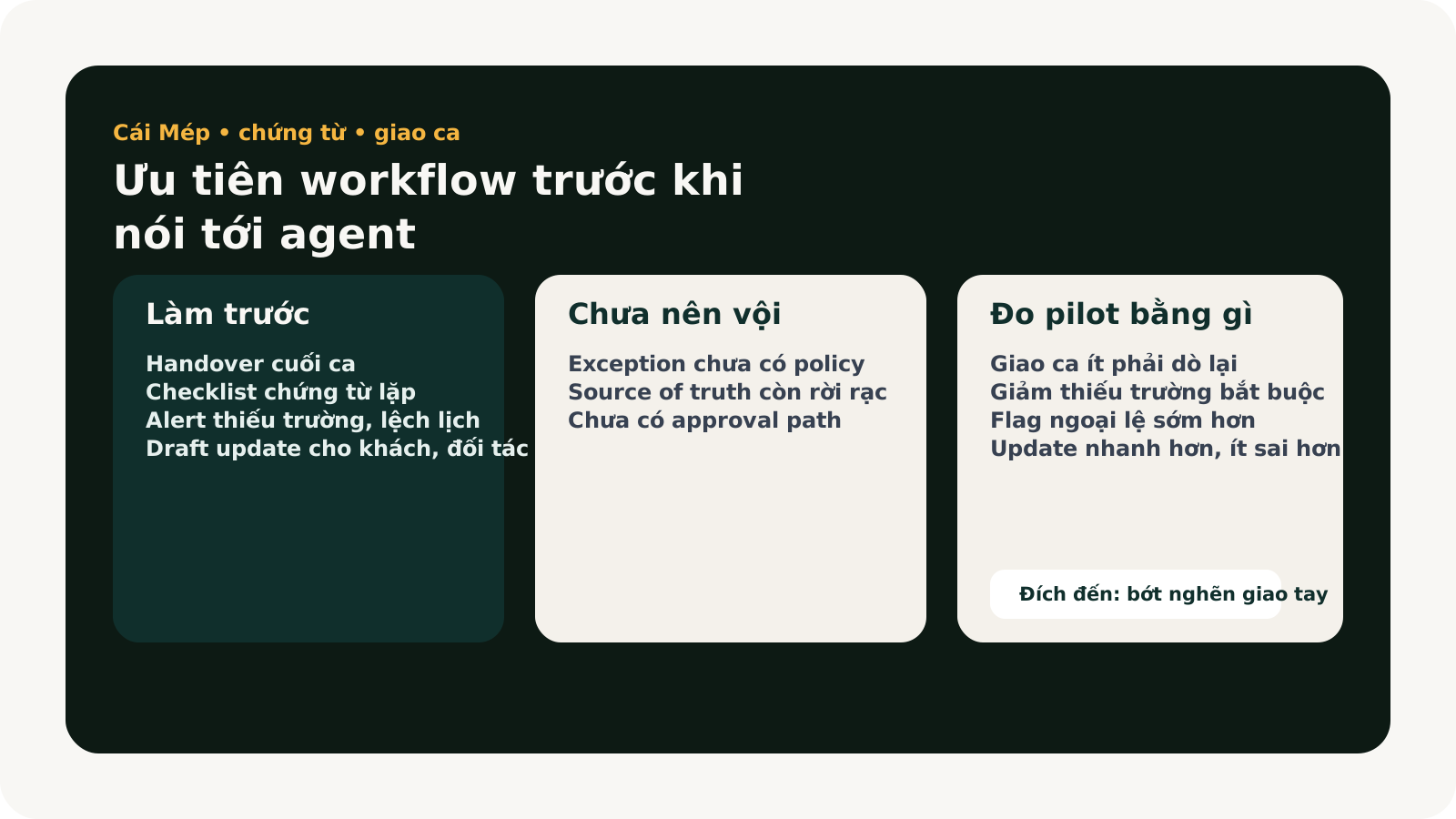
- High repetition: the step appears in most shifts or loads.
- High handoff count: information passes between dispatch, field staff, documentation, clients, or transport partners.
- Chain blockage risk: one delay slows downstream confirmation, release, or scheduling.
Workflow groups worth prioritizing in the first 30 to 60 days
| Workflow group | Why it is a good first target | Expected output |
|---|---|---|
| Shift handover | Information loss is most visible when responsibility changes hands | Shift summary, open backlog, unresolved items, next owner |
| Repetitive document checks | The same validation repeats and invites copy-paste mistakes | Completion checklist, missing-field alerts, correct routing |
| Exception alerts | Problems often get noticed too late | Priority flag for missing data, timing mismatch, or stalled confirmation |
| Customer and partner update logs | Teams rewrite similar status updates across channels | Draft updates with owner, timestamp, and clear next step |
Where not to rush into automation
- Legal or commercial exceptions without a clear policy.
- Processes whose source of truth still lives in scattered files, chat threads, and individual memory.
- High-impact steps without approvals or strong logging.
If ownership and data are still fragmented, automation only makes errors happen faster. Golden Sea usually clarifies lanes, owners, and handover formats before raising the automation level.
How to choose the “small but painful” workflow first
When people hear automation, they often picture a large dashboard or an assistant that answers everything. Around Cai Mep, early value usually comes from smaller painful workflows: a shift handover that must be reconstructed from multiple chat threads, a repetitive document checklist that misses one field and delays the next confirmation step, or a customer update that goes out late because nobody can consolidate the current status. Those are better pilot candidates.
Once those workflows are standardized, the business can safely add context layers such as draft updates, exception prioritization, or end-of-shift summaries. Without that foundation, AI becomes a polished layer on top of inconsistent information.
A quick checklist before choosing the first logistics pilot
- Does the workflow have a clear owner at the start and end of each shift?
- Is there a minimum information set that people still enter manually or repeatedly ask for?
- Does one small mistake delay the rest of the chain?
- Does the team have enough logging to tell whether failure came from missing data, missing ownership, or missing decisions?
Which metrics prove that the logistics pilot is useful?
- Shift handovers take less time and require less reconstruction.
- Mandatory-field gaps in repetitive documents decline week by week.
- Exception cases are flagged earlier instead of being discovered late.
- Status updates to clients or partners become faster and more accurate.
If the pilot improves none of these signals, the company should reconsider whether it chose the right first workflow. The goal is not more technology. The goal is less blockage at real handoff points.
Read next: AI automation for Vung Tau port logistics · Automating field maintenance reporting · Digital transformation for oil and gas businesses in Vung Tau