
Short answer: AI coding agents will not make software outsourcing obsolete. They will make outsourcing models built on selling developer hours and handing over poorly governed code lose value quickly. Companies still need external teams when they lack architecture, QA, security, integration, and accountable production delivery.
AI lowers the price of an hour spent typing code. It raises the value of a correct technical decision and a delivery commitment with a named owner.
Why is this question getting louder in July 2026?
Recent research, market signals, and founder discussions point to the same shift: software is being produced faster, but review capacity and accountability do not automatically scale with it. A study of Microsoft’s early 2026 rollout of Claude Code and GitHub Copilot CLI, published on July 1, followed tens of thousands of engineers and found that adopters merged roughly 24% more pull requests than they otherwise would have. The authors also make an important qualification: a merged pull request is a proxy for output, not proof of business value.
Another longitudinal study covering 802 developers and 196,212 pull requests found that per-capita throughput reached 2.09 times the pre-mandate baseline by April 2026. That is a meaningful gain, but the paper’s title captures the other side of the equation: AI writes faster than humans can review. When change volume doubles, a company needs more verification capacity, not merely more tokens or more agents.
Reddit frames the concern in buyer language. In a discussion about software outsourcing in 2026, one participant argued that many outsourcing failures are specification problems disguised as quality problems. An offshore team may implement the literal brief correctly and still build the wrong thing. A newer outsourcing-trends thread points to another risk: an agent-enabled vendor may compress a three-month cycle into six weeks while the client loses the ability to explain what actually changed across the organizational and time-zone boundary.
The practical question is no longer whether AI can write code. It is who turns an ambiguous business request into a correct system, who verifies the accelerated change volume, and who remains accountable when the product fails in production.
What part of outsourcing has AI coding already changed?
Modern coding agents can read repositories, create plans, modify multiple files, run tests, draft documentation, and open pull requests. Gartner describes the market as moving from AI-assisted coding toward agentic software development across the full software development life cycle, including planning, implementation, and review. It predicts that by 2027, more than 65% of engineering teams using agentic coding will treat the IDE as optional, with control, governance, and validation shifting toward automated platforms.
This reduces the value of four categories of work:
- Repetitive boilerplate and CRUD: standard forms, basic endpoints, migrations, and test scaffolds need fewer manual hours.
- Rule-based transformations: API migrations, library upgrades, and pattern changes across many files are good agent tasks when reliable tests exist.
- Documentation of known work: agents can draft READMEs, changelogs, and pull-request descriptions from actual diffs.
- Prototypes for testing assumptions: founders can move from an idea to a running artifact faster than before.
An outsourcing vendor that prices primarily by the hours required for these tasks will face legitimate pressure. Buyers should ask why a deliverable still requires three weeks when the delivery team already uses agents that materially increase throughput.
What do AI coding agents still not replace?
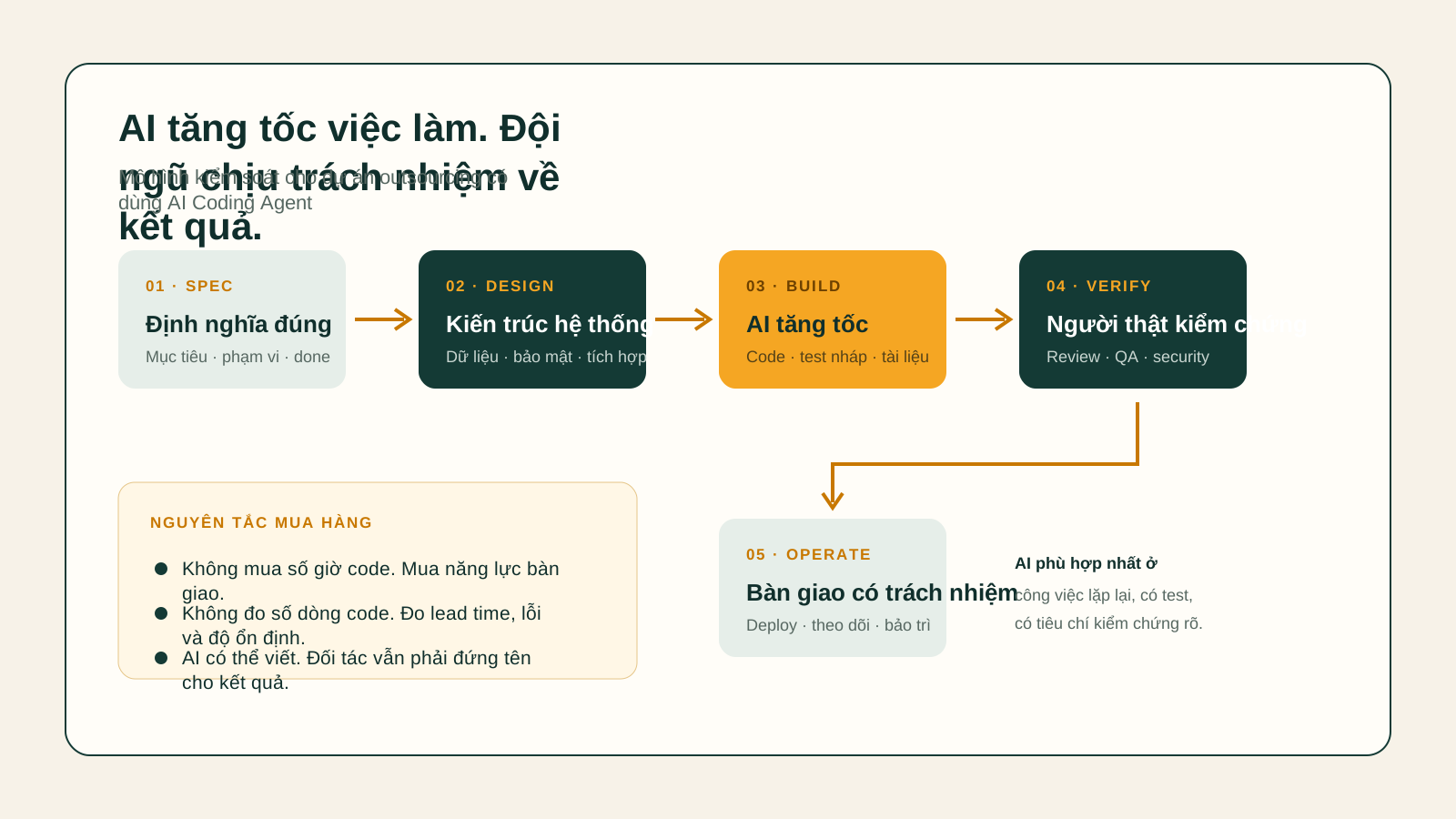
1. Turning a business problem into the right specification
Founders express needs as outcomes: reduce order-processing time, recover leads, show accurate inventory, or launch an MVP before a fundraising milestone. An agent needs sharper definitions: which system is the source of truth, how access works, which edge cases must be blocked, and what counts as done. Product thinking and delivery experience still bridge those two languages.
2. Making architecture trade-offs
AI can propose several plausible architectures, but it does not own the consequences. A company must still choose between speed and extensibility, managed services and infrastructure control, or a simple system that works now and a platform designed around hypothetical future demand. A strong architect knows not only what can be built but what should not be built yet.
3. Verifying long-term quality
A large-scale study of 302,600 verified AI-authored commits across 6,299 repositories identified 484,366 issues; 89.3% were code smells. More than 15% of commits from every studied assistant introduced at least one issue, and 22.7% of tracked issues survived in the repository’s latest version. This does not prove that AI-generated code is always poor. It proves that “the agent ran the tests” is not a replacement for QA strategy, independent review, and technical-debt monitoring.
4. Owning what happens after deployment
When payments fail, synchronization corrupts data, or a user journey breaks, the business needs someone to investigate, decide whether to roll back, communicate with stakeholders, and fix the root cause. An agent can support each operation, but production accountability still belongs to a team with the appropriate context, authority, and SLA.
Which outsourcing model is losing value?
| Model | Why it weakens in the AI era | Better replacement |
|---|---|---|
| Selling developer hours or headcount | AI changes throughput, making hours a weak proxy for output | Price around scope, milestones, and acceptance criteria |
| Taking tickets and producing code | An agent can also execute a well-defined ticket quickly | Participate in problem framing, solution design, and outcome measurement |
| Showing a demo and handing over a repository | Prototypes are cheap; stable operation remains difficult | Deliver tests, observability, documentation, and a maintenance plan |
| Keeping AI usage opaque | The buyer cannot assess data exposure, agent permissions, or review quality | Disclose agent scope, controls, and verification evidence |
| Measuring progress with lines of code | More code may simply create more technical debt | Track lead time, escaped defects, change failure rate, and reliability |
Which outsourcing model becomes more valuable?
Upwork’s July 14 Future Workforce Index suggests that value is concentrating in complex, judgment-heavy work. The study combined a survey of 2,400 U.S. knowledge workers with marketplace data. Freelancers doing more complex AI work increased earnings by 45% year over year. AI-augmented professional services grew 72% in volume and 22% in earnings. Upwork uses the term “AI Orchestrator” for professionals who connect AI tools to domain expertise, apply human judgment, and turn AI-enabled execution into business outcomes.
For software outsourcing, the more valuable model includes five capabilities:
- Deep discovery: clarify goals, users, data, risk, and success criteria before estimating.
- Spec-driven development: every meaningful task has acceptance criteria, a test plan, and a defined agent scope.
- Mandatory senior review: important changes are verified by someone who understands architecture, security, and production operations.
- Proof of delivery: demos arrive with tests, logs, documentation, changelogs, and evidence against acceptance criteria.
- Post-release ownership: the engagement includes SLAs, observability, incident handling, and technical-debt reduction.
Buyers should not pay simply because a vendor does or does not use AI. They should pay for the ability to use AI to deliver faster while preserving quality, verifiability, and accountability.
How should companies change the way they buy outsourcing?
Ask about the control system, not the tool list
“Do you use Claude Code, Codex, or Copilot?” is a secondary question. The primary questions are what permissions agents receive, which data cannot leave the environment, which changes require approval, which tests are mandatory, and who signs off. Tools change rapidly; the control system determines risk.
Require estimates to separate three layers
A useful proposal should separate discovery and architecture, AI-assisted implementation, and verification or rollout. This makes it clear which work is accelerated, which controls remain non-negotiable, and why. If a proposal is still only headcount multiplied by months, the commercial model does not reflect how software is built in 2026.
Change the definition of done
Done is not code merged or a screen working on a developer laptop. Done should mean acceptance criteria met, automated tests passing, appropriate security review complete, basic logging and alerts configured, handover documentation supplied, temporary access revoked, and rollback prepared. Customer-data or payment features need additional failure-mode testing and named approval.
Measure outcomes instead of activity
Metrics should match project intent: time to production, escaped-defect rate, recovery time, workflow completion, and operating cost after release. Prompts, tokens, commits, and lines of code are activity data. They do not demonstrate business value.
Ten questions before hiring an AI-enabled outsourcing team
- Who turns business goals into testable acceptance criteria?
- What may the agent execute autonomously, and what always requires approval?
- Are code, data, or secrets sent to a third-party model?
- How are prompt injection, dependencies, and agent permissions controlled?
- Does every change have tests, review, and an approval trail?
- Which quality metrics are used beyond delivery speed?
- Who is the senior owner for architecture and production?
- When an agent creates a defect, how is it detected, rolled back, and investigated?
- What documentation, changelog, access, and ownership does the client receive?
- What SLA and maintenance plan apply after release?
If a vendor can answer these questions clearly, using coding agents is an advantage. If it only promises “ten times faster with AI” without showing the control system, that speed may simply take the company to the wrong destination sooner.
Golden Sea’s view
Golden Sea does not treat AI as a reason to reduce engineering accountability. AI should absorb repetitive execution so engineers can spend more time on architecture, verification, and decisions that materially affect the product. The right model is not “AI replaces developers” or “outsourcing replaces the internal team.” It is a small, senior team that uses AI well and remains accountable for the complete delivery result.
Companies should not outsource all judgment. An internal founder or product owner must still own goals, priorities, and trade-off decisions. A good partner turns those decisions into testable specifications, operable systems, and a delivery rhythm both sides can inspect.
Conclusion
AI coding agents do not end software outsourcing. They gradually end a version of outsourcing based on labor arbitrage, opaque execution, and billing for code hours. The next model competes on judgment, controlled speed, integration capability, and responsibility after release.
Before asking how much cheaper AI makes the project, ask which work becomes faster, which controls remain intact, and who is accountable once the product enters production. The answer will reveal whether you are buying more code or a real delivery capability.
Read next: 9 criteria for choosing a software outsourcing partner in the AI era · How to evaluate an AI automation partner · Do not automate a chaotic process