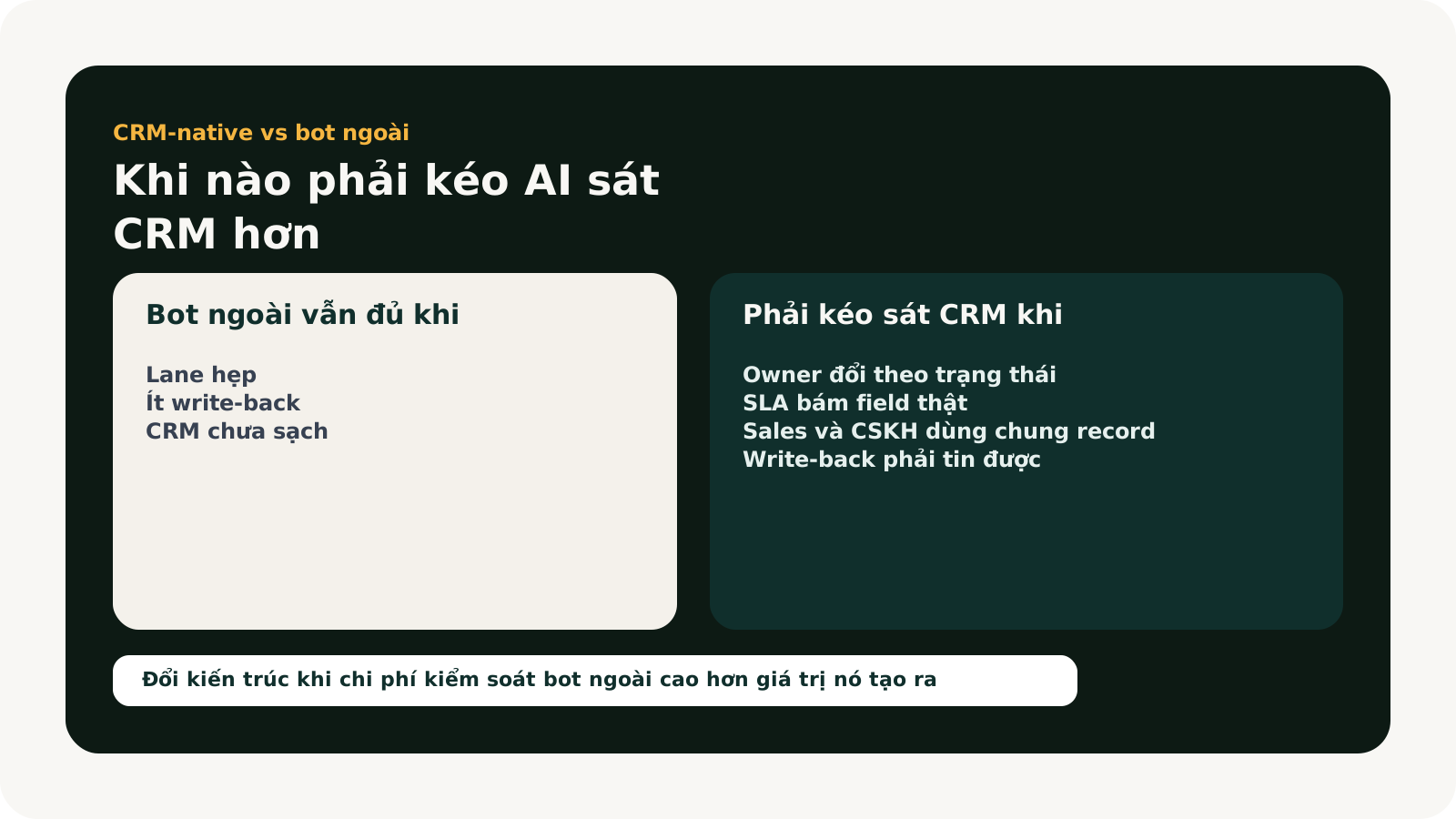
Short answer: Not every business needs CRM-native AI immediately. But at a certain point, keeping bots outside the CRM and writing data back through loose workflows creates more control cost than value. The architecture usually needs to change when owner assignment, SLA behavior, record-writing, and history quality become mission-critical to how sales and service teams operate day to day.
Why this question is heating up
Salesforce is pushing the case for CRM-integrated AI agents, while Zendesk keeps emphasizing agents that work against real workflows instead of conversational surface alone. The shared signal is clear: businesses want AI to act on operational truth, not just talk around it.
So the practical SME question is not whether the CRM has AI features. It is whether the current architecture still preserves owner clarity, SLA accuracy, and trustworthy write-back.
When external bot plus workflow is still enough
It is often enough when lead volume is moderate, the lane is narrow, AI mostly handles intake or reminders, and the CRM itself is not yet clean enough to deserve deeper automation. In that stage, external workflow architecture may be the faster and safer proving ground.
Signals that the architecture must get closer to the CRM
| Signal | What breaks if you stay outside |
|---|---|
| Owners change with record status | Routing errors and stale updates increase |
| Real notes and timestamps matter | Write-back becomes unreliable |
| SLA depends on CRM fields | The bot reacts to outdated snapshots |
| Sales and service share one record | Teams stop trusting each other's state |
Golden Sea's rule of thumb
Keep the lane external when the goal is to prove a narrow workflow with low-risk actions. Pull the system closer to the CRM when real fields, real owners, real SLAs, and durable history become the backbone of the flow. But do not push AI into a dirty CRM and expect architecture to fix the underlying data discipline problem.
Signals that you are upgrading too early
The first signal is expecting CRM-native AI to clean the CRM by itself. In reality, deeper integration often spreads dirty data faster when naming rules, ownership rules, and field discipline remain weak.
The second is choosing the platform before defining the revenue lane. If the first question is which CRM tier has AI instead of which lane is losing money because owner and SLA logic are broken, the business is likely solving the tool question before the operating question.
The third is that sales and service teams still work from copied records or parallel trackers. In that situation, deeper AI integration will not solve the fact that different teams are still operating on different versions of truth.
The financial question before changing architecture
Before moving from external workflow architecture toward CRM-native behavior, Golden Sea asks a simple question: how much time does the team spend rechecking records, owner routing, or write-back quality every week? Once that verification cost starts eating into real follow-up time, the old architecture is already costing money even if nothing has visibly exploded.
This reframes the decision. Architecture is no longer just a technology preference. It becomes a decision about buying back trust in the revenue lane that actually matters.
FAQ
Read next: Minimum architecture for automated lead routing · The real cost of a forgotten lead · How fragmented data blinds enterprise AI