
Short answer: If an SME receives leads through Zalo, Facebook, and web forms as three separate streams, the first problem is not finding a bot that replies faster. The real problem is merging those streams into one record, scoring readiness, routing to the right owner, and keeping follow-up SLA from depending on memory. The July 22, 2026 scan shows that large vendors and operator communities are both circling back to that operational layer.
Golden Sea's operating view: good lead routing does not start with a chatbot. It starts with a queue that has an owner, clear rules, and enough evidence to know which lead deserves an immediate callback, which one needs nurture, and which one must be escalated to a human.
Why move this topic up right now?
The newest signals are no longer about whether AI sounds natural. A Salesforce article published on July 22, 2026 about the signs that a business has outgrown its CRM points to three core moves: create one source of truth for customer data, use CRM to handle lead routing, and build a repeatable playbook for the sales team. HubSpot's 2026 lead management guide describes a lead management system as the automation layer that captures, qualifies, routes, and nurtures leads while blocking the three most common leaks: missed leads, slow follow-up, and inconsistent qualification.
Those are official-source facts. The qualitative community signal adds the part vendors usually understate: SMB buyers do not want a giant new CRM rollout just to solve five basic operating failures. In an Indie Hackers discussion accessed on July 22, 2026, a builder working with quote-heavy local businesses explains that speed-to-lead solves only the first leak. The second leak starts after a quote or site visit, when nobody knows which lead needs follow-up today, which stage it is in, or what message should go next. That is qualitative research, not a market benchmark, but it aligns tightly with Golden Sea's operating lens.
Builder-side signal on Hacker News points the same way. In the July 2026 “What Are You Working On?” thread, one builder described AI-backed SMS numbers for 24/7 and multilingual lead-generation support. The interesting part is not SMS itself. The interesting part is that operators are still investing in intake and first-response infrastructure first, because that is where small teams lose opportunities fastest.
In Vietnam, the case is even more practical. Zalo remains a primary communication layer for many service-led SMEs, while Meta Lead Ads and web forms continue to drive paid and website demand. If those three channels do not flow into one operating system with one set of rules, the business will think it has more leads when in reality it only has more inboxes.
What is the minimum architecture here?
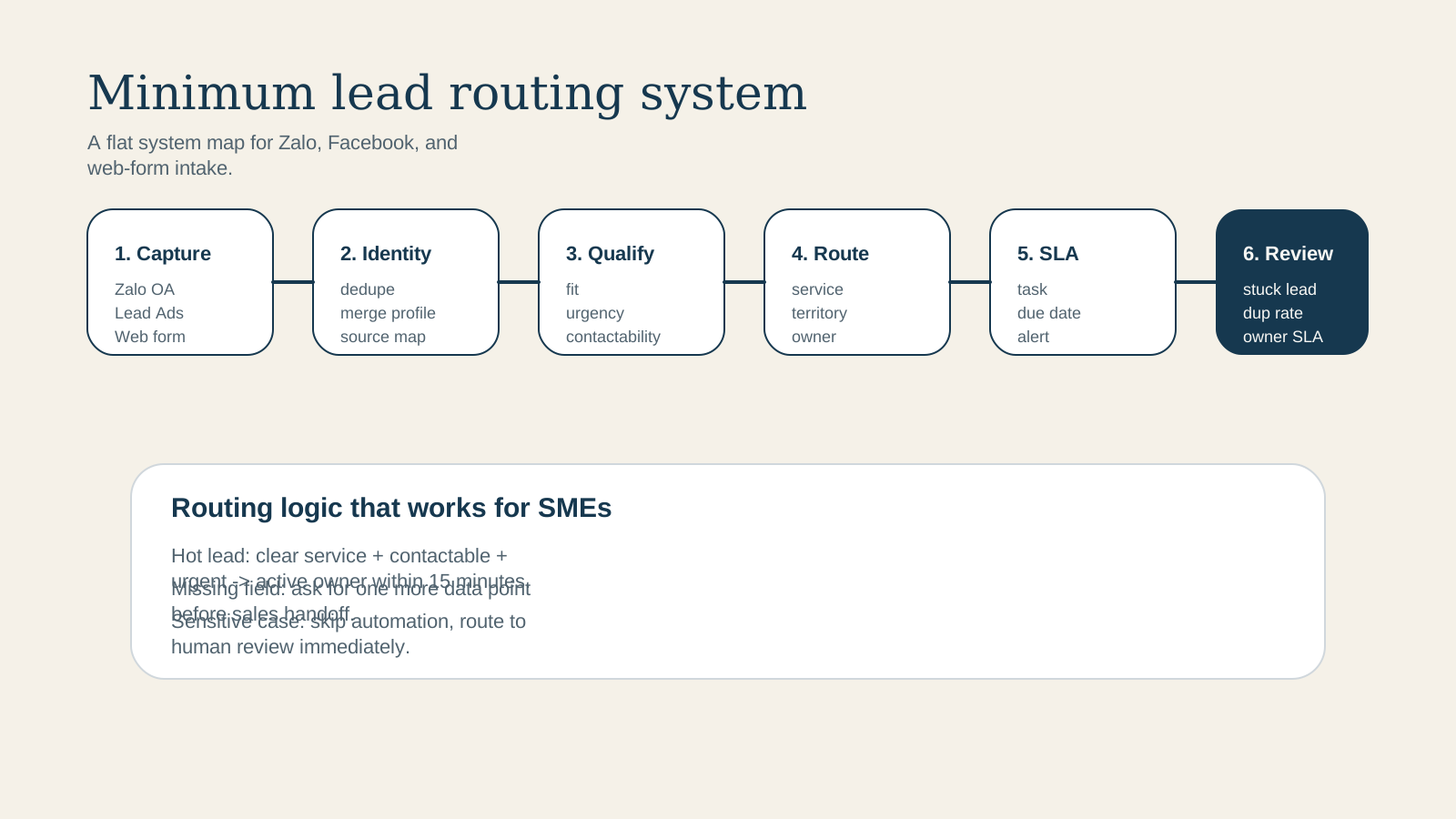
The minimum architecture for automated lead classification is not an enterprise stack. For SMEs, it only needs to do six jobs in the right order:
| Layer | What it must do | What breaks if missing |
|---|---|---|
| 1. Unified intake | Collect leads from Zalo, Facebook Lead Ads, and web forms into one queue or shared store. | Each channel keeps its own state and the team never sees the true open-lead load. |
| 2. Identity and dedupe | Merge or separate records using phone, email, channel, campaign, and timing. | One person submits a form and later messages on Zalo, but becomes two different leads. |
| 3. Minimum qualification | Score fit and urgency using required fields rather than the judgment of whoever opens the inbox first. | Hot leads get mixed together with low-intent price checkers. |
| 4. Routing rule | Assign the right owner or queue based on service, area, urgency, and team capacity. | Leads bounce between marketing, sales, and front desk with no accountable owner. |
| 5. SLA and follow-up | Create next step, due time, and overdue alerts the moment the lead enters the system. | The team responds quickly to a few leads and silently forgets the rest. |
| 6. Review loop | Log routing outcomes, contact rates, duplicate rates, and why leads got stuck. | No one knows which rule is causing leakage or rework. |
The critical point is that the three middle layers, identity, qualification, and routing, need one shared operating vocabulary. If marketing calls something an MQL, sales calls it a qualified lead, and the receptionist labels it only as “replied,” the system will automate confusion rather than fix it.
How should the three channels be standardized differently?
Although all three are inbound leads, Zalo, Facebook, and web forms do not enter the system with the same data quality. Intake rules should reflect that reality.
| Source | Strength | Typical data gap | First thing to standardize |
|---|---|---|---|
| Zalo OA / inbox | Rich conversation context and fast intent capture in live messaging. | Clean name, email, budget, precise service request, follow-up owner. | A short data-completion template plus a visible stage field inside the first reply flow. |
| Facebook Lead Ads | Structured form data and near-real-time delivery through webhook integration. | Lead quality varies; intent can be shallow; duplicate risk is high against existing CRM records. | Field mapping into the shared CRM model plus dedupe logic and auto-tasking for hot leads. |
| Web forms | Higher control over field design and often higher intent if the form is written well. | Incomplete submission, spam, missing urgency, missing preferred callback time. | Required-field validation, hidden source or campaign fields, and immediate response SLA. |
Meta's lead-ads documentation explicitly supports real-time webhooks and CRM integration for downloading new leads the moment users submit. Zalo for Developers also frames OA as a place where businesses can centralize, store, and manage customer information instead of leaving every interaction trapped in chat windows. Those signals are enough to support one practical conclusion: the near-real-time intake layer already exists. The harder question is whether the business has operating rules clear enough to use it well.
What should be scored before anyone talks about AI lead scoring?
Many teams jump straight into AI scoring while still missing basic fields. For SMEs, rule-based qualification should come first, then AI can help interpret free-text messages.
Golden Sea usually recommends four minimum buckets:
- Fit: whether the requested service, area, or business type belongs to the customers you actually want to serve.
- Urgency: whether the buyer needs help today, this week, or is only browsing.
- Contactability: whether the business has enough information to follow up through the right channel.
- Commercial next step: whether the next move should be a call, a message, a booking step, or a nurture flow.
Salesforce Trailhead separates lead scoring by behavior from lead grading by factors like location, industry, and company size. Using both together helps teams share higher-quality leads with sales instead of forcing reps to sort manually. That matters for Golden Sea because Automation Operations is not an impulse-buy service. If routing and prioritization are wrong in the first minutes, the team wastes capacity and may burn the best leads with follow-up that does not match the real need.
Where should AI enter the picture? It is most useful in reading free-text messages to suggest intent, summarize need, and detect hot phrases such as “need today,” “comparing quotes,” or “want to book.” But the final routing decision should still run through explicit rules in the early phase. The pattern “AI for extraction and drafts, deterministic rules for routing and system updates” showed up again in the July Reddit scan, and it is much safer than letting the model silently choose the owner from day one.
What should a minimum routing rule look like?
| Input signal | Suggested route | Suggested SLA |
|---|---|---|
| Clear service need + required within 24 hours + valid phone number | Active sales or advisor queue | Call back or confirm within 5-15 minutes during business hours |
| Clear service need + needed this week + missing one required field | Qualification queue | Request missing data immediately and assign owner within 30 minutes |
| Generic pricing question with unclear need | Nurture or inbox triage queue | Structured reply within 30-60 minutes |
| Lead from an out-of-scope service area | Manual review or partner handoff queue | Handle within the day without pushing to the main sales queue |
| Complaint, refund, or sensitive signal | Human-only escalation | Prioritize under service policy; do not send into auto-nurture |
HubSpot's guide on lead routing explains that manual routing becomes slow and error-prone once teams need to consider product, territory, and account history at the same time. Vietnamese SMEs often do not have multi-product enterprise complexity, but they do have multi-channel intake with too few operators. The logic is still the same: naive round robin is rarely enough. A lead asking about internal app development should not go to the same queue as someone asking about an AI receptionist. A returning customer should not be greeted like a brand-new prospect.
Owner and SLA matter more than a stronger model
If a lead is scored correctly but no one owns it, the system still fails. This is exactly where this topic diverges from the earlier “AI receptionist” article. The receptionist piece answers which channel to open first. This article answers what must happen after the lead arrives so the queue does not become a graveyard.
HubSpot's sales-automation guide says the highest-value starting points for SMB teams are lead routing, email sequences, and automatic task creation because they handle the operational layer between conversations. That is especially true for service businesses. A prospect may already have received a fast first response, but if there is no task, due date, and owner, the opportunity still cools down in silence.
Golden Sea usually starts with three SLA baselines:
- Speed to first response: every lead receives an acknowledgment or first classification within 5-15 minutes during business hours.
- Speed to owner: every qualified lead gets one named owner the moment qualification is complete.
- Speed to next step: every hot lead gets a callback, appointment, or concrete next action on the same day.
Those SLAs sound simple, but without one shared data model and one owner field they are almost impossible to measure honestly.
A 30-day playbook for SMEs building a minimum routing layer
| Week | What to do | Required output |
|---|---|---|
| Week 1 | Map every current lead source: Zalo, Facebook Lead Ads, web forms, hotline, referrals. | A real intake map plus the current fields captured by each source. |
| Week 2 | Lock the 8-12 minimum fields plus dedupe, qualification, and owner-assignment rules. | A standard field model and routing-rule v1. |
| Week 3 | Run shadow mode: workflow or AI proposes routing but the team still checks manually. | A log of mismatches between suggested route and final route. |
| Week 4 | Turn on auto-tasking and SLA alerts for one or two services or one narrow area first. | A pilot dashboard covering duplicate rate, first response, owner assignment, and booked next step. |
The discipline point is scope. Do not try to build routing, nurturing, and quote automation in the same month. The Indie Hackers discussion around “follow-up due today” is useful because it reinforces a simple rule: prove one small but obvious unit of value first, then expand. For Golden Sea, that first unit is often “no hot lead remains ownerless after 15 minutes.”
Five mistakes that make automated lead classification create more work
- Using a different stage language in every channel. Zalo says “replied,” Facebook says “new lead,” web form says “contact request,” and no one can compare like for like.
- Failing to separate qualification from nurture. Leads with missing data get pushed into sequences, so the team feels busy while still avoiding the real routing decision.
- Letting AI route directly without a baseline rule model. When routing goes wrong, nobody knows whether the failure came from the model, the prompt, or a vague definition of what “hot” means.
- Not storing channel source and campaign source on the same record. Sales loses context and marketing learns nothing about which source actually drives quality.
- Skipping stuck-lead review. Every rule looks smart until 30 leads breach SLA and nobody audits why.
When should the system still be considered not ready?
If the business is missing one of these four elements, it should keep the work in NEEDS_WORK rather than scale it: a shared owner and next-step field, duplicate detection across channels, a service-specific definition of a hot lead, and enough logging to identify which leads entered but were not handled on time. In that situation, adding more AI only increases the speed of confusion.
Conclusion
Automating lead classification across Zalo, Facebook, and web forms is not a project about a clever reply bot. It is a project about building a minimum revenue-operations layer so every lead lives in one record, gets scored by one set of criteria, reaches one accountable owner, and leaves enough evidence behind for later optimization. For most SMEs, that is far more valuable than buying another chatbot channel while still letting leads fall between teams.
Read next: The true cost of ignored leads · Should SMEs start with calls or inbox? · A 15-minute missed-call follow-up playbook · How fragmented data makes business AI go blind · AI customer service QA checklist